
When it comes to competitive gaming, audio precision can mean the difference between victory and defeat. One of the most debated topics among gamers is whether open-back or closed-back headphones are better suited for detecting subtle in-game cues—like enemy footsteps—while also managing environmental noise. The choice isn’t just about comfort or sound signature; it’s about how sound is delivered, isolated, and perceived in high-stakes scenarios.
Understanding the structural and acoustic differences between these two headphone types reveals why one may excel in spatial awareness while the other dominates in noise containment. This guide breaks down the core distinctions, performance in gaming contexts, and practical considerations so you can make an informed decision based on your play style, environment, and priorities.
How Open-Back and Closed-Back Headphones Work
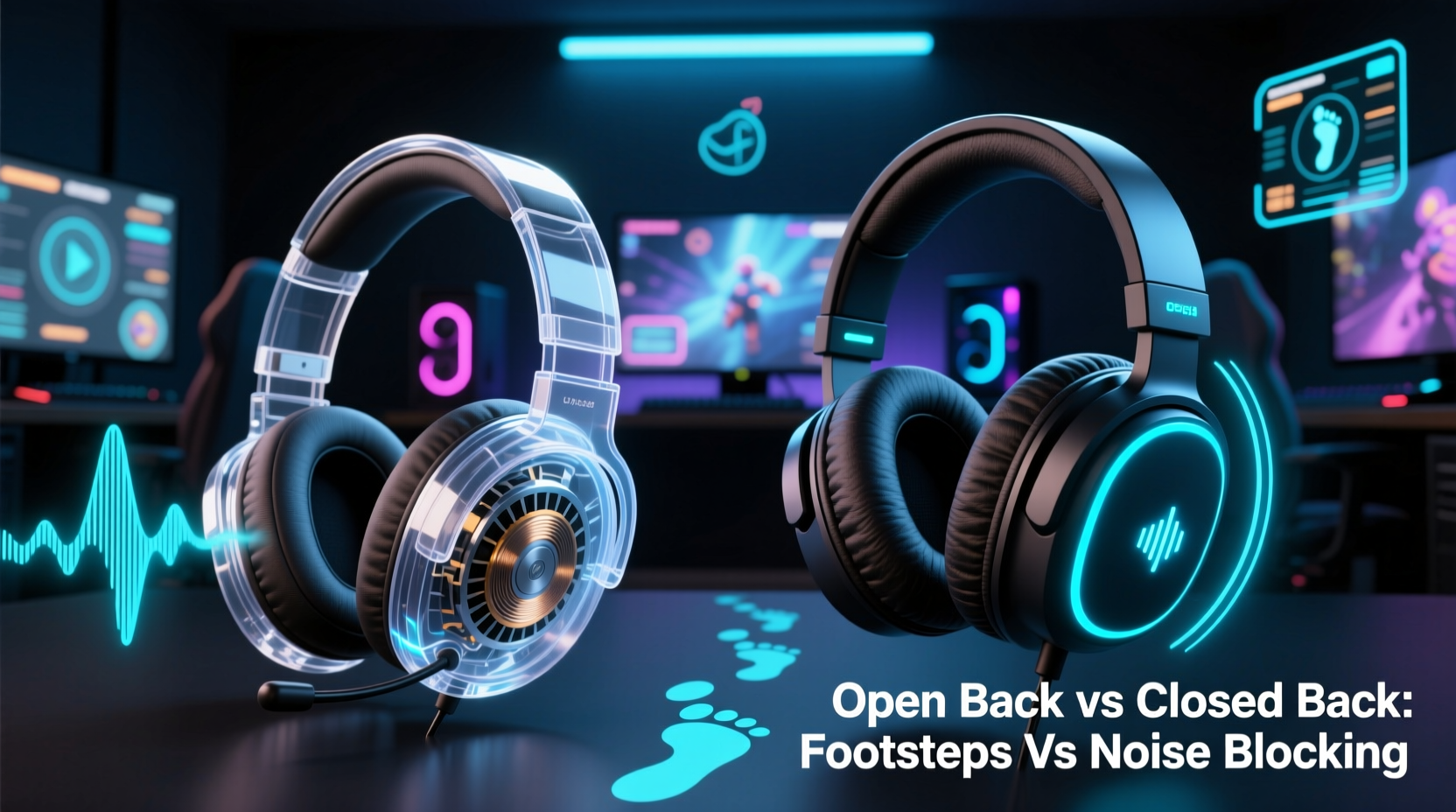
The fundamental distinction lies in their design. Open-back headphones feature perforated earcups that allow air and sound to pass freely through the housing. This creates a more natural, spacious soundstage—similar to listening to speakers in a room. Because external sound enters and internal sound escapes, these headphones offer minimal isolation.
In contrast, closed-back headphones have sealed earcups designed to contain sound within and block outside noise from entering. This enclosure enhances bass response and improves passive noise isolation, making them ideal for noisy environments or when privacy is needed.
These physical differences directly affect three critical factors in gaming: soundstage accuracy, imaging precision, and ambient noise control. Gamers who rely on directional audio cues—such as footstep direction or gunfire origin—need clarity in all three areas.
Footstep Detection: Clarity, Imaging, and Soundstage
In games like Counter-Strike 2, Valorant, or Escape from Tarkov, the ability to detect faint footsteps from specific directions is crucial. This depends heavily on stereo imaging—the perception of where sounds originate in 3D space—and the width of the soundstage.
Open-back headphones typically outperform closed-back models in both categories. Their semi-open design reduces internal reflections and resonance, resulting in a cleaner separation of audio elements. Sounds appear to come from beyond the head rather than inside it, mimicking real-world acoustics. This expanded soundstage makes it easier to distinguish whether an enemy is approaching from the left flank, behind cover, or ascending stairs above.
Closed-back models, while capable of good imaging, often suffer from a narrower soundstage due to sound bouncing within the sealed chamber. However, modern engineering has narrowed this gap. High-end closed-back gaming headsets now use advanced driver tuning and software-based spatial audio (e.g., Windows Sonic, Dolby Atmos) to simulate openness.
“High-resolution audio reproduction and accurate transient response are key to identifying micro-sounds like cloth rustling or light footfalls. Open-back designs inherently support this.” — Dr. Lena Park, Audio Perception Researcher, MIT Media Lab
Noise Isolation: When Silence Matters
While open-back headphones shine in audio fidelity, they fall short in noisy environments. Since they don’t seal around the ears, external sounds—roommates, traffic, HVAC systems—bleed into your audio feed. Worse, your teammates hear game audio leaking from your headphones during voice chat, which can be disruptive.
Closed-back headphones provide significant passive noise isolation, typically reducing ambient noise by 15–25 dB depending on fit and materials. This makes them suitable for shared spaces, dorms, or households where background noise is unavoidable. They also prevent audio leakage, preserving privacy and communication clarity.
For streamers or multiplayer gamers using voice comms, this isolation is essential. A teammate hearing echoes of gunfire from your end can degrade coordination and create feedback loops during intense moments.
Comparative Analysis: Performance Across Key Metrics
| Metric | Open-Back Headphones | Closed-Back Headphones |
|---|---|---|
| Soundstage Width | Excellent – wide, speaker-like imaging | Fair to Good – more confined, head-localized |
| Imaging Precision | Superior – clear directional cues | Good – improved with premium tuning |
| Noise Isolation | Poor – allows external sound in/out | Excellent – blocks ambient noise effectively |
| Bass Response | Natural, less exaggerated | Enhanced, tighter due to enclosure |
| Audio Leakage | High – not private | Low – minimal spill |
| Best For | Quiet rooms, single-player, audiophile gamers | Loud environments, team play, streaming |
Real-World Scenario: Competitive Gamer Setup Comparison
Consider two players in a ranked match of Apex Legends. Alex uses Sennheiser HD 6XX (open-back), while Jordan uses SteelSeries Arctis Pro + GameDAC (closed-back). Both are skilled, but their experiences differ.
Alex, playing in a quiet home office, hears a distant shuffle to the southeast. The sound feels external, almost as if coming from behind a wall. The precise timing difference between left and right channels allows instant localization. Alex signals the squad, setting up an ambush. Success.
Jordan, playing from a busy apartment, benefits from strong isolation. Neighbors vacuuming nearby don’t interfere. However, when an enemy sneaks up quietly, the muffled footstep blends slightly with in-game ambient wind. It’s still detectable, but less distinct. Jordan reacts a half-second later—just enough time for the opponent to land the first shot.
This example illustrates that neither design is universally superior. The advantage depends on context: environment, game genre, and personal sensitivity to spatial cues.
Step-by-Step Guide: Choosing the Right Type for Your Gaming Needs
- Evaluate your gaming environment. Is it quiet and dedicated, or shared and noisy? Open-back suits the former; closed-back fits the latter.
- Determine your primary game genres. Tactical shooters (e.g., CS2) benefit from open-back imaging. Fast-paced multiplayer or MMOs may prioritize isolation and communication.
- Test audio leakage concerns. If others complain about hearing your game audio, or if your mic picks up sound, switch to closed-back.
- Assess your tolerance for ambient noise. Can you focus with background distractions? If not, closed-back is safer.
- Try both types if possible. Visit an electronics store or borrow models to compare real-world performance before investing.
- Consider hybrid solutions. Some newer models (e.g., Audeze Maxwell) combine planar magnetic drivers with strong isolation, offering near-open-back clarity in a closed design.
Expert Tips for Maximizing Performance
- Use EQ profiles tailored to gaming. Boosting frequencies between 1,500 Hz and 3,000 Hz can enhance footstep clarity without distorting balance.
- Pair with high-quality audio sources. Open-back headphones reveal more detail, so ensure your DAC or sound card supports high-resolution output.
- Position your microphone correctly. On closed-back headsets, place the mic boom close to your mouth to reduce pickup of leaked game audio.
- Keep firmware updated. Many modern gaming headsets receive driver updates that improve spatial processing and latency.
FAQ: Common Questions Answered
Can I use open-back headphones for competitive online gaming?
Yes, but only if you’re in a quiet environment and don’t share space with others. The superior imaging helps in tactical games, but audio leakage and lack of isolation can be drawbacks during voice chat or in loud settings.
Do closed-back headphones make footsteps harder to hear?
Not necessarily harder, but sometimes less distinct. While they isolate well, some models emphasize bass or compress dynamics, masking subtle cues. Choose models known for balanced sound signatures (e.g., Beyerdynamic DT 770 Pro 80 Ohm) and apply EQ to highlight mid-high frequencies.
Are there any headphones that offer the best of both worlds?
True hybrids are rare, but some high-end closed-back designs come close. Models with planar magnetic drivers (e.g., Audeze LCD-2C) or electrostatic transducers offer expansive soundstages despite being closed. Additionally, open-back headphones with padded seals (like the AKG K712 Pro) offer slight isolation improvements without sacrificing openness.
Final Recommendation: Match Design to Lifestyle
The decision between open-back and closed-back headphones ultimately hinges on lifestyle as much as performance. If you have a controlled, quiet gaming space and prioritize immersion and precision, open-back models offer unmatched realism and spatial accuracy. They reward attentive listeners with nuanced audio details that can give a tangible edge in stealth-based or strategy-heavy games.
Conversely, if you game in dynamic environments—apartments, offices, or shared rooms—closed-back headphones provide necessary isolation, privacy, and consistency. Modern advancements have significantly reduced the imaging gap, allowing many competitive players to perform at high levels without compromising on environmental adaptability.
There’s no universal “best” option. Instead, align your choice with your surroundings, habits, and gameplay goals. Invest in quality, tune your setup, and trust your ears. In gaming, awareness isn’t just visual—it’s auditory, instinctive, and deeply contextual.




 浙公网安备
33010002000092号
浙公网安备
33010002000092号 浙B2-20120091-4
Comments
No comments yet. Why don't you start the discussion?