
In recent years, open world games have dominated the gaming industry. From sprawling fantasy realms to meticulously recreated cities, titles like The Legend of Zelda: Breath of the Wild, Red Dead Redemption 2, and Ghost of Tsushima offer unprecedented freedom. Yet, despite their scale and ambition, many players report feeling fatigued—sometimes even before finishing them. Meanwhile, tightly crafted linear experiences such as God of War (2018), The Last of Us, or Portal often leave players emotionally fulfilled and eager for more. Why does this disparity exist? And why do so many gamers experience burnout in open worlds while staying deeply engaged with linear narratives?
The answer lies not just in personal preference but in fundamental differences in game design, player psychology, and the evolving expectations of modern audiences. Understanding these dynamics reveals how freedom can become a burden—and how structure, when well-executed, fosters deeper immersion.
The Allure and Illusion of Freedom
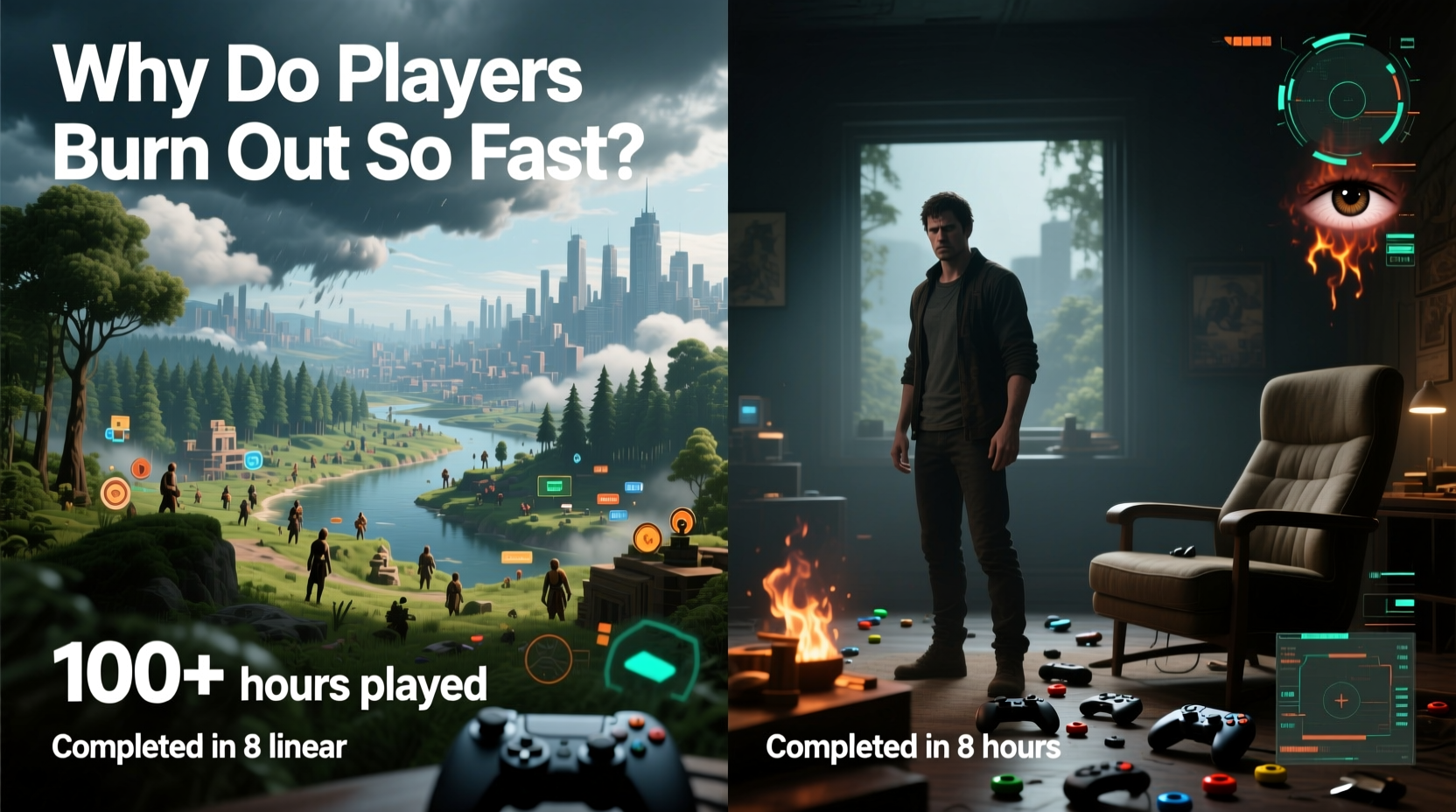
Open world games promise autonomy: explore where you want, tackle objectives in any order, and shape your own journey. This sense of agency is powerful and initially exhilarating. However, that same freedom can lead to decision fatigue—a psychological phenomenon where too many choices erode motivation and satisfaction.
When players are handed a vast map filled with icons, side quests, collectibles, and activities, they’re not just offered opportunity—they’re burdened with responsibility. Every marker becomes a potential obligation. The joy of discovery turns into a checklist of tasks. What was meant to be liberation begins to feel like labor.
Game designer Amy Hennig, known for her work on the Uncharted series, once noted:
“Freedom without purpose is just noise. A great narrative gives players direction, emotional stakes, and a reason to care.” — Amy Hennig, Narrative Designer
Linear games excel at providing that purpose. They guide players through a curated sequence of events, escalating tension and character development. There’s no ambiguity about what to do next—just momentum. In contrast, open world games often sacrifice narrative urgency for exploration, leaving players adrift in a sea of optional content.
The Psychology of Completionism and Task Saturation
Modern open world design frequently encourages completionism—the desire to “do it all.” Progress bars, percentage trackers, and achievement systems reinforce the idea that leaving anything undone is failure. This mindset transforms play into performance.
A study published in the *Journal of Media Psychology* found that players who pursued 100% completion in open world games reported higher levels of stress and lower enjoyment over time compared to those who played more casually. The pressure to optimize, collect, and conquer every corner of a digital landscape drains the spontaneity that made open worlds appealing in the first place.
This saturation effect is amplified by repetitive mission design. Many open world games rely on formulaic side quests: fetch items, eliminate targets, escort NPCs. While efficient from a development standpoint, these tasks lack narrative weight and mechanical variety. After the tenth identical errand, even the most beautiful environment starts to feel like a gilded cage.
Design Contrasts: Open World vs. Linear Narratives
To better understand the burnout dynamic, consider how core design elements differ between open world and linear games:
| Design Element | Open World Games | Linear Narrative Games |
|---|---|---|
| Pacing | Player-controlled; often uneven due to optional content | Tightly controlled; builds toward climaxes |
| Narrative Focus | Frequently diluted by side content | Sustained and prioritized throughout |
| Player Agency | High in movement and choice of activity | Limited in path, high in emotional investment |
| Mechanical Variety | Broad but often repetitive in side content | Focused, with mechanics evolving alongside story |
| Completion Pressure | High, due to tracking systems and achievements | Low; completion is typically binary (finished/not) |
The table illustrates a key trade-off: open worlds prioritize breadth, while linear games emphasize depth. When done poorly, open world games spread themselves thin across hundreds of hours of content, sacrificing cohesion. When done well, linear games deliver concentrated, memorable experiences that resonate long after the credits roll.
A Case Study: Two Journeys Through Hyrule
Compare two entries in Nintendo’s flagship franchise: The Legend of Zelda: Twilight Princess (2006) and Breath of the Wild (2017). Both are critically acclaimed, yet player engagement patterns differ dramatically.
Twilight Princess follows a largely linear path through Hyrule. Players progress through dungeons in a set sequence, guided by clear objectives and story beats. Though the world is sizable, exploration is gated by ability unlocks, ensuring players don’t feel overwhelmed. Completion rates are high, and many fans replay it years later.
Breath of the Wild, by contrast, drops players into an immense, unstructured world from the start. You can climb anywhere, fight anyone, and ignore the main quest entirely. Its freedom was revolutionary—but also exhausting for some. Numerous players reported abandoning the game halfway, not because they disliked it, but because they lost direction. Without narrative momentum, the sheer volume of possibilities became paralyzing.
Interestingly, Tears of the Kingdom (2023), the sequel, attempts to balance both models. It retains open exploration but introduces stronger narrative scaffolding and mission progression. Early data suggests higher completion rates and sustained engagement—indicating that hybrid designs may offer a sustainable middle ground.
Strategies to Prevent Open World Burnout
Burnout isn’t inevitable. With mindful play habits and smarter design, players can reclaim the joy of open worlds. Here are actionable strategies:
- Set Personal Goals: Instead of chasing 100%, define what matters to you—e.g., completing the main story, mastering combat, or visiting every region.
- Play in Bursts: Treat open world sessions like sightseeing trips. Limit playtime to 60–90 minutes with a loose agenda.
- Ignore the Map Icons: Disable objective markers or cover them physically on-screen. Rediscover environments organically.
- Embrace Linearity Within Openness: Follow the main quest for several hours straight to rebuild narrative momentum.
- Take Breaks Between Games: Don’t jump from one massive RPG into another. Alternate with shorter, focused titles.
What Developers Can Learn
The burnout issue isn't solely on players. Game studios must reconsider how they structure expansive experiences. Some promising trends include:
- Dynamic Content Unlocking: Reveal side activities based on story progress or player behavior, reducing early overload.
- Meaningful Side Quests: Ensure optional content develops characters, lore, or themes—not just rewards.
- Optional Guidance Systems: Allow players to toggle between minimal and full navigation aids.
- Time-Gated Exploration: Use weather, NPC schedules, or story triggers to make exploration feel intentional, not obligatory.
As game director Todd Howard once said:
“Our goal is to give players a world they can live in. But if they’re only living in it because they feel they have to, we’ve failed.” — Todd Howard, Director, Bethesda Game Studios
This sentiment underscores a critical shift: open worlds should serve players, not the other way around. Designers must prioritize emotional resonance over sheer volume.
FAQ
Is burnout only a problem in open world games?
No, burnout can occur in any genre. However, it's more prevalent in open world titles due to their scale, completionist culture, and frequent repetition of tasks. Linear games tend to have natural endpoints and clearer pacing, reducing the risk of prolonged fatigue.
Can linear games be boring compared to open worlds?
They can, if poorly written or mechanically stagnant. But strong linear narratives use pacing, character arcs, and escalating stakes to maintain engagement. Many players find them more emotionally satisfying than sprawling but shallow open worlds.
Are hybrid games the future?
Evidence suggests yes. Titles like Horizon Zero Dawn, Spider-Man, and Elden Ring blend open exploration with strong narrative spine and mission structure. These hybrids offer freedom without sacrificing focus, making them less prone to player fatigue.
Conclusion: Reclaiming Joy in Game Worlds
The debate between open world and linear games isn’t about which is better—it’s about understanding what each offers and how we engage with them. Open worlds invite us to wander, explore, and lose ourselves. Linear narratives pull us forward with purpose, emotion, and clarity. Burnout arises not from open worlds themselves, but from how they’re designed and how we choose to play them.
Players hold power too. By setting boundaries, redefining success, and listening to their own rhythms, they can enjoy expansive games without succumbing to fatigue. Likewise, developers who prioritize meaning over metrics will create experiences that endure beyond completion percentages.




 浙公网安备
33010002000092号
浙公网安备
33010002000092号 浙B2-20120091-4
Comments
No comments yet. Why don't you start the discussion?