
In the last two decades, video games have undergone a dramatic transformation in scale. What once began with tightly designed corridors and scripted sequences has evolved into sprawling digital landscapes where players can roam for hundreds of square miles. The rise of open-world design—seen in franchises like The Legend of Zelda: Breath of the Wild, Red Dead Redemption 2, and Assassin’s Creed—has redefined expectations. But as game worlds grow ever larger, a growing number of players and critics are asking: are these expansive maps enhancing immersion, or are they becoming bloated distractions that dilute the experience?
This isn’t just about preference. It’s a fundamental shift in game design philosophy—one that pits the freedom of exploration against narrative focus, mechanical depth, and meaningful content. As developers chase bigger budgets and broader appeal, we must examine whether the pursuit of scale is coming at the cost of quality, engagement, and emotional resonance.
The Evolution of Game Worlds
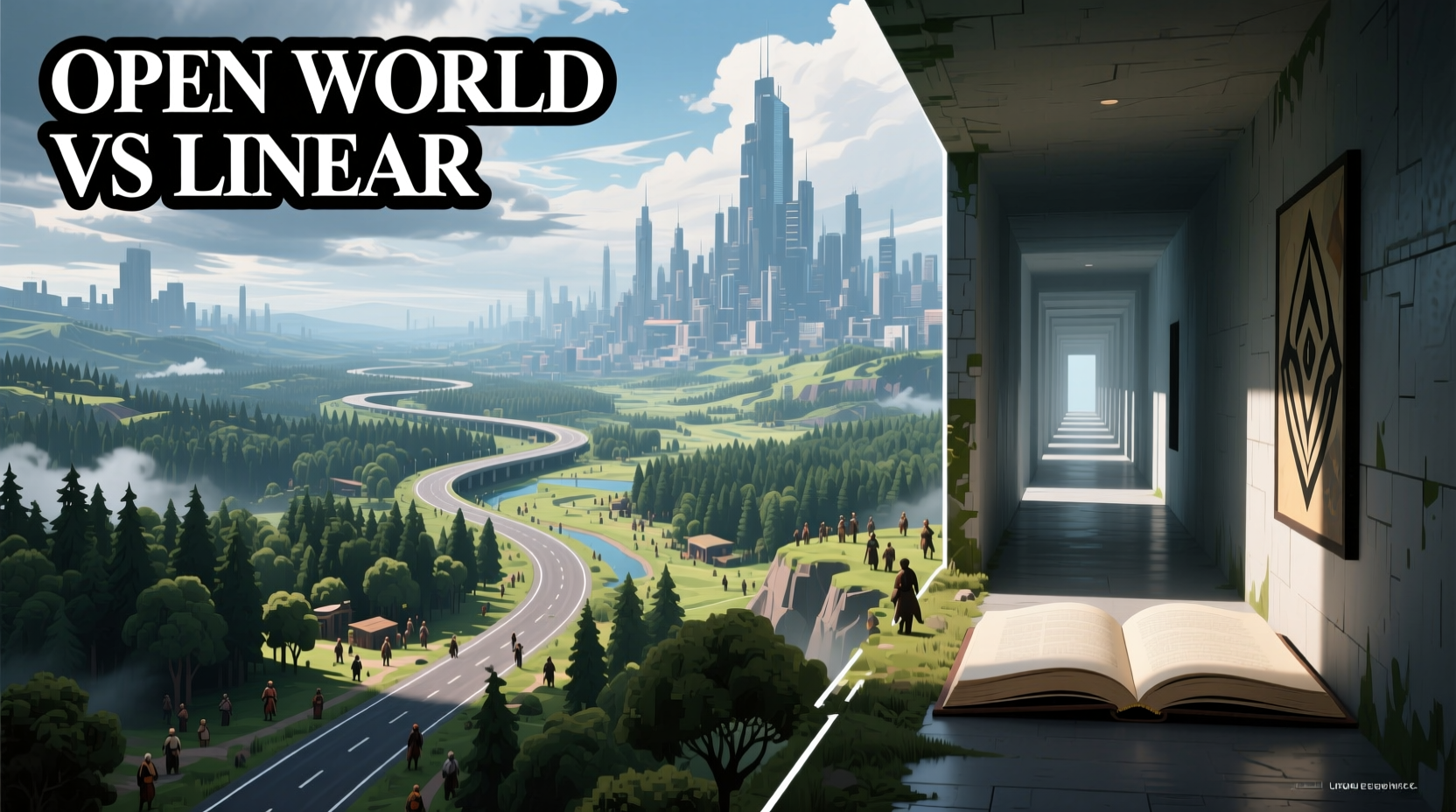
Early video games were inherently linear by necessity. Technical limitations meant designers had to be economical with space and resources. Games like Super Mario Bros. (1985) or Halo: Combat Evolved (2001) guided players through carefully curated levels, each one serving a specific gameplay or narrative purpose. Every enemy, platform, or dialogue sequence was intentional.
As hardware advanced, so did ambition. Titles such as Grand Theft Auto III (2001) introduced fully explorable 3D cities, giving players unprecedented agency. This model proved wildly successful, paving the way for increasingly complex open worlds. By the 2010s, games like Just Cause 3 and Far Cry 4 filled their maps with hundreds of collectibles, side missions, and outposts—not because they added depth, but because “content” became synonymous with value.
Today, it's common for AAA open-world titles to feature maps larger than real-world cities. Red Dead Redemption 2's world spans approximately 50 square kilometers, while Microsoft Flight Simulator recreates the entire planet. Yet, paradoxically, many players report feeling disconnected, overwhelmed, or bored despite the abundance of space.
Open World vs Linear: Design Philosophies Compared
The core difference between open-world and linear games lies not just in structure, but in intent. Open-world games prioritize player autonomy. You decide where to go, when to engage, and how to approach objectives. Linear games, on the other hand, emphasize pacing, narrative control, and environmental storytelling. They guide you through a crafted journey, often with tighter mechanics and more focused themes.
Consider The Last of Us Part I. Its environments are meticulously designed to support both story and survival tension. Every abandoned house, overgrown alleyway, and military checkpoint advances character development or gameplay. Contrast this with Starfield, which offers over 1,000 planets to visit—many of which are procedurally generated and functionally identical. Quantity replaces quality.
It’s not that open worlds are inherently worse. When done well, they deliver unparalleled immersion. Shadow of the Colossus used vast emptiness to evoke loneliness and awe. Horizon Zero Dawn integrated its post-apocalyptic landscape into both lore and combat. But too often, modern open-world design defaults to checklist-driven exploration: climb the tower, clear the camp, collect the artifact—repeat.
“Scale without substance turns exploration into chore. We’ve mistaken filling space with designing it.” — Naomi Clark, Game Designer & Assistant Arts Professor at NYU
Why Bigger Isn’t Always Better
There’s a psychological principle known as “choice overload,” where an excess of options leads to decision paralysis and reduced satisfaction. This applies directly to oversized game maps. When every direction offers dozens of unmarked points of interest, players often feel lost—not in the adventurous sense, but in the anxious one.
Moreover, large maps demand significant development resources. Instead of deepening AI behavior, refining physics, or enriching narratives, teams spend months generating filler content: generic enemies, repetitive fetch quests, and cosmetic collectibles. This results in what some call “Ubisoft towers”—a reference to the recurring mechanic of climbing structures to reveal map sections across multiple franchises.
A telling example is Assassin’s Creed Origins. While praised for its visual fidelity and historical detail, many players noted that after a few hours, tombs, bandit camps, and wildlife hunts began to feel indistinguishable. The map was massive, but the variety wasn’t sustainable. Engagement waned not because the game was bad, but because the design prioritized coverage over novelty.
Table: Open World vs Linear Game Design Trade-offs
| Aspect | Open World | Linear |
|---|---|---|
| Player Freedom | High – Choose path, pace, and objectives | Low – Guided progression |
| Narrative Focus | Often diluted by side content | Strong, uninterrupted storytelling |
| Exploration Reward | Variable – Can feel arbitrary | Curated – Discovery is intentional |
| Development Depth | Spread thin across large areas | Concentrated in key zones |
| Replayability | High due to freedom and side activities | Lower, but often more impactful per playthrough |
Case Study: The Success of Focused Design in Elden Ring
Elden Ring presents a fascinating hybrid. It’s one of the most celebrated open-world games of recent years, offering a vast, seamless realm filled with secrets. Yet unlike many AAA titles, its map doesn’t rely on UI markers or quest logs to guide players. Exploration is driven by visual cues, environmental storytelling, and player curiosity.
Crucially, FromSoftware didn’t fill every corner with tasks. Many areas exist solely to impress, challenge, or surprise. A crumbling bridge might lead to nothing but a view—and that’s okay. The world feels lived-in, mysterious, and rewarding because discovery isn’t gamified. You aren’t clearing icons; you’re uncovering lore.
This demonstrates that open worlds don’t need to be “full” to be effective. Elden Ring proves that thoughtful design can make even a massive map feel intimate and purposeful. The lesson isn’t to abandon open worlds, but to treat scale as a tool—not a goal.
Tips for Developers and Players Alike
As the industry continues to push boundaries, both creators and consumers can benefit from a more critical approach to game design. Below are actionable insights for getting the most out of either format.
- Prioritize density over distance. A smaller world with layered systems (weather, NPC routines, dynamic events) can feel richer than a huge one with static content.
- Use negative space intentionally. Silence, emptiness, and isolation can be powerful storytelling tools—don’t rush to fill them.
- Limit fast travel early. Encourage players to learn the geography before offering shortcuts, reinforcing spatial awareness and immersion.
- Make exploration self-rewarding. Let discoveries matter through story, mechanics, or aesthetics—not just XP or loot.
- Respect player time. Avoid padding. If a side quest doesn’t enhance the world or character, consider cutting it.
Checklist: Is a Game’s Map Enhancing or Hindering the Experience?
- Do most locations feel unique and memorable?
- Are side activities meaningfully tied to the world or story?
- Does exploration feel rewarding without being mandatory?
- Is the map easy to navigate without constant reliance on GPS-style markers?
- Do I feel emotionally connected to the environment?
The Future of Game Worlds
The trend toward larger maps shows no sign of slowing. With cloud gaming and next-gen engines enabling even more ambitious projects, the temptation to build “the biggest game ever” will only grow. But history suggests that innovation rarely comes from sheer size.
Some of the most influential games in recent memory—Portal, Inside, Disco Elysium—are compact, linear, or even stationary. Their power comes from tight writing, inventive mechanics, and emotional depth. Meanwhile, several high-budget open-world titles have underperformed critically due to shallow content and fatigue-inducing repetition.
The solution may lie in hybrid models. Games like Deathloop use time-loop mechanics to create dense, interconnected spaces that evolve with each run. Others, like Returnal, blend roguelike structure with open-zone exploration. These approaches offer freedom without sprawl, replayability without bloat.
Additionally, indie developers are leading the charge in redefining what open worlds can be. Titles like Wildermyth and Outer Wilds prove that small-scale, handcrafted environments can deliver profound exploration experiences. Outer Wilds, in particular, features a solar system only minutes across—but every planet hides layers of mystery that unfold over tens of hours.
Frequently Asked Questions
Are linear games outdated?
No. Linear games remain vital for delivering focused narratives, cinematic pacing, and polished set pieces. They are especially effective for story-driven genres like horror, adventure, and thriller. Their relevance depends on design intent, not market trends.
Can an open-world game avoid feeling empty?
Yes, but it requires disciplined design. Avoid procedural filler. Populate the world with reactive systems, meaningful choices, and environmental storytelling. Make every location feel intentional—even if it serves only aesthetic or atmospheric purposes.
Why do developers keep making huge maps if players complain?
Marketing plays a major role. “Largest world ever” is an easy selling point. Additionally, larger scopes justify higher budgets and longer development cycles. However, player feedback is shifting priorities—games like Tears of the Kingdom improved upon Breath of the Wild not by expanding the map, but by deepening interactivity within it.
Conclusion: Reclaiming Purpose in Game Design
The debate between open world and linear games isn’t about declaring one superior. It’s about recognizing that scale alone cannot sustain engagement. A game’s greatness lies not in how many square miles it contains, but in how thoughtfully it uses every inch.
Players deserve worlds that inspire wonder, not exhaustion. Developers should be celebrated not for how much they fill a map, but for how deeply they make us care about being in it. As technology advances, the true challenge won’t be building bigger universes—it will be creating smaller moments that feel infinite.




 浙公网安备
33010002000092号
浙公网安备
33010002000092号 浙B2-20120091-4
Comments
No comments yet. Why don't you start the discussion?