
When choosing between smartphones, especially in the mid-range segment, it’s easy to assume that newer automatically means better. But is that always true? The Oppo F5, released in late 2017, entered the market shortly after the Samsung Galaxy A7 (2017), a device already praised for its premium design and solid all-around performance. On paper, the Oppo F5 appears more modern with its emphasis on selfie photography and sleek full-screen display. But does it truly outperform its slightly older rival? Let’s dive into a detailed comparison beyond release dates to see which device offers better value and user experience.
Design and Build Quality
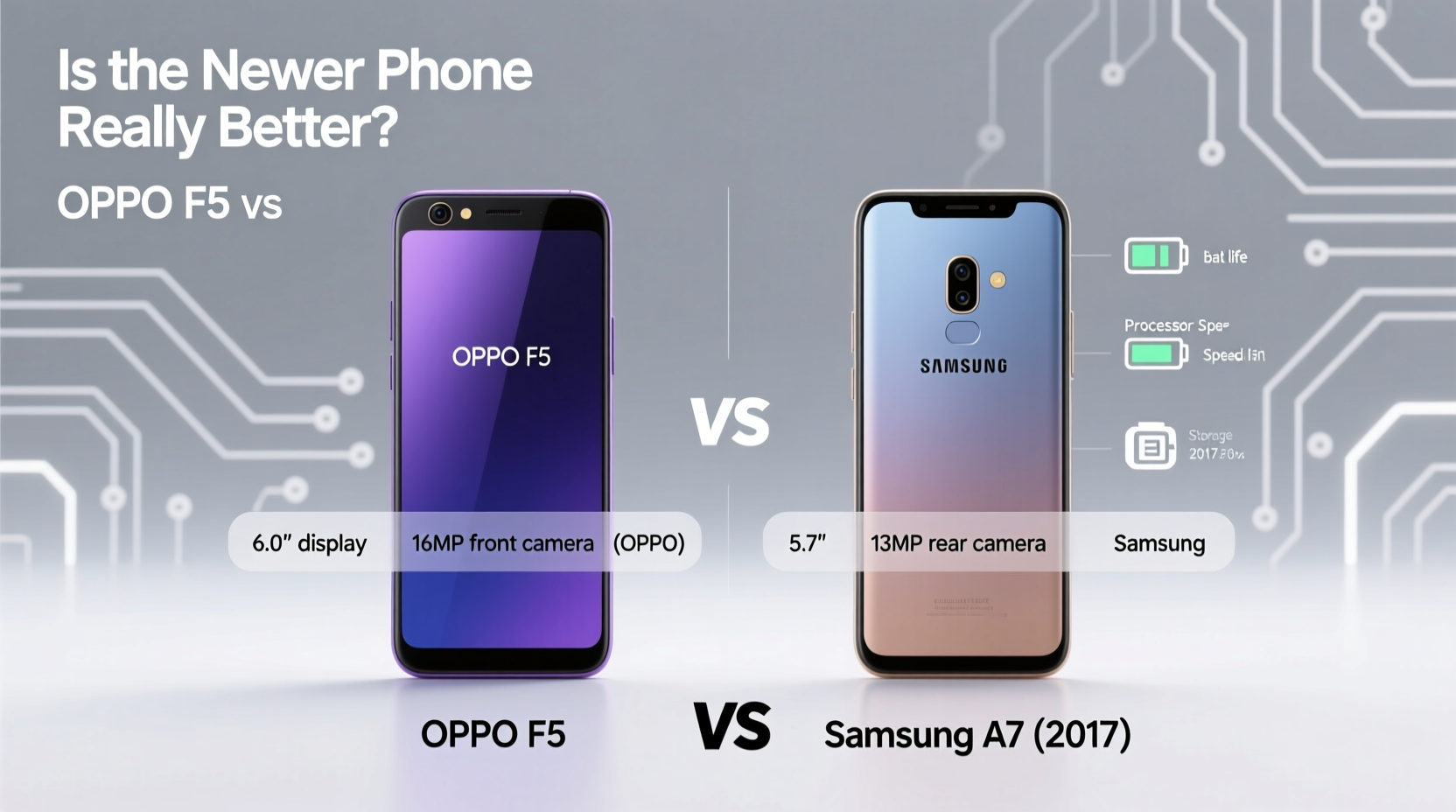
The Samsung Galaxy A7 (2017) stands out with a metal unibody frame and glass front and back, giving it a premium feel rarely seen in this price bracket. It’s also IP68-rated for dust and water resistance—a feature absent in the Oppo F5. At 168 grams, it’s slightly heavier but feels sturdy and well-balanced in hand.
In contrast, the Oppo F5 uses a polycarbonate (plastic) body with a metallic finish. While lighter at 152 grams and easier to handle one-handed, it lacks the durability and tactile satisfaction of Samsung’s build. Its 6.0-inch IPS LCD with an 18:9 aspect ratio was marketed as a “Full Screen” design, appealing to users wanting a modern look. However, the screen-to-body ratio is only about 74%, compared to the A7’s 72%—a marginal difference.
Display and Usability
Both phones feature 1080p resolution displays, but they differ in size and technology. The Oppo F5 has a larger 6.0-inch Full HD+ (1080 x 2160) panel, while the A7 sports a 5.7-inch Full HD (1080 x 1920) Super AMOLED screen. Despite the smaller size, the A7’s Super AMOLED delivers deeper blacks, richer colors, and better outdoor visibility due to higher peak brightness.
The F5’s taller screen benefits media consumption and multitasking, especially with split-screen apps. However, the lower pixel density (367 PPI vs. A7’s 386 PPI) and IPS LCD panel result in less vibrant visuals and narrower viewing angles.
“Display quality isn’t just about size—it’s about color accuracy, contrast, and real-world readability.” — Rajiv Mehta, Mobile Display Analyst at TechPulse Asia
Performance and Software Experience
Under the hood, the two phones take different approaches. The Oppo F5 runs on the MediaTek Helio P23—an octa-core processor built on a 16nm process—paired with either 3GB or 4GB of RAM. The Samsung A7 (2017) uses the Exynos 7880, also an octa-core chip on a 14nm process, with 3GB RAM and 32GB internal storage.
While both processors are capable for everyday tasks like browsing, messaging, and streaming, benchmarks show the Exynos 7880 holds up better under sustained loads. Samsung’s optimized software and efficient thermal management give it an edge in long gaming sessions or multitasking.
Software-wise, the A7 launched with Android 6.0 Marshmallow but received updates up to Android 8.0 Oreo with Samsung Experience UI. The Oppo F5 shipped with Android 7.1 Nougat and ColorOS 3.2, known for heavy customization and bloatware. Users often report slower update cycles and intrusive ads in system apps on Oppo devices.
Real-World Example: Daily Use Scenario
Consider Maya, a college student using her phone for classes, social media, and weekend vlogs. She bought the Oppo F5 for its tall screen and front camera. Initially impressed, she soon noticed lag when switching between Zoom, Instagram, and Spotify. After six months, the phone felt sluggish, and background app refresh became unreliable. Her friend, who owned the A7, reported smoother performance despite similar usage—even after two years, thanks to consistent optimization and fewer background processes.
Camera Comparison: Selfies vs. Balanced Photography
This is where the Oppo F5 tries hardest to differentiate itself. Marketed as a “Selfie Expert,” it features a 20MP front camera with AI-powered beautification and facial recognition. In good lighting, selfies are sharp and skin tones appear natural—though the beautification can oversoften details if not adjusted.
The rear camera is a 16MP sensor with f/1.7 aperture, performing decently in daylight but struggling in low light with noise and slow focusing.
Samsung takes a more balanced approach. The A7 (2017) has a 16MP front camera—not as high-resolution, but with better dynamic range and accurate color reproduction. Its rear dual-pixel 16MP sensor excels in autofocus speed and low-light clarity, producing consistently reliable photos across conditions.
For video recording, both support 1080p at 30fps, but the A7 includes electronic image stabilization, reducing shake during handheld filming.
Checklist: What to Consider When Choosing Based on Camera Needs
- Do you prioritize selfies over rear camera quality? → Lean toward Oppo F5
- Do you shoot in varied lighting conditions? → A7’s rear camera is more versatile
- Do you dislike heavy post-processing or filters? → A7 offers more natural output
- Are you sensitive to software bloat in camera apps? → Samsung’s interface is cleaner
Battery Life and Charging
The Samsung A7 packs a 3600mAh battery, one of the largest in its class at the time. With moderate use—browsing, calls, music—the device easily lasts a full day and a half. It supports adaptive fast charging, recovering from 0 to 60% in about 45 minutes.
The Oppo F5 comes with a smaller 3200mAh battery. While power-efficient software helps, heavy users report needing a recharge by late afternoon. It lacks fast charging, meaning a full charge takes nearly two hours.
| Feature | Oppo F5 | Samsung A7 (2017) |
|---|---|---|
| Battery Capacity | 3200 mAh | 3600 mAh |
| Charging Speed | Standard (5V/2A) | Fast Charging Supported |
| Estimated Daily Use | 10–12 hours | 16–18 hours |
| Durability Over Time | Moderate degradation after 1 year | Well-managed cycle longevity |
Value Over Time: Longevity and Resale
A phone’s true worth becomes clear after a year of use. The Samsung A7 (2017) was built to last. Its robust hardware, water resistance, and stronger resale demand mean it retains value better. Used units still fetch competitive prices in secondary markets.
The Oppo F5, while stylish and selfie-focused, suffers from shorter software support and less durable materials. Many users upgrade within 12–18 months due to performance decline or battery wear.
Frequently Asked Questions
Is the Oppo F5 faster than the Samsung A7 2017?
Not significantly. While the F5’s Helio P23 has slight advantages in burst performance, the A7’s Exynos 7880 provides better sustained performance and thermal efficiency. Real-world speed depends more on software optimization, where Samsung excels.
Which phone has better selfie quality?
The Oppo F5 wins on paper with its 20MP front camera and AI enhancements. However, many users find the results overly processed. The A7’s 16MP front shooter produces more natural-looking selfies with better exposure control, making it preferable for professional or casual use without editing.
Can the Samsung A7 survive accidental drops or spills?
Yes. With IP68 rating, the A7 can withstand submersion in up to 1.5 meters of water for 30 minutes. It also handles minor drops better due to its metal-glass construction. The Oppo F5 has no official water resistance and a plastic body more prone to scuffs and cracks.
Conclusion: Newer Isn’t Always Better
The Oppo F5 may have arrived later and carried buzzworthy features like a tall display and high-megapixel selfie cam, but the Samsung Galaxy A7 (2017) proves that thoughtful engineering and holistic design often trump novelty. It delivers superior build, display quality, battery life, and durability—all critical factors for long-term satisfaction.
Choosing a smartphone shouldn’t hinge solely on release date or marketing slogans. The A7 demonstrates that a slightly older device, built with care and balanced priorities, can outperform a newer model focused narrowly on trends. If you value reliability, resilience, and consistent performance, the A7 remains a compelling choice even years after launch.




 浙公网安备
33010002000092号
浙公网安备
33010002000092号 浙B2-20120091-4
Comments
No comments yet. Why don't you start the discussion?