
When planning an outdoor gathering, music plays a pivotal role in setting the mood. Whether it’s a backyard barbecue, poolside chill session, or garden soirée, choosing the right audio system matters. The debate between using a smart speaker versus a traditional Bluetooth speaker often comes down to more than just sound quality—it involves control, connectivity, durability, and long-term value. While both options have their strengths, understanding the real-world differences can help you decide whether a smart speaker is truly worth the investment for your outdoor events.
Understanding the Core Differences
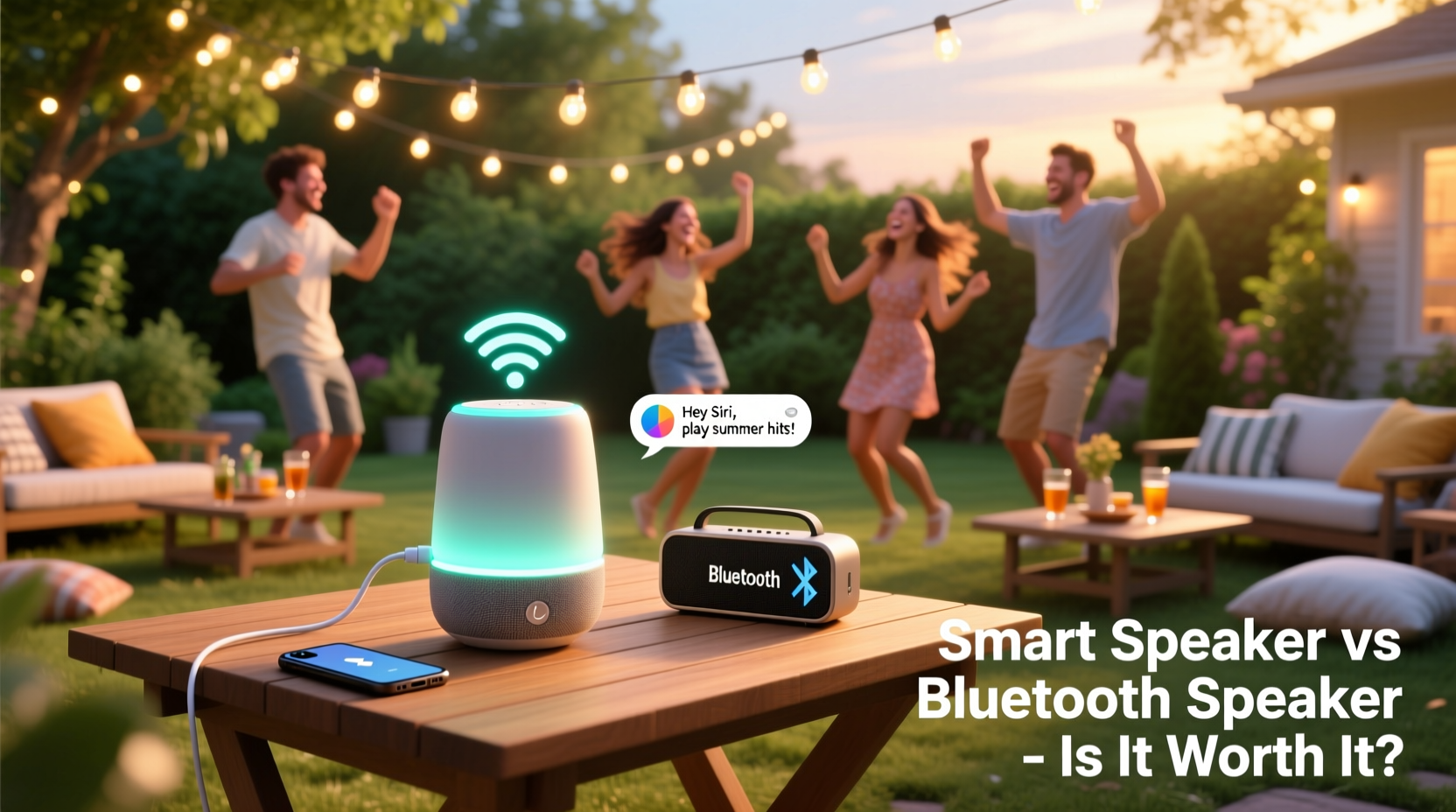
A Bluetooth speaker connects wirelessly to your phone or tablet via Bluetooth technology. It's straightforward: pair, play, and enjoy. Most are compact, battery-powered, and built for portability. On the other hand, a smart speaker integrates voice assistants like Amazon Alexa, Google Assistant, or Apple Siri. It typically requires Wi-Fi and offers hands-free voice control, multi-room audio, app integration, and even home automation features.
For outdoor use, these distinctions become critical. A Bluetooth speaker works independently of your network—ideal if Wi-Fi is spotty or unavailable. Smart speakers, while feature-rich, depend on consistent internet connectivity. In open-air environments where signals weaken, this reliance can be a limitation unless the model supports mesh networking or offline voice commands.
Sound Quality and Volume: Does Power Matter?
Outdoor environments demand louder, clearer audio due to ambient noise—wind, conversation, traffic, or nature sounds. Smart speakers, especially higher-end models like the Sonos Move or HomePod (2nd gen), are engineered with advanced acoustic tuning and larger drivers, delivering richer bass and wider sound dispersion. Many support stereo pairing and adaptive EQ that adjusts based on surroundings.
Bluetooth speakers vary widely. Entry-level models may struggle beyond small patios, while rugged, high-output options like the JBL Boombox 3 or Ultimate Ears MEGABOOM 3 rival some smart speakers in volume and clarity. However, they lack dynamic sound optimization—what you get is fixed by hardware design.
| Feature | Smart Speaker | Bluetooth Speaker |
|---|---|---|
| Max Volume (Outdoors) | High (adaptive gain) | Medium to High (fixed output) |
| Bass Response | Stronger, tuned for rooms and open areas | Varies; often boosted artificially |
| Spatial Audio | Yes (on premium models) | Rarely supported |
| Auto Sound Adjustment | Yes (e.g., Sonos detects environment) | No |
“Smart speakers today offer studio-grade acoustics adapted for real-world spaces, which gives them an edge outdoors when properly placed.” — David Lin, Audio Engineer at SoundLabs Studio
Convenience and Control: Voice vs. Touch
One of the most compelling arguments for smart speakers is hands-free operation. At a lively outdoor party, being able to say, “Alexa, play upbeat summer hits,” without fumbling for your phone, enhances the experience. You can adjust volume, skip tracks, check weather, or even dim connected lights—all through voice commands.
Bluetooth speakers require manual interaction. Even with app controls or physical buttons, reaching for your device disrupts flow. Some newer Bluetooth models include basic voice prompts, but none match the seamless ecosystem integration of smart speakers.
However, voice assistants aren’t foolproof outdoors. Background noise can interfere with command recognition. Windy conditions may cause misinterpretations or failed triggers. In such cases, tactile control becomes more reliable.
Real Example: Sarah’s Pool Party Dilemma
Sarah hosted a weekend pool party using her indoor Echo Studio moved outside temporarily. Guests loved asking Alexa for song requests, and she could manage playlists while grilling. But during peak hours, overlapping voices caused frequent misfires—“Play reggae” turned into “Call Reggie.” She eventually switched to Bluetooth mode and controlled music manually from her phone. The smart features were fun but inconsistent under noisy conditions.
Durability and Weather Resistance
Outdoor use demands resilience. Rain, humidity, dust, and temperature changes test any electronic device. Here, many dedicated Bluetooth speakers outperform standard smart speakers. Models like the Bose SoundLink Revolve+ II or Tribit StormBox Pro boast IP67 ratings—fully waterproof and dustproof. They’re designed to survive drops, splashes, and even brief submersion.
In contrast, most smart speakers are built for indoor use. The Sonos Move is a notable exception with IP56 rating (dust and water-resistant), but it's heavier and pricier. Apple’s HomePod lacks meaningful weather protection entirely. Unless explicitly marketed as outdoor-ready, smart speakers risk damage when exposed to the elements.
Cost and Long-Term Value Comparison
Smart speakers generally cost more upfront. A capable outdoor-ready model like the Sonos Move retails around $399. Compare that to $150–$200 for a top-tier Bluetooth speaker with similar loudness and battery life. But the value equation shifts when considering longevity and functionality.
If you already use a smart home ecosystem, adding a compatible outdoor speaker extends its utility. You can create synchronized audio zones, schedule playlists, or integrate with security systems. Over time, this versatility can justify the price. Bluetooth speakers, while cheaper, remain single-purpose devices.
- Smart Speaker Pros: Voice control, app integration, future-proofing, multi-room audio
- Smart Speaker Cons: Higher cost, Wi-Fi dependency, limited ruggedness (except select models)
- Bluetooth Speaker Pros: Affordable, portable, durable, no network needed
- Bluetooth Speaker Cons: Manual control only, no automation, limited scalability
Step-by-Step: Choosing the Right Speaker for Your Outdoor Setup
- Evaluate your outdoor space: Is it close to your home Wi-Fi router? Will the speaker be under cover or fully exposed?
- Determine usage frequency: Occasional parties favor affordable Bluetooth options. Frequent hosting justifies investing in a smart solution.
- Check compatibility: Ensure the smart speaker works with your existing ecosystem (Amazon, Google, Apple).
- Assess weather needs: Look for IP67 or IP56 ratings if rain or moisture is likely.
- Test connectivity: Try streaming via Wi-Fi and Bluetooth to see which performs better in your yard.
- Consider backup options: Choose a smart speaker with Bluetooth pairing so you’re not silenced during outages.
Frequently Asked Questions
Can I use a smart speaker outdoors permanently?
Only if it’s specifically rated for outdoor use (e.g., Sonos Move, certain Eero units). Most smart speakers aren’t sealed against moisture and UV exposure, making permanent outdoor installation risky.
Do Bluetooth speakers drain my phone battery faster?
Yes, maintaining a Bluetooth connection uses power. Streaming for several hours can reduce battery life by 20–40%. Smart speakers reduce this burden since they connect directly to Wi-Fi and operate independently.
Are there hybrid models that offer both smart features and rugged design?
Yes. The Sonos Move, Bose Portable Home Speaker, and JBL Link Portable combine voice assistant support with durable builds and weather resistance. These bridge the gap but come at a premium price.
Final Verdict: Is It Worth It?
The answer depends on how you define \"worth.\" If your priority is simplicity, affordability, and toughness, a high-quality Bluetooth speaker remains the smarter choice for occasional outdoor use. It’s plug-and-play, dependable, and resilient.
But if you host frequently, value seamless control, and want deeper integration with your digital lifestyle, a rugged smart speaker pays off over time. Its ability to evolve with your needs—adding routines, syncing with other devices, adapting to your habits—offers long-term benefits beyond mere playback.
Ultimately, the best solution might not be one or the other. Many users find success with a dual setup: a durable Bluetooth speaker for impromptu gatherings and a protected smart speaker stationed under a covered patio for regular use. This way, you enjoy the best of both worlds—reliability when you need it, and intelligence when you want it.




 浙公网安备
33010002000092号
浙公网安备
33010002000092号 浙B2-20120091-4
Comments
No comments yet. Why don't you start the discussion?