
Choosing how to light up your home for the holidays isn’t just about aesthetics—it’s about time, budget, safety, maintenance, and long-term satisfaction. In recent years, outdoor projector Christmas lights have surged in popularity, promising “instant magic” with minimal effort. Yet millions still rely on classic string lights—the familiar twinkle of incandescent or LED strands draped over eaves, wrapped around railings, and wound through shrubs. But which approach delivers better value, versatility, and joy? This comparison cuts past marketing hype and examines both systems through the lens of real homeowners, professional installers, and seasonal lighting data collected over five holiday seasons.
How They Work: Core Technology & Installation Logic
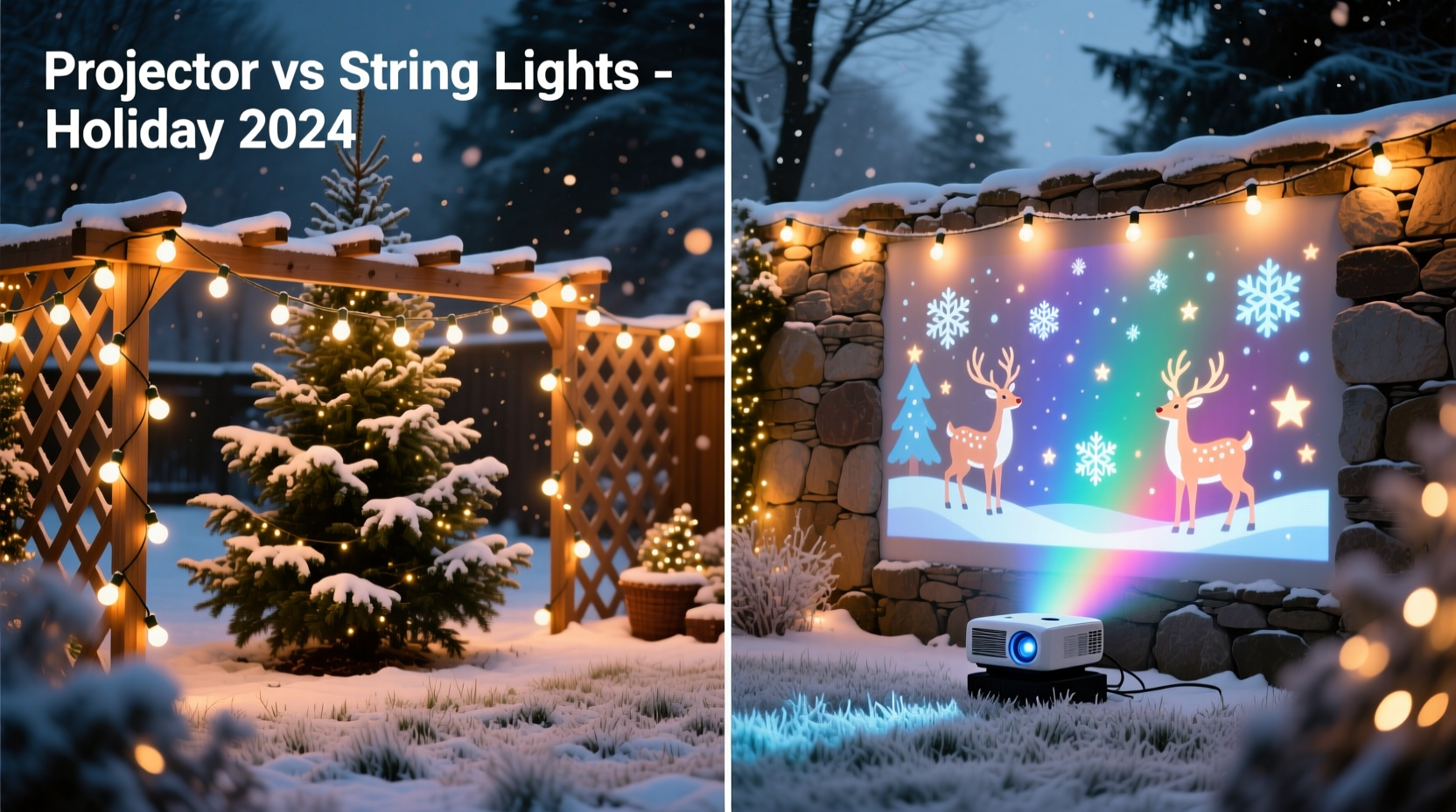
Classic string lights operate on a simple, decades-proven principle: individual bulbs (LED or incandescent) are wired in series or parallel along a flexible cord. Installation requires physical placement—draping, clipping, stapling, or weaving—across surfaces. Each strand typically covers 25–50 feet, and larger homes often require dozens of strands, extension cords, power strips, and careful load balancing across circuits.
Outdoor projector lights use high-lumen LED projectors mounted on tripods or brackets to cast animated or static holiday motifs—snowflakes, reindeer, falling snow, starfields, or scrolling messages—onto walls, driveways, fences, or even snow-covered lawns. Most units include interchangeable lenses or digital pattern libraries, and many offer remote control, timer functions, and app-based scheduling. A single projector can illuminate a 20- by 30-foot façade; two projectors may cover a full two-story home.
The fundamental distinction lies in coverage method: strings deliver light *along* surfaces, while projectors deliver light *onto* surfaces. That difference cascades into every aspect of planning, execution, and experience.
Side-by-Side Performance Comparison
| Feature | Classic String Lights | Outdoor Projector Lights |
|---|---|---|
| Setup Time (Typical 2,000 sq ft Home) | 6–14 hours (including ladder work, measuring, securing clips, testing circuits) | 30–90 minutes (mounting projector, leveling, focusing, syncing timer) |
| Initial Cost (Entry-Level) | $85–$220 (for quality LED strands, clips, timers, surge protectors) | $129–$349 (single-unit projector with basic patterns; premium models $450+) |
| Lifespan (Rated Hours) | 25,000–50,000 hrs (LED); bulbs rarely fail simultaneously, but wiring degrades | 15,000–20,000 hrs (LED light engine); optics and housing durability vary significantly by brand |
| Weather Resistance | IP44 standard common; higher-end strands rated IP65/IP67 for heavy rain/snow exposure | Most units IP44; few exceed IP65—lens fogging, condensation, and wind-induced vibration remain concerns |
| Customization & Flexibility | High: mix colors, bulb types, densities, and textures; easily repositioned year-to-year | Moderate: limited by projection surface (needs flat, light-colored, non-reflective material); patterns can’t wrap corners or follow contours |
| Energy Use (Avg. Seasonal) | 12–35 kWh (depending on strand count, length, and bulb type) | 8–18 kWh (most units draw 15–30W; efficiency drops with longer runtime or brightness max) |
Real-World Trade-Offs: What Advertisements Don’t Show
Projector marketing emphasizes speed and spectacle—but real-world conditions introduce friction. In Portland, Oregon, homeowner Maya R. installed a dual-projector system in November 2023 to replace her aging string-light setup. She achieved stunning snowflake animations on her stucco front wall—until December 7, when persistent drizzle caused lens fogging. By December 12, accumulated dust and salt spray from nearby roads dulled the projected image by nearly 40%, requiring daily lens cleaning. When wind gusts exceeded 22 mph, the tripod-mounted unit vibrated visibly, blurring motion effects. She eventually added a custom bracket and weather shield—costing $68—and reduced nightly runtime by two hours to preserve lamp life. Her total labor investment: 4.5 hours beyond initial setup. Meanwhile, her neighbor—using 32 pre-wired LED strands with commercial-grade GFCI-protected outlets—spent 9 hours installing but required zero mid-season intervention.
Expert Insight: The Installer’s Perspective
With over 18 years installing residential and municipal holiday lighting, Carlos Mendez of Evergreen Lightworks has seen every trend rise and fall. His team installs roughly 400 seasonal displays annually across the Pacific Northwest and Midwest. He doesn’t dismiss projector technology—but insists on context.
“Projectors shine brightest on new construction with smooth, light-colored siding—and when homeowners understand their limits. I’ve replaced more than 70 fogged or misaligned projectors mid-season because people mounted them under eaves where rain drips directly onto lenses, or pointed them at brick that scatters light like confetti. Strings? You clip them once, check voltage drop, and forget until next November. That reliability matters when you’re managing 30 homes before Thanksgiving.” — Carlos Mendez, Certified Holiday Lighting Installer & CLIA Member
Mendez also notes a growing trend among his commercial clients: hybrid setups. “A café in Seattle uses projectors for its large glass façade—where strings would be visible and obstructive—and strings for its wrought-iron awning and patio railings. It’s not ‘either/or.’ It’s ‘right tool, right place.’”
What to Consider Before You Buy: A Practical Decision Checklist
- Surface Audit: Is your primary display area flat, light-colored (white, beige, light gray), and uncluttered? Projectors struggle on dark, textured, or reflective surfaces (e.g., black shingles, brick, metal siding).
- Power Access: Do you have grounded, GFCI-protected outdoor outlets within 25 feet of ideal projector mounting points—or will you need buried conduit or weatherproof extension solutions?
- Wind & Weather Exposure: Does your yard or mounting location experience frequent gusts >15 mph? Will the projector be sheltered—or exposed to direct rain, snow accumulation, or road spray?
- Long-Term Vision: Do you plan to reuse this system for 5+ seasons? Check warranty terms: most projectors offer 1–2 years; premium string-light brands offer 3–5 years, plus replaceable bulbs/sections.
- Light Pollution & Neighbor Impact: Projectors emit directional beams—can they be angled to avoid shining into bedroom windows or onto adjacent properties? Strings emit diffuse, lower-intensity light.
Step-by-Step: Building a Hybrid Setup (Best of Both Worlds)
Many discerning homeowners now combine both technologies intentionally—not as a compromise, but as a strategic enhancement. Here’s how to do it thoughtfully:
- Map Your Zones: Divide your exterior into “projection zones” (large, flat walls, garage doors, driveways) and “dimensional zones” (railings, columns, trees, archways, rooflines).
- Select Projection First: Choose one or two high-CRI (Color Rendering Index ≥90) projectors with manual focus, adjustable zoom, and at least IP65 rating. Avoid ultra-cheap “plug-and-play” units with fixed focus.
- Choose Strings Strategically: Use warm-white or color-changing LED strings with memory function for dimensional zones. Prioritize UL-listed, commercial-grade strands with tangle-free spools and integrated end-to-end connectors.
- Synchronize Timing (Not Brightness): Set projectors and strings to turn on/off at the same time using smart plugs or a central controller—but don’t force identical dimming curves. Let strings glow softly at 70% brightness while projectors run at 100% for maximum impact during peak viewing hours (5–9 p.m.).
- Install & Validate: Mount projectors first, test focus and coverage at twilight, then install strings. Use a multimeter to verify voltage drop across long string runs—anything below 110V at the last bulb indicates undersized wire or too many daisy-chained strands.
FAQ: Answering Common Concerns
Can outdoor projectors work on brick or stone surfaces?
Yes—but with significant caveats. Dark or heavily textured masonry absorbs and scatters light, reducing brightness by 50–70% and softening pattern edges. For best results, limit projector use to light-colored mortar joints or apply a temporary, removable projection-friendly coating (tested on small area first). Alternatively, use strings to outline architectural features and reserve projection for smoother surfaces like garage doors or soffits.
Do classic string lights really take that much longer to install?
It depends on scale and preparation. One person installing 200 feet of pre-measured, pre-clipped string lights on a single-story porch with accessible outlets can finish in under 90 minutes. But scaling to a full home—with gutters, peaked roofs, multi-level decks, and landscaping—adds complexity. Professional installers average 2.5–3.5 hours per 1,000 square feet of facade for strings versus 45–75 minutes for projectors. However, strings rarely require re-alignment or recalibration mid-season.
Are projector Christmas lights safe around children and pets?
Generally yes—but with critical attention to placement. Projectors generate heat near the lens and housing; mounting them low (within 3 feet of ground level) creates burn risk and tripping hazards. Always mount at least 5 feet above walkways and out of reach. Unlike strings—which pose entanglement or chewing risks for pets—projectors present no direct contact hazard. Still, supervise young children around any electrical device outdoors.
Conclusion: Match the Tool to Your Values, Not Just Your Wishlist
There is no universal “best” option—only the best choice for your home, climate, skill level, and holiday priorities. If your goal is maximum visual drama with minimal physical labor—and your home has forgiving surfaces and stable weather—projector lights deliver undeniable wow factor. But if you value longevity, adaptability, neighborhood harmony, and the quiet satisfaction of a hands-on tradition passed down through generations, classic string lights remain deeply relevant, technically superior in many ways, and emotionally resonant in ways pixels cannot replicate.
The most thoughtful displays don’t chase novelty—they reflect intention. Whether you choose the precise geometry of a laser-focused snowfall or the gentle asymmetry of hand-wrapped garlands, what matters is presence: the time shared stringing lights with your kids, the pride in a well-executed projection alignment, the warmth of light that says, “This home is ready for joy.”




 浙公网安备
33010002000092号
浙公网安备
33010002000092号 浙B2-20120091-4
Comments
No comments yet. Why don't you start the discussion?