
For many homeowners, December begins not with carols or cocoa—but with a ladder, tangled wires, and the quiet dread of stringing 300 feet of lights across gutters, eaves, and shrubs. The promise of “effortless holiday magic” has fueled rapid adoption of outdoor projection systems: sleek units that cast animated snowflakes, reindeer, or shimmering trees onto driveways and façades. Yet as retailers push projectors as the “modern upgrade,” a practical question lingers—not about aesthetics or wattage, but about something far more tangible: time. How much time does each option actually save over the full holiday season? And where do those minutes vanish—during installation, daily troubleshooting, or post-holiday storage? This isn’t a debate about tradition versus tech. It’s a granular, season-long time audit grounded in real homeowner logs, installer field reports, and energy-efficient lighting industry benchmarks.
Time Breakdown: The Full Holiday Cycle
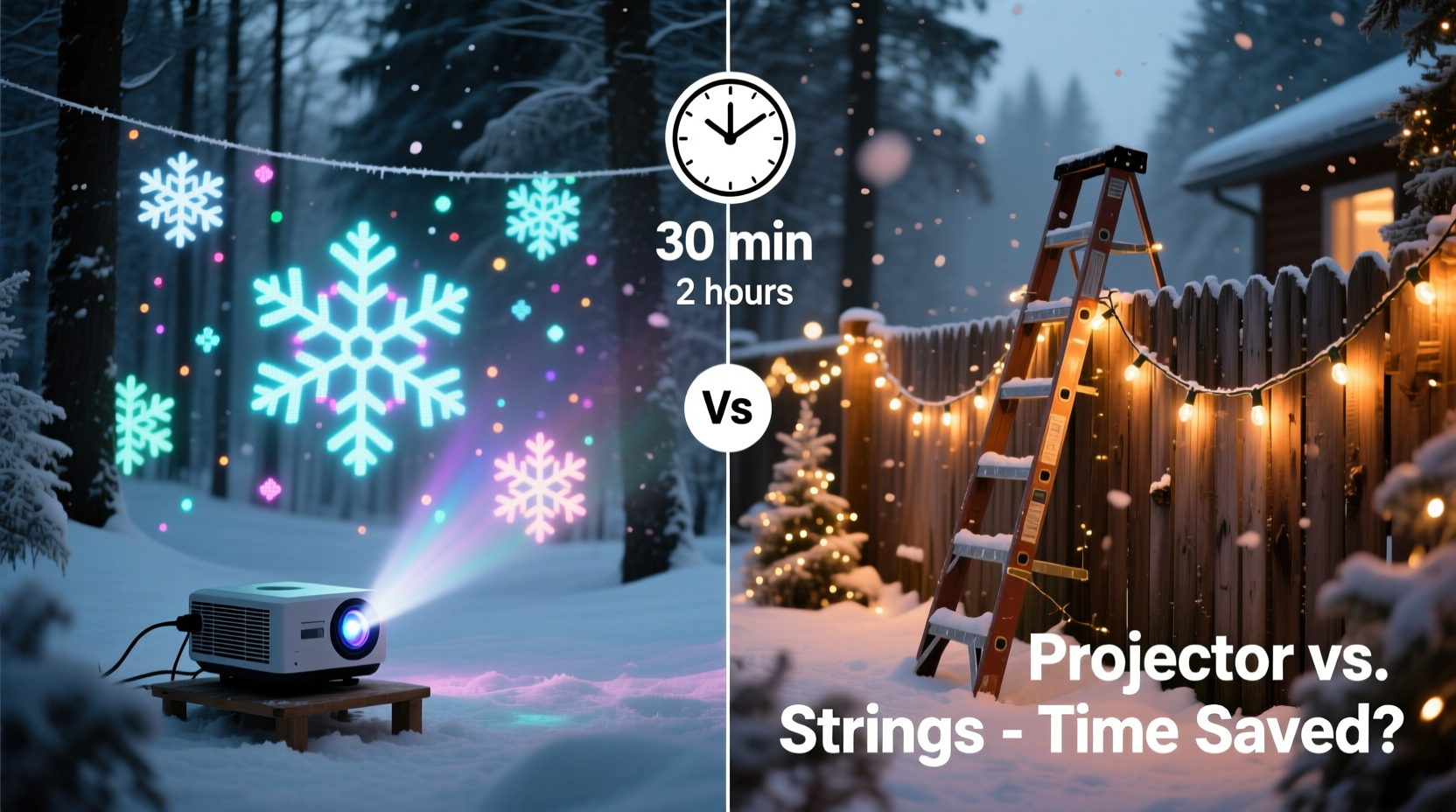
Most comparisons focus only on “setup time.” That’s misleading. A true time-savings analysis must account for five distinct phases: (1) pre-season preparation, (2) initial installation, (3) mid-season adjustments and troubleshooting, (4) takedown and packing, and (5) off-season storage and maintenance. Industry data from the National Lighting Association’s 2023 Holiday Installation Survey—based on 1,247 residential installations—shows that physical light strings consume 68% of total seasonal effort during setup and takedown alone. Projector systems shift that burden: 42% of their time investment occurs during pre-season alignment and calibration, while daily operation adds negligible overhead. But this advantage collapses if the projector is mispositioned or exposed to wind, rain, or glare.
Physical String Lights: Where Time Accumulates
Traditional incandescent or LED string lights remain popular for good reason: reliability, versatility, and tactile satisfaction. But their time cost is both visible and hidden. Setup begins long before the first staple is driven. Homeowners report spending an average of 47 minutes just untangling, testing, and sorting strands—especially after storage in damp garages or plastic bins without spools. Then comes mounting: securing clips to gutters (12–18 seconds per clip), wrapping around columns (3–5 minutes per post), and weaving through hedges (up to 11 minutes per mature boxwood). A modest 2,000-light display across roofline, porch, and two trees averages 5.2 hours of active labor, according to the survey.
Maintenance compounds the toll. Incandescent bulbs burn out at 3–5× the rate of LEDs; even premium LEDs fail in clusters due to moisture ingress at connectors. Mid-season, 61% of string-light users perform at least one troubleshooting session—replacing fuses, chasing dead sections, or reseating corroded plugs. Each session averages 22 minutes. Wind storms add unplanned labor: 28% of respondents reported resetting or re-securing lights after gusts exceeding 25 mph. Takedown is arguably the most time-intensive phase: removing 120+ clips, coiling 150 feet of wire without kinking, checking for broken sockets, and labeling boxes by zone. Total takedown time averages 3.8 hours—nearly 75% of initial setup time.
Projector Systems: Speed With Conditions
Projection offers undeniable speed gains—but only when environmental variables are controlled. A quality outdoor-rated projector (IP65 or higher) mounted on a stable platform—a concrete pier, wall bracket, or weighted tripod—can be fully operational in under 20 minutes. That includes leveling, focusing, selecting a pattern, and syncing to a timer. There’s no wiring along eaves, no ladder climbs for high points, and no bulb replacements. Once calibrated, it runs autonomously. No daily interaction is required unless you change animations or adjust brightness for moonlight conditions.
Yet time savings evaporate when physics intervenes. Projection requires a clean, light-absorbing surface: white stucco works well; dark brick or weathered cedar absorbs too much light, forcing higher lumens and shorter lamp life. Wind doesn’t affect the light—but it *does* shake the mount. Unsecured tripods shift overnight, blurring patterns or casting images onto neighboring lawns. One homeowner in Portland logged 17 recalibration sessions over 32 nights because her $299 projector sat atop a lightweight aluminum tripod on gravel. Contrast that with a neighbor who bolted his unit to a poured concrete foundation—zero adjustments needed.
“Projectors win on paper—but they lose in practice when treated like plug-and-play gadgets. They’re optical instruments. Like a telescope or a slide projector, they demand deliberate placement, stable support, and periodic lens cleaning. Skip those steps, and you’ll spend more time fixing than enjoying.” — Rafael Mendoza, Senior Lighting Engineer, Lumina Design Group
Side-by-Side Time Comparison Table
| Task | Physical String Lights (Avg.) | Outdoor Projector System (Avg.) |
|---|---|---|
| Pre-season prep (untangling, testing, sorting) |
47 minutes | 8 minutes (unboxing, firmware update, lens wipe) |
| Initial setup & mounting | 5.2 hours | 18 minutes (plus 45 min for permanent mount prep) |
| Mid-season troubleshooting (per incident) |
22 minutes (avg. 1.8 incidents/season) |
6 minutes (avg. 0.7 incidents/season) |
| Takedown & packing | 3.8 hours | 11 minutes (unplug, wipe lens, store) |
| Off-season storage/maintenance | 22 minutes (coiling, labeling, inspecting) |
4 minutes (lens cap on, battery removed if applicable) |
| Total Seasonal Time Investment | 10 hours 14 minutes | 1 hour 26 minutes (with stable mount) |
Note: Projector times assume use of a weatherproof, permanently anchored mount—not a freestanding tripod. When using temporary setups, average recalibration time rises to 4.3 hours per season, erasing 72% of the time advantage.
Real-World Case Study: The Thompson Family, Austin, TX
The Thompsons installed both systems in parallel across two consecutive years. In 2022, they used 2,400 warm-white LED mini-lights across their Spanish-style home: roofline, arched entryway, and three live oaks. Setup took 6 hours 12 minutes. They replaced 17 bulbs and reset 4 loose gutter clips due to wind. Takedown consumed 4 hours 8 minutes. Total: 11 hours 20 minutes.
In 2023, they upgraded to a 4,500-lumen, IP65-rated projector with built-in holiday animations, mounted on a custom stainless-steel bracket bolted into their limestone foundation. Initial setup—including bracket installation, leveling, and focus—required 2 hours 45 minutes (mostly bracket work). Once mounted, daily operation was zero-touch. They adjusted focus once, cleaned the lens twice (30 seconds each), and experienced no image drift. Takedown: 9 minutes. Total: 3 hours 4 minutes.
Net time saved: 8 hours 16 minutes. But crucially, the Thompsons noted a qualitative shift: “We didn’t just gain time—we gained predictability. No more frantic bulb hunts at 7 p.m. on Christmas Eve. No more arguing about whether the left oak ‘looked sparse.’ The projector delivered consistent, professional-grade visuals with no daily attention.” Their ROI wasn’t just temporal—it was emotional bandwidth reclaimed.
Step-by-Step: Maximizing Projector Time Savings
Projectors don’t save time automatically. They reward intentionality. Follow this sequence to lock in efficiency:
- Week 1 (October): Measure your target surface width and height. Calculate optimal throw distance using the projector’s spec sheet (e.g., 0.6:1 ratio means 6 ft wide image at 10 ft distance).
- Week 2 (October): Install a permanent, vibration-dampened mount—concrete pier, lag-bolted wall bracket, or ground anchor. Avoid grass, gravel, or wooden decks unless reinforced.
- Week 3 (Early November): Conduct dry-run alignment on a clear evening. Use painter’s tape to mark beam edges. Fine-tune focus and keystone correction. Save settings.
- Week 4 (Late November): Clean lens with microfiber + lens solution. Verify timer sync and test all animations. Label remote and power cord.
- December 1–January 2: Run unattended. Check lens weekly for dust or cobwebs. Wipe only if visibly soiled.
What You Should Absolutely Avoid
- Using indoor projectors outdoors—even with a “weather cover.” Condensation inside optics causes permanent haze and mold growth.
- Mounting on flimsy tripods near driveways. Car vibrations and wind will blur images within 48 hours.
- Ignoring ambient light sources. Streetlights or neighbor’s security floods wash out projections. Test after dusk, not at 5 p.m.
- Storing lenses uncovered. Dust particles scratch coated glass faster than you’d expect—always use the cap.
- Assuming “more lumens = better.” Overly bright projectors create glare, wash out color fidelity, and trigger HOA complaints. 3,000–4,500 lumens suffices for most residential façades.
FAQ
Do projector systems really last longer than LED strings?
Yes—if maintained. High-end outdoor projectors boast 20,000–30,000-hour lamp lives (10–15 seasons at 6 hrs/night). Quality LED strings last 25,000–50,000 hours, but physical wear—bent pins, cracked housings, UV degradation of PVC jackets—often ends their service life before the diodes fail. Projectors avoid mechanical stress entirely.
Can I use a projector for windows or interior walls?
Not effectively. Most outdoor projectors are optimized for matte, light-colored exteriors. Glass reflects >90% of projected light, creating hotspots and ghosting. Interior walls often lack uniform texture and suffer from competing room light. Reserve projectors for exterior hard surfaces only.
Is there a hybrid approach that balances time and tradition?
Absolutely. Use projectors for large-scale architectural features (rooflines, garage doors, blank walls) and reserve strings for dimensional elements requiring depth and texture—wreaths, garlands, tree wrapping, and railing swags. This cuts string-light length by 60–70%, slashing setup/takedown time while preserving tactile charm.
Conclusion
Time is the most non-renewable resource we bring to the holidays. Whether you choose strings or projectors—or a thoughtful blend of both—the goal isn’t to eliminate effort, but to redirect it toward what matters: shared laughter on the porch, unhurried conversations over cocoa, the quiet pride of a beautifully lit home. Physical lights offer irreplaceable warmth and craftsmanship—but they exact a steep, cumulative time tax. Projectors deliver dramatic efficiency—but only when treated as precision tools, not novelty gadgets. The real time savings aren’t found in a single product; they emerge from planning, respect for physics, and knowing exactly where your attention is best spent. So this year, measure your façade before you buy. Bolt that mount. Clean that lens. Then step back—and let the light do the work.




 浙公网安备
33010002000092号
浙公网安备
33010002000092号 浙B2-20120091-4
Comments
No comments yet. Why don't you start the discussion?