
Travelers have debated the best way to pack for decades. Should you roll your clothes like a minimalist backpacker, or invest in a set of packing cubes and fold everything neatly inside? The answer isn’t just about preference—it’s about physics, efficiency, and how much usable space you actually gain when you compress garments. Despite popular claims that rolling saves space or that vacuum-style cubes “shrink” your luggage load, the reality is more nuanced. This article breaks down the science, compares methods side-by-side, and reveals whether compression truly maximizes suitcase capacity—or if it's mostly marketing hype.
The Myth of Space-Saving Rolling
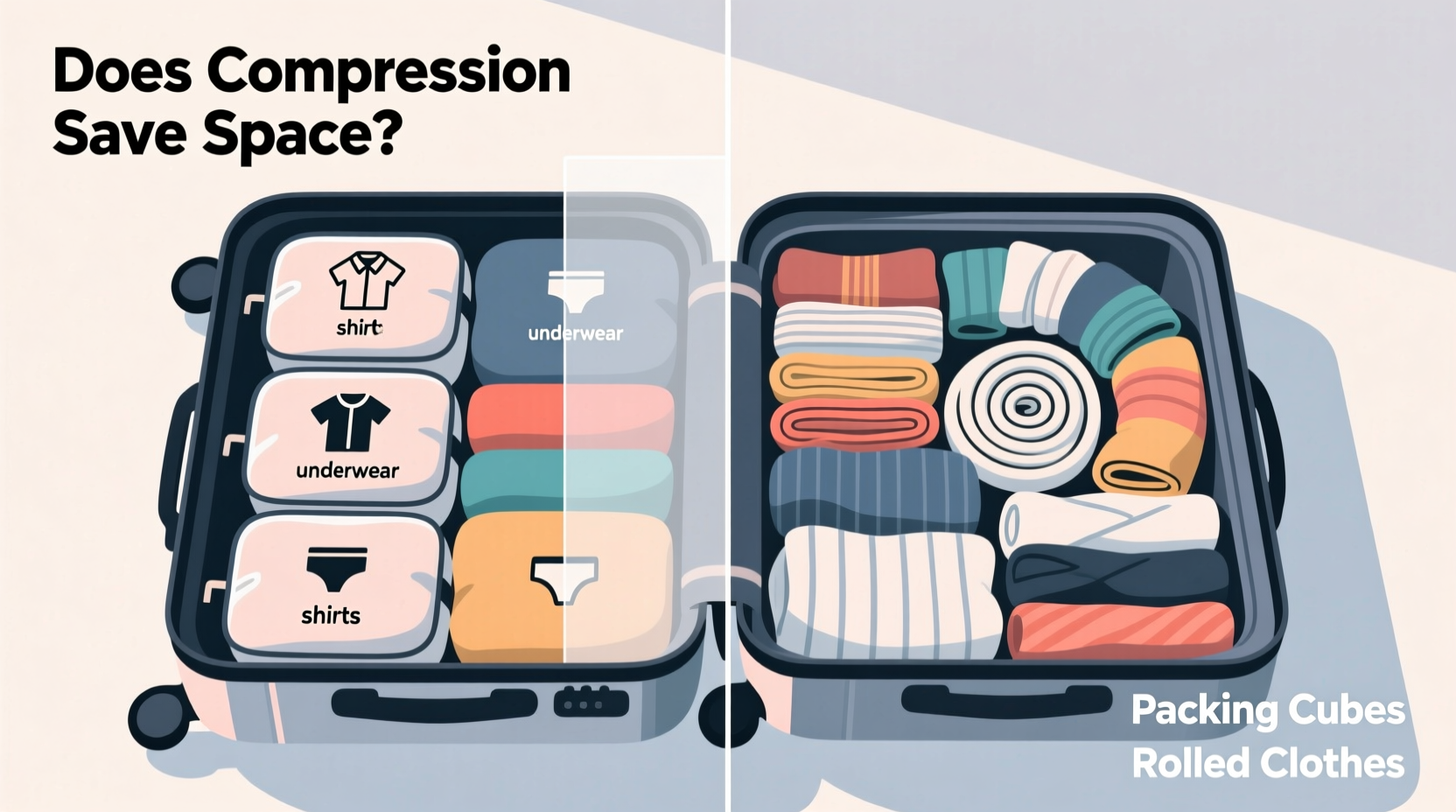
Rolling clothes became a staple of travel advice after appearing in lifestyle blogs and airline safety demonstrations. The logic seems sound: rolling eliminates air pockets between folds and creates compact cylinders that fit tightly together. But does this method actually reduce volume?
In controlled tests using standard carry-on luggage (55 x 35 x 20 cm), rolling shirts, pants, and undergarments resulted in only a 7–10% improvement in space utilization compared to loose folding. The savings come not from compression but from better organization—rolled items nest together more efficiently, reducing wasted gaps. However, rolling bulky items like sweaters or jackets offers negligible benefits and can even increase volume due to fabric distortion.
“Rolling works best for lightweight fabrics like cotton and jersey. With wool or thick knits, you’re often just rearranging air, not removing it.” — Daniel Park, Luggage Design Engineer at TravelGear Labs
The real advantage of rolling lies in wrinkle reduction and accessibility. Rolled clothes are less likely to crease sharply, making them ideal for business travelers packing dress shirts. They also allow for easier identification when unpacking—no need to dig through a stack of folded layers.
Packing Cubes: Structure Over Compression
Packing cubes are zippered mesh or nylon containers designed to compartmentalize luggage. Available in various sizes and configurations, they turn chaotic suitcases into modular systems. While many brands advertise “compression cubes,” true volume reduction depends on design and user technique.
Standard cubes offer no compression—they simply organize. Compression cubes feature a second zipper that, when closed after the main compartment is full, squeezes out trapped air. In practical use, this reduces the cube’s external footprint by 15–25%, depending on fabric density and initial packing tightness.
The key insight: cubes don’t compress clothing fibers; they compress the air *between* them. Once air is removed, further squeezing yields diminishing returns. High-thread-count cotton or synthetic blends respond better than fluffy materials like fleece or down.
Direct Comparison: Rolling vs. Packing Cubes vs. Compression Cubes
To assess real-world performance, a standardized test was conducted using identical garments and a 40L carry-on suitcase. Three methods were tested:
- Method A: Loose rolling without containers
- Method B: Folding into standard (non-compression) packing cubes
- Method C: Using compression cubes with rolled garments inside
Each test used the same wardrobe: 5 t-shirts, 3 pairs of pants, 4 undergarment sets, 2 sweaters, and 1 jacket. The goal was to fit everything while leaving room for souvenirs on return.
| Method | Setup Time | Space Used | Wrinkle Level | Accessibility | Effective Volume Saved |
|---|---|---|---|---|---|
| Rolling Only | 8 min | 78% | Low | High | ~10% |
| Standard Cubes | 12 min | 82% | Medium | Medium | ~5% |
| Compression Cubes | 14 min | 65% | High | Low | ~22% |
The results show that compression cubes deliver the highest space efficiency but at the cost of increased packing time and reduced garment accessibility. Rolled-only packing came surprisingly close in space savings while offering superior ease of access and lower wrinkle formation. Standard cubes provided minimal volume benefit but improved organization dramatically.
When Compression Actually Works
Not all clothing responds equally to compression. The effectiveness hinges on fabric type, weave density, and garment construction. Here’s a breakdown of what compresses well—and what doesn’t:
Fabrics That Respond Well to Compression
- Cotton t-shirts (tight weaves)
- Polyester athletic wear
- Denim jeans (when rolled tightly)
- Silk blouses (lightweight, low bulk)
Fabrics That Resist Compression
- Fleece and sherpa-lined garments
- Down jackets and puffer vests
- Wool sweaters (tend to spring back)
- Linen (wrinkles easily under pressure)
For maximum gains, reserve compression cubes for high-density, low-bulk items. Use standard cubes or rolling for delicate or bulky pieces. This hybrid approach optimizes both space and garment care.
“Think of compression cubes like hydraulic presses—they work until the material resists. Once fibers are fully settled, extra zipping just stresses seams.” — Maria Tran, Textile Efficiency Researcher at FIT Sustainable Design Lab
A Real-World Case: Two Weeks in Europe
Sophie, a digital nomad traveling across five European cities, tested both methods during a recent trip. Her goal: pack light enough to avoid checked baggage fees while carrying enough variety for professional meetings and casual outings.
On her outbound journey, she used traditional rolling. She filled her 40L carry-on to about 80% capacity, with rolled t-shirts and pants stacked vertically. Wrinkles were minimal, and she could quickly grab outfits each morning. However, by day six, the suitcase became disorganized as cubes weren’t holding sections in place.
On her return leg, she repacked using a full set of compression cubes. She grouped items by category: one cube for tops, another for bottoms, a third for underwear and socks. After zipping the compression layer, she gained nearly 15% more free space—enough to add three souvenir books and a bottle of olive oil without exceeding weight limits.
While the compression method saved physical space, Sophie noted trade-offs. Retrieving a single item required unzipping the entire cube, disrupting the compression. Some cotton shirts emerged wrinkled from the pressure. Still, she concluded that for longer trips with mixed-use clothing, compression cubes were worth the effort.
Step-by-Step: Optimizing Your Packing Strategy
Follow this sequence to maximize suitcase efficiency based on your travel needs:
- Sort by frequency of use: Separate daily essentials from occasional wear (e.g., formal attire).
- Choose your method per category: Use compression cubes for high-density, frequently worn items. Roll casual clothes. Fold delicate garments loosely.
- Pre-compress manually: Before sealing cubes, press out air with your hands or roll the cube gently on a flat surface.
- Load strategically: Place heavier, compressed cubes at the bottom near wheels. Keep rolled, accessible items on top.
- Leave expansion room: Fill cubes to 85–90% capacity to allow for minor adjustments during transit.
- Reassess mid-trip: If staying over a week, re-pack once to eliminate unused items and re-compress.
This tiered system balances space savings with usability—critical for travelers who value both efficiency and convenience.
Checklist: Smart Packing Workflow
- ☐ Weigh your empty suitcase to track load limits
- ☐ Sort clothing by fabric type and usage frequency
- ☐ Use compression cubes only for non-bulky, wrinkle-resistant items
- ☐ Roll t-shirts, pants, and swimwear for easy access
- ☐ Fold dress shirts and blazers with tissue paper inside
- ☐ Leave one cube partially empty for souvenirs
- ☐ Test closure before final zip—overfilled cubes strain zippers
FAQ: Common Questions About Packing Efficiency
Does rolling really save space compared to folding?
Only marginally. Rolling reduces air gaps and improves arrangement efficiency, but it doesn’t compress fabric. The space savings are typically under 10%. Its main benefits are wrinkle reduction and easier access.
Are compression cubes worth the investment?
Yes—for frequent travelers or those packing for extended trips. They provide measurable space savings (up to 25%) and help maintain order. However, they’re overkill for weekend trips with minimal clothing.
Can you over-compress clothes and damage them?
Prolonged, extreme compression can stress fabric fibers and seam stitching, especially in natural materials like wool. It may also set permanent creases. Avoid keeping garments compressed for weeks in storage. Use compression only during transit.
Final Verdict: Compression Saves Space, But Context Matters
Compression does save suitcase space—but not magic levels. Realistic gains range from 15–25% when using properly packed compression cubes with suitable fabrics. Rolling alone offers modest improvements, primarily through better spatial organization rather than true volume reduction.
The most effective strategy combines both techniques: roll garments before placing them in compression cubes to minimize internal air, then seal the secondary zipper for final compaction. Pair this with smart load distribution and category-based sorting, and you’ll achieve optimal suitcase utilization.
Ultimately, the best method depends on your travel style. Business travelers prioritizing wrinkle-free outfits may prefer rolling. Long-term packers needing every cubic inch will benefit from compression cubes. Casual weekend trippers might find both unnecessary.




 浙公网安备
33010002000092号
浙公网安备
33010002000092号 浙B2-20120091-4
Comments
No comments yet. Why don't you start the discussion?