
In an age where digital convenience dominates reading habits, a quiet but persistent question remains: do paper books help us remember more than e readers? As tablets, e-readers, and smartphones become default reading tools, educators, professionals, and lifelong learners are re-evaluating how medium affects memory. The answer isn’t simply about preference—it’s rooted in neuroscience, attention span, and the physical experience of reading.
While both formats deliver content effectively, research increasingly suggests that the tactile and spatial cues of printed books contribute to deeper comprehension and better recall. This article explores the cognitive mechanisms behind reading retention, compares paper and digital formats across multiple dimensions, and offers practical guidance for choosing the right medium based on your learning goals.
The Cognitive Science of Reading and Memory
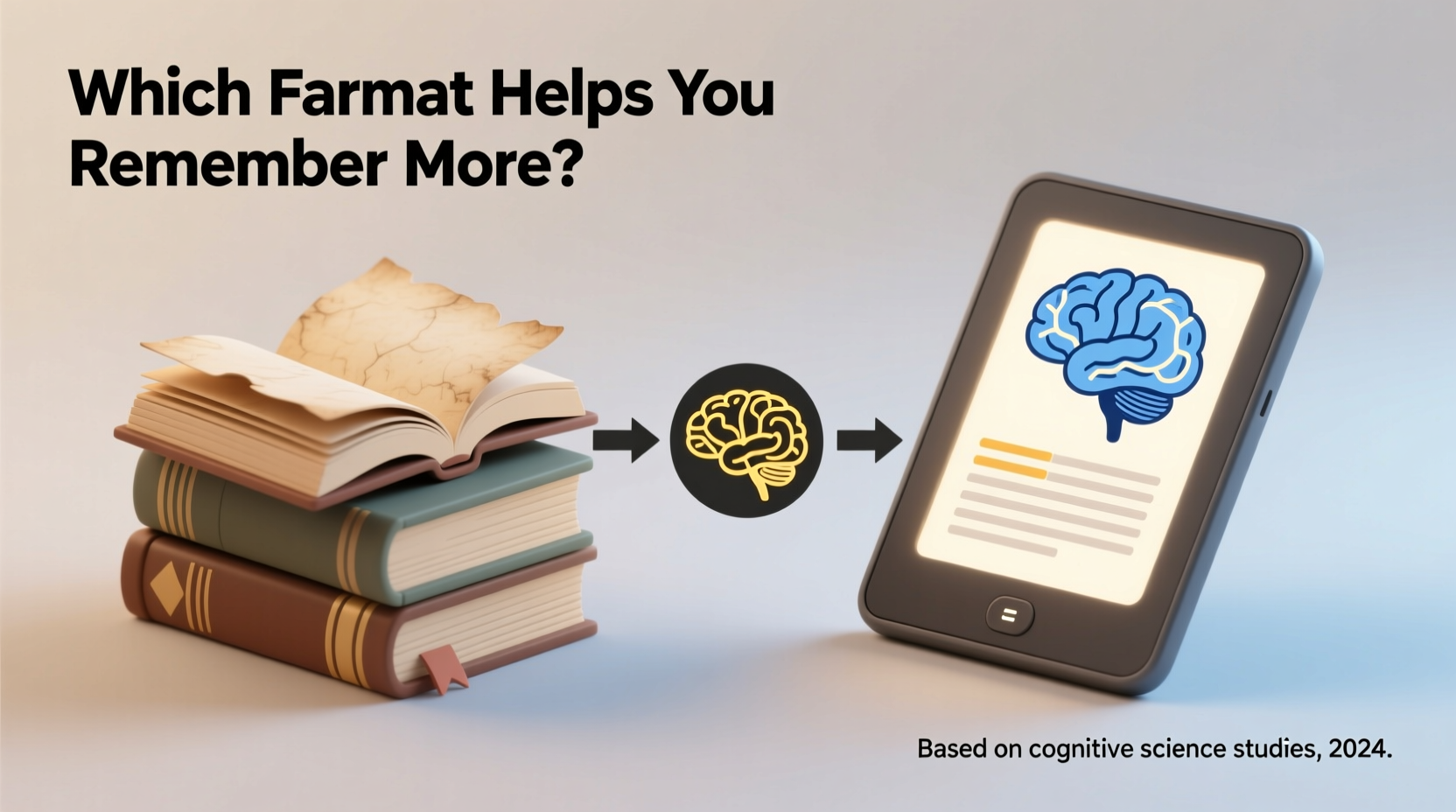
Memory formation during reading depends on three key processes: encoding (absorbing information), storage (retaining it), and retrieval (recalling it later). How we read directly influences each stage. Printed books engage multiple sensory channels—touch, smell, even sound—that reinforce neural pathways associated with memory.
When turning physical pages, readers build a mental map of the text. They remember where information appeared—on the left or right page, near the top or bottom, close to an illustration. These spatial cues act as anchors, making it easier to retrieve details later. In contrast, scrolling through a backlit screen creates a homogenous, fluid experience that lacks distinct landmarks.
A 2014 meta-analysis published in Psychonomic Bulletin & Review found that readers of printed texts consistently outperformed e-reader users on comprehension and recall tasks, especially when tested on narrative sequence and detail-oriented questions. The study concluded that “the physicality of the book may serve as a scaffold for mental representation.”
“People remember information better when they can form a spatial and tactile relationship with the material. That’s harder to achieve on a flat, glowing screen.” — Dr. Naomi Baron, Professor of Linguistics, American University
Comparing Paper Books and E Readers: A Feature-by-Feature Breakdown
Understanding the strengths and limitations of each format requires a side-by-side comparison. Below is a detailed table summarizing key differences relevant to memory retention:
| Feature | Paper Books | E Readers |
|---|---|---|
| Spatial Memory Support | High – tangible page turns, visible progress, physical landmarks | Low – uniform scrolling, no fixed location for content |
| Tactile Feedback | High – texture, weight, page turning | Low – smooth glass or plastic surface |
| Distractibility | Low – no notifications or hyperlinks | High – potential for alerts, multitasking, web browsing |
| Eye Strain | Low – matte surfaces, natural light reflection | Moderate to High – blue light emission, glare |
| Note-Taking & Annotation | Physical highlighting and marginalia enhance engagement | Digital notes possible, but less kinesthetic involvement |
| Portability & Access | Limited – one book at a time, heavier to carry | High – thousands of books in one lightweight device |
| Retention Performance | Generally higher for deep reading and long-term recall | Slightly lower, especially for complex or lengthy texts |
This comparison shows that while e readers win on convenience and accessibility, paper books offer significant advantages in supporting memory through multisensory engagement and reduced cognitive load.
Real-World Learning: A Mini Case Study
Consider Maria, a graduate student in psychology preparing for comprehensive exams. She initially relied on her tablet to read research papers and textbooks, appreciating the ability to search keywords and highlight passages digitally. However, she noticed that after several weeks, she struggled to recall where specific theories were discussed or how arguments unfolded across chapters.
She switched to using printed versions of core texts, reserving her e reader only for supplementary articles. Within a month, her self-assessment scores improved by nearly 25%. More importantly, she reported feeling “more connected” to the material. She began creating mind maps based on her mental image of textbook layouts and could often point to where a concept appeared on a page.
Maria’s experience reflects findings from a 2022 study at the University of Stavanger, where students who read printed materials scored significantly higher on conceptual understanding tests than those using screens—even when both groups spent equal time studying.
Strategies to Maximize Retention Regardless of Format
Not everyone has access to printed editions of every book, nor should they be expected to. The good news is that certain techniques can improve memory whether you're reading on paper or screen. Here’s a step-by-step guide to optimizing retention:
- Create a Reading Ritual: Set aside distraction-free time. Use the same chair, lighting, and environment consistently to strengthen contextual memory.
- Engage Actively with the Text: Underline, annotate, or summarize paragraphs in your own words. Writing by hand—even briefly—boosts retention more than typing.
- Use the “Page Position” Technique: On e readers, take note of page numbers or percentages where key ideas appear. Mentally bookmark locations like “just after 60%” to simulate spatial memory.
- Pause and Reflect: After each chapter or section, close the book (or app) and ask: What were the main points? How does this connect to what I already know?
- Teach What You’ve Learned: Explain concepts aloud or write a short summary as if teaching someone else. This forces deeper processing and reveals gaps in understanding.
These steps align with the levels-of-processing theory in cognitive psychology, which holds that information remembered more deeply when processed meaningfully rather than superficially.
When to Choose Paper vs. Digital: A Practical Checklist
Choosing the right format shouldn’t be arbitrary. Use this checklist to decide based on your purpose:
- ✅ Choose paper books when:
- You’re reading dense academic, technical, or philosophical content
- Long-term retention is critical (e.g., exam prep, professional training)
- You want to minimize distractions and maximize focus
- You benefit from handwriting notes or drawing diagrams in margins
- ✅ Choose e readers when:
- You need portability (travel, commuting)
- Accessibility features like font resizing or text-to-speech are helpful
- You’re reading light fiction or short-form content
- You rely on search functions to locate specific terms quickly
Hybrid approaches work well too. For example, many professionals download free sample chapters to an e reader before purchasing a printed copy of a high-value nonfiction book. This allows them to assess relevance while reserving deep study for the physical edition.
Frequently Asked Questions
Does font size or screen type affect memory on e readers?
Yes. Studies show that e-ink displays (like those on Kindle Paperwhite) cause less eye strain than LCD or OLED screens, leading to better sustained attention. Larger fonts and increased line spacing also improve comprehension by reducing visual crowding. However, even under optimal conditions, e-ink devices still lag behind print in fostering spatial memory.
Are audiobooks worse for memory than both paper and e readers?
It depends on the listener’s engagement. Passive listening—while driving or doing chores—often results in lower retention because attention is divided. However, active listening with note-taking or pausing to reflect can yield comparable results, especially for narrative content. Audiobooks lack visual and tactile cues, so they generally support recognition more than precise recall.
Can using both formats together improve learning?
Absolutely. A 2021 study in the Journal of Educational Psychology found that students who first read a chapter on paper and then reviewed highlights on an e reader performed better on assessments than those who used only one medium. Combining formats leverages the strengths of each: deep encoding from print and quick review from digital.
Conclusion: Match Your Medium to Your Goal
The debate between paper books and e readers isn’t about declaring a universal winner—it’s about matching the tool to the task. If your goal is deep understanding, long-term retention, and meaningful engagement with complex ideas, printed books hold a clear cognitive edge. Their physicality supports the brain’s natural way of organizing and remembering information.
That said, e readers remain invaluable for accessibility, efficiency, and convenience. They excel in scenarios where volume, portability, or searchability matter more than deep memorization.
The most effective readers aren’t loyal to one format—they’re strategic. They choose paper when they want to learn, grow, and remember. They use digital when they need speed, flexibility, or mobility. By understanding how each medium shapes cognition, you gain control over your learning outcomes.




 浙公网安备
33010002000092号
浙公网安备
33010002000092号 浙B2-20120091-4
Comments
No comments yet. Why don't you start the discussion?