
In an age where smartphones, tablets, and cloud-based apps dominate every aspect of productivity, the simple paper notebook might seem like a relic. Yet, millions still reach for pen and paper when attending lectures, meetings, or brainstorming sessions. Why? Because despite the convenience of digital tools, handwriting notes appears to engage the brain in ways typing simply can’t replicate. The question isn’t just about preference—it’s about cognitive performance. Which method—paper notebooks or digital note-taking apps—actually boosts memory more effectively?
Research from neuroscience, psychology, and education consistently suggests that writing by hand strengthens memory encoding, comprehension, and long-term recall. But digital tools offer searchability, synchronization, and multimedia integration that paper can’t match. So what’s the real trade-off? And how can you leverage both systems to maximize learning and retention?
The Science Behind Handwriting and Memory
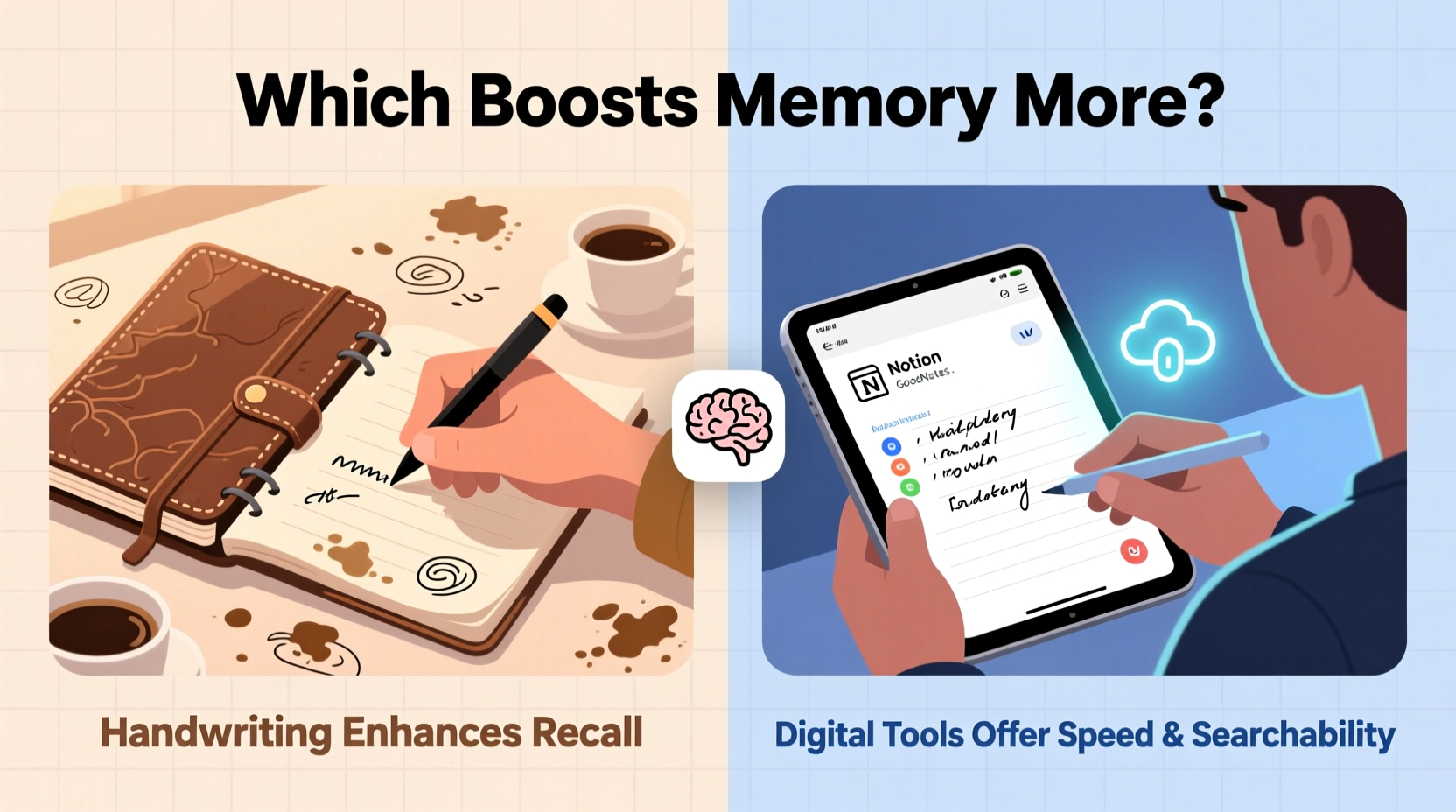
When you write with pen and paper, your brain engages in a complex process involving motor coordination, visual processing, and semantic encoding. This multi-sensory experience creates deeper neural pathways than passive typing. A landmark 2014 study by Pam Mueller and Daniel M. Oppenheimer at Princeton University found that students who took handwritten notes performed significantly better on conceptual questions than those who typed their notes—even when typing allowed verbatim transcription.
The reason? Handwriting forces summarization. Because writing by hand is slower than typing, students must listen, process, and rephrase information in their own words. This act of synthesis strengthens understanding and memory. In contrast, typing often leads to mindless transcription, which requires less cognitive engagement.
“Students who take notes by hand appear to learn more because they are forced to process information at a deeper level.” — Dr. Daniel M. Oppenheimer, Cognitive Psychologist, UCLA
Neuroimaging studies support this. Functional MRI scans show greater activation in regions associated with language, memory, and sensorimotor integration during handwriting compared to typing. The physical motion of forming letters appears to reinforce memory traces—what researchers call the “generation effect.”
Digital Note-Taking: Speed and Structure at a Cost
Digital note-taking apps like Evernote, Notion, OneNote, and Obsidian offer undeniable advantages. They allow instant search, cross-referencing, voice memos, image embedding, and seamless syncing across devices. For professionals managing large volumes of information, these features are indispensable.
However, the very efficiency of digital tools can undermine learning. Typing encourages surface-level processing. When users can capture everything instantly, there’s little incentive to summarize, prioritize, or reflect. The result? Faster note-taking, but shallower understanding.
A 2017 meta-analysis published in *Psychological Science in the Public Interest* reviewed over 50 studies and concluded that while digital note-taking allows for higher volume, it does not lead to better retention—especially for conceptual material. In fact, students who typed their notes were more likely to forget key ideas within 24 hours unless they reviewed them extensively.
Comparing Paper and Digital: A Practical Breakdown
Let’s examine the core differences between paper notebooks and digital note-taking apps across key dimensions relevant to memory and learning.
| Factor | Paper Notebooks | Digital Apps |
|---|---|---|
| Memory Encoding | High – promotes deep processing through slower, deliberate writing | Moderate to Low – encourages shallow transcription |
| Retention Over Time | Stronger long-term recall due to active engagement | Weaker unless paired with active review strategies |
| Organization & Search | Limited – relies on indexing, tabs, or personal systems | Excellent – full-text search, tagging, linking |
| Multimedia Support | None – limited to text and sketches | High – supports audio, video, images, links |
| Distraction Level | Low – no notifications or multitasking | High – prone to interruptions from alerts and other apps |
| Portability & Backup | Fragile – risk of loss or damage; no backup | High – synced across devices, encrypted backups |
This comparison shows that neither method is universally superior. Paper excels in cognitive engagement, while digital wins in accessibility and scalability. The best approach depends on your goals: deep learning versus efficient information management.
A Real-World Example: Medical Student Study Habits
Consider the case of Sarah Kim, a third-year medical student at Johns Hopkins. During her first year, she relied entirely on her iPad and Apple Pencil for lecture notes, using Notability to record audio and annotate slides. While her notes were comprehensive, she struggled to retain complex physiological concepts for exams.
In her second year, she switched to a hybrid model: she used paper notebooks during lectures, focusing on summarizing key mechanisms in her own words. After class, she spent 15 minutes digitizing her notes into Notion, adding diagrams and linking related topics. She also recorded only selective audio clips—those covering difficult concepts.
The result? Her exam scores improved by nearly 20%, and she reported feeling more confident during clinical rotations. “Writing by hand made me pay attention differently,” she said. “I wasn’t just capturing data—I was building understanding.”
Sarah’s experience reflects a growing trend among high-performing students and professionals: using paper for initial learning and digital tools for organization and retrieval.
Optimizing Your Note-Taking Strategy: A Step-by-Step Guide
You don’t have to choose one system over the other. With intentionality, you can combine the strengths of both. Here’s how to build a memory-optimized note-taking workflow.
- Capture in analog, process in digital: Take initial notes by hand during lectures, meetings, or reading sessions. Focus on summarizing, sketching diagrams, and asking questions—not recording every word.
- Wait before transcribing: Don’t digitize immediately. Wait 12–24 hours to let the information consolidate. Then rewrite your notes in your own words using a digital app.
- Add structure and connections: Use your digital tool to create headings, tags, and backlinks between related ideas. This builds a personal knowledge base (a “second brain”).
- Review actively: Schedule weekly reviews of both handwritten originals and digital summaries. Test yourself with flashcards or self-quizzing.
- Use multimedia selectively: Embed audio clips or screenshots only for complex explanations. Avoid passive consumption—always pair media with written reflection.
Checklist: Building a Memory-Boosting Note-Taking System
- ✅ Use a high-quality notebook with blank or dotted pages for flexibility
- ✅ Choose a pen with smooth ink flow to reduce friction and fatigue
- ✅ Limit digital note-taking during live learning sessions
- ✅ Allocate time daily or weekly to transfer and expand handwritten notes
- ✅ Use color coding or symbols to highlight key concepts in both formats
- ✅ Review handwritten notes within 24 hours to reinforce memory
- ✅ Turn key points into flashcards (digital or physical) for spaced repetition
- ✅ Disable notifications when using digital apps for studying
Expert Insight: What Neuroscience Tells Us
Dr. Judy Willis, a neurologist and former classroom teacher, emphasizes the importance of movement in learning. “The motor act of writing activates the reticular activating system, which helps focus attention,” she explains. “When students move their hands to form letters, they’re also reinforcing memory circuits in the brain.”
“The physical connection between hand and brain creates a feedback loop that enhances learning. It’s not just about what you write—it’s how you write it.” — Dr. Judy Willis, Neurologist and Education Consultant
She warns against equating speed with effectiveness. “Just because students can type faster doesn’t mean they’re learning more. In fact, the extra time spent synthesizing information by hand pays off in deeper understanding and better test performance.”
Frequently Asked Questions
Does typing notes ever help memory?
Yes—but only under specific conditions. Typing can support memory if you avoid verbatim transcription and instead summarize, paraphrase, and organize information in real time. However, most people default to passive typing, which reduces cognitive engagement. Structured frameworks like Cornell Notes or outline formatting can make digital note-taking more effective.
Are some people better suited to digital note-taking?
Individual preferences and needs vary. People with motor difficulties, dysgraphia, or fast-paced jobs may benefit more from digital tools. Similarly, those managing large collaborative projects may need the sharing and version control features of apps like Notion or Google Docs. The key is awareness: know when you’re sacrificing depth for convenience.
Can I improve memory with digital tools alone?
Yes, but it requires discipline. To boost memory with digital notes, incorporate active recall, spaced repetition, and regular summarization. Apps like Anki or RemNote integrate flashcards and review scheduling, making them more conducive to retention than standard note apps. Still, supplementing with occasional handwriting can deepen encoding.
Conclusion: Choose Depth, Then Scale
The debate between paper notebooks and digital note-taking apps isn’t about nostalgia versus progress—it’s about cognitive effectiveness. When the goal is memory retention, understanding, and long-term learning, the evidence clearly favors handwriting. The physical act of writing engages the brain in a way that typing rarely matches.
But digital tools have their place. Once information is encoded through handwriting, digital platforms become powerful allies for organization, retrieval, and expansion. The most effective learners aren’t loyal to one medium—they strategically use both.
Start by reclaiming the pen. Let your next meeting or study session be captured in ink, not keystrokes. Feel the rhythm of thought and writing align. Then, later, bring that knowledge into the digital world—not as a copy, but as an evolved, interconnected system of understanding.




 浙公网安备
33010002000092号
浙公网安备
33010002000092号 浙B2-20120091-4
Comments
No comments yet. Why don't you start the discussion?