
In an era dominated by smartphones, tablets, and cloud-based note-taking apps, the humble paper notebook might seem outdated. Yet, despite the convenience of digital tools, a growing body of research suggests that writing by hand on paper offers unique cognitive advantages—particularly when it comes to memory retention and sustained focus. The question isn’t just about preference; it’s about performance. Which method truly supports deeper learning, better recall, and sharper concentration?
This article examines the neurological, psychological, and practical differences between paper notebooks and digital notes. Drawing from cognitive science, educational studies, and real-world experiences, we’ll explore how each medium shapes the way we think, learn, and remember.
The Cognitive Science Behind Handwriting
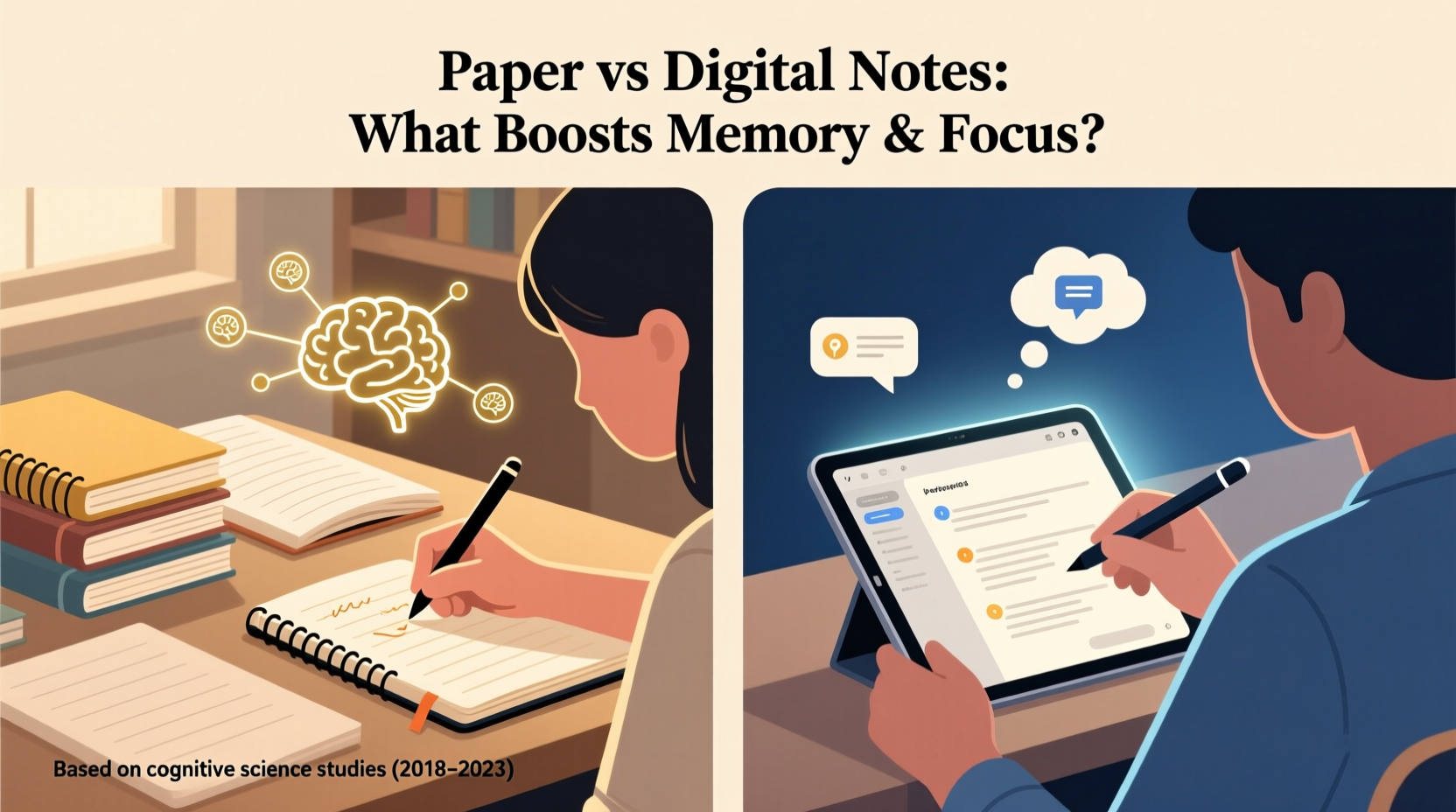
When you write by hand, your brain engages in a complex, multisensory process. Unlike typing, which is largely mechanical and repetitive, handwriting activates regions associated with language processing, motor control, and memory formation. A landmark 2014 study conducted at Princeton University and UCLA found that students who took notes longhand performed significantly better on conceptual questions than those who typed their notes—even when both groups were given time to review before testing.
The reason? Typing encourages verbatim transcription. Students often try to capture every word spoken in a lecture, treating their devices like audio recorders. In contrast, handwriting forces summarization and paraphrasing due to its slower pace. This act of distillation requires deeper cognitive engagement, leading to stronger encoding of information into long-term memory.
“Students who take notes by hand are forced to process information more deeply because they can’t write everything down. That cognitive effort leads to better understanding.” — Dr. Pam Mueller, co-author of the 2014 study on note-taking methods
This phenomenon is known as the “generation effect”—the idea that information is remembered better when one actively generates it rather than passively records it. Writing by hand naturally promotes this effect.
Digital Notes: Speed, Searchability, and Distraction
Digital note-taking platforms like Evernote, Notion, and OneNote offer undeniable benefits: instant search, multimedia integration, synchronization across devices, and the ability to organize vast amounts of information efficiently. For professionals managing complex projects or researchers compiling data, these tools are indispensable.
However, the same features that make digital notes powerful also introduce challenges. The speed of typing reduces friction but increases the risk of shallow processing. Additionally, the environment in which digital notes are taken—often a laptop or tablet connected to Wi-Fi—introduces constant distractions: email notifications, social media alerts, and browser tabs tempting users away from the task at hand.
A 2017 study published in Computers & Education found that students using laptops during lectures scored lower on comprehension tests, not because of the device itself, but due to multitasking behaviors enabled by it. Even when students believed they were focused, background applications reduced attentional resources available for learning.
Memory Retention: What the Research Shows
Multiple studies have compared memory outcomes between handwritten and typed notes. The results consistently favor paper.
- A 2020 Japanese study had participants watch a short lecture and take notes either on paper or on a tablet. One week later, those who used paper recalled 20–30% more information, particularly on conceptual and spatial details.
- Neuroimaging revealed that paper note-takers showed greater activation in brain regions linked to spatial memory and navigation—suggesting they mentally mapped the layout of their notes, aiding retrieval.
- Another study found that people who wrote shopping lists by hand were more likely to remember unlisted items they needed, indicating stronger associative memory formation.
The physicality of paper appears to play a role. Turning pages, feeling the texture of ink, and seeing the spatial arrangement of words create sensory anchors that enhance recall. Digital notes, while searchable, lack this tactile dimension and spatial context.
Focus and Flow: How Medium Shapes Attention
Focus isn’t just about avoiding distraction—it’s about entering a state of deep work, where sustained attention allows for meaningful progress. Cal Newport, author of Deep Work, argues that uninterrupted concentration is becoming increasingly rare and valuable in the modern knowledge economy.
Paper notebooks inherently support this state. They are single-purpose tools. When you open a notebook, there’s only one thing you can do: write. There are no notifications, no updates, no competing windows. This simplicity creates a mental space conducive to reflection and creativity.
In contrast, digital devices are designed for versatility—and interruption. Even if you’re using a distraction-free app, the mere presence of a connected device can trigger what psychologists call “attention residue,” where part of your mind remains alert for incoming stimuli.
“When I switched back to a Moleskine for brainstorming sessions, my ideas became more cohesive. I wasn’t jumping between thoughts to check messages. I was actually thinking.” — Sarah Lin, UX designer and productivity coach
Comparative Overview: Paper vs Digital
| Feature | Paper Notebooks | Digital Notes |
|---|---|---|
| Memory Retention | Higher due to deeper cognitive processing | Lower unless active summarization is practiced |
| Focus Support | Strong—minimal distractions | Weak—prone to multitasking |
| Speed of Entry | Slower, encourages summarization | Faster, risks verbatim transcription |
| Searchability | Limited—requires indexing or tagging | Excellent—full-text search available |
| Spatial Memory | High—physical layout aids recall | Low—uniform scrolling reduces context |
| Portability & Backup | Physical only—risk of loss | Cloud-synced, highly portable |
| Environmental Impact | Uses paper and ink | Energy-intensive devices and data centers |
Real-World Application: A Case Study
Jamal, a third-year medical student, struggled with retaining complex physiology concepts despite taking detailed notes on his iPad. He would rewatch lectures and highlight key points, yet felt his understanding remained superficial. After reading about the cognitive benefits of handwriting, he decided to experiment.
For one semester, he switched to a Leuchtturm1917 notebook for all class notes. He committed to writing summaries in his own words, sketching diagrams, and leaving margins for reflections. At first, the transition was slow—he missed the search function and had to adapt to slower input. But within weeks, he noticed a shift.
During exams, he could visualize where information appeared on specific pages. He recalled diagrams he’d drawn and phrases he’d underlined. His exam scores improved by nearly 15%, and more importantly, he felt a deeper grasp of the material. “It wasn’t just about memorizing,” he said. “I finally felt like I understood it.”
Jamal now uses a hybrid approach: handwritten notes for learning and digital tools for organization and reference.
Best Practices: Maximizing Both Worlds
Neither paper nor digital is universally superior. The key is alignment with purpose. Here’s how to use each method strategically:
- Use paper for initial learning and deep processing. Lectures, meetings, and study sessions benefit most from handwriting, especially when concepts are new or complex.
- Use digital for storage, search, and collaboration. Once information is internalized, digitize key summaries for easy retrieval and sharing.
- Combine sketching with writing. Doodling, diagramming, and marginalia boost engagement regardless of medium—but are more natural on paper.
- Review notes within 24 hours. Whether on paper or screen, timely review strengthens memory consolidation.
- Create a personal indexing system. Number pages, use tabs, or maintain a table of contents to improve navigability in paper notebooks.
FAQ: Common Questions Answered
Does handwriting help with ADHD or attention difficulties?
Yes. Many individuals with attention challenges report improved focus when using paper notebooks. The tactile feedback and limited functionality reduce cognitive overload. Occupational therapists often recommend handwriting exercises to strengthen attentional control.
Can digital pens (like Apple Pencil) replicate the benefits of paper?
Preliminary evidence suggests yes—if used correctly. Writing on a tablet with a stylus engages similar motor pathways as pen-on-paper. However, the surrounding digital environment still poses distraction risks. To maximize benefit, use distraction-free apps like GoodNotes or Nebo in offline mode.
Is typing ever better for memory?
In some cases. For transcribing interviews, coding syntax, or capturing large volumes of data quickly, typing is more efficient. But for learning, reflection, and synthesis, handwriting typically leads to better retention.
Action Plan: Build a Smarter Note-Taking System
Follow this step-by-step guide to optimize your note-taking strategy:
- Assess your goals. Are you trying to learn, archive, or collaborate? Match the tool to the purpose.
- Start with paper for active learning. Use a dedicated notebook for classes, readings, or brainstorming sessions.
- Summarize in your own words. Avoid copying text verbatim. Focus on meaning, connections, and examples.
- Digitize selectively. After reviewing, transfer key insights to a digital system for long-term access.
- Review regularly. Schedule weekly reviews of both paper and digital notes to reinforce memory.
- Iterate and refine. Track what works. Adjust your system based on performance and comfort.
Conclusion: Choose Depth Over Convenience
In the debate between paper notebooks and digital notes, the winner depends on what you value most. If speed, search, and scalability are your priorities, digital tools excel. But if your goal is deeper understanding, stronger memory, and sustained focus, paper remains unmatched.
The most effective learners aren’t those who rely solely on technology or tradition—they’re the ones who understand the strengths of each and use them intentionally. By returning to handwriting for critical thinking and reserving digital tools for organization, you harness the best of both worlds.




 浙公网安备
33010002000092号
浙公网安备
33010002000092号 浙B2-20120091-4
Comments
No comments yet. Why don't you start the discussion?