
In a world buzzing with notifications and packed schedules, remembering important dates—birthdays, deadlines, appointments—has never been more critical. Yet, despite technological advances, many people still wrestle with forgetfulness. The tools we use to track time play a crucial role in shaping our memory retention. Two dominant options stand out: the paper planner and the digital calendar. One is tactile and analog; the other is instant and automated. But when it comes to actually helping your brain retain information, which system wins?
This isn't just about preference or convenience. It's about cognitive science, attention, and long-term recall. Choosing the wrong tool might mean missed opportunities, forgotten commitments, or chronic stress. Let’s examine how each method influences memory, supported by research, expert insights, and real-life experiences.
The Cognitive Science of Memory and Planning
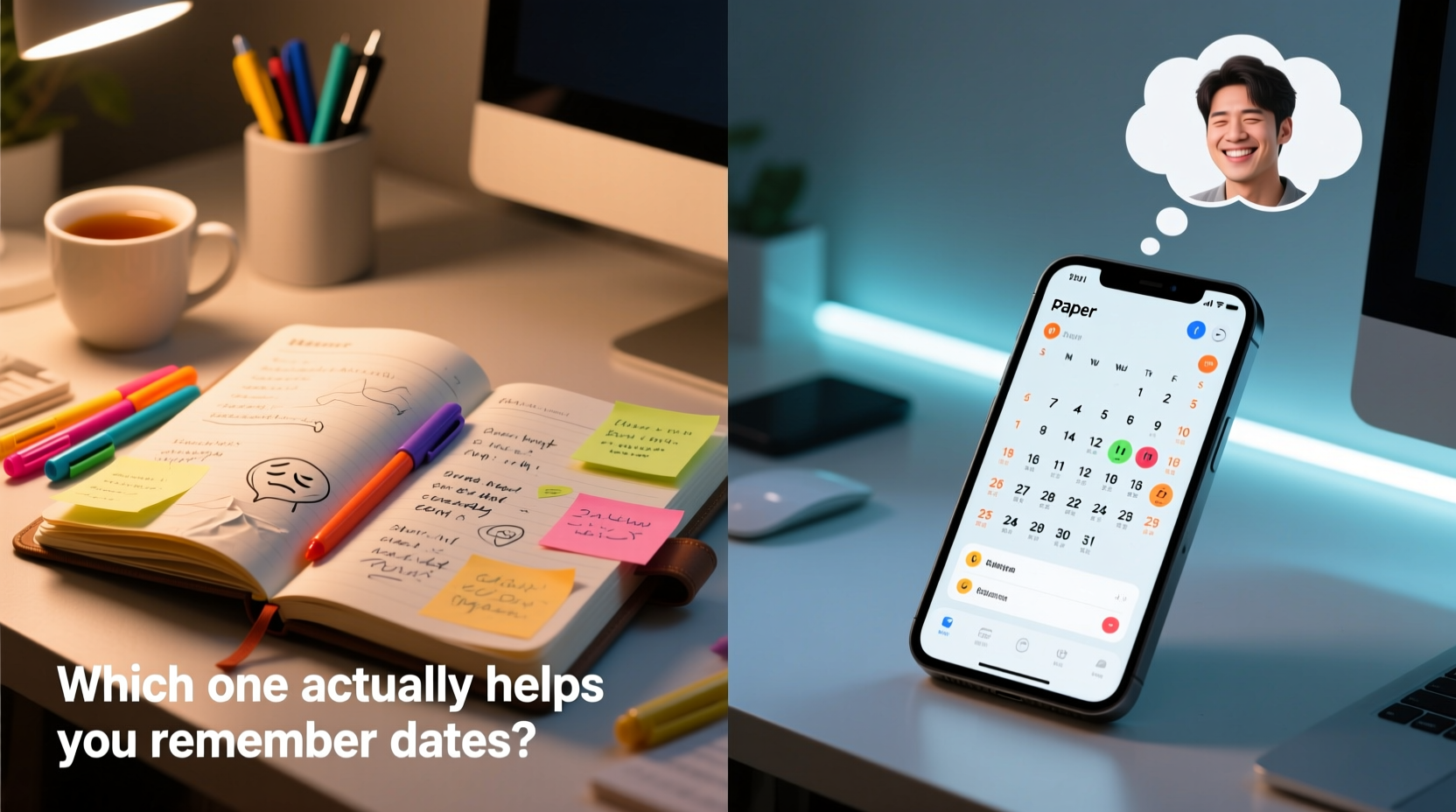
Memory isn’t passive storage—it’s an active process influenced by how we engage with information. When you write something down, especially by hand, you're not just recording data. You're encoding it. This act triggers deeper neural processing than typing or tapping.
A 2014 study published in Psychological Science found that students who took notes by hand demonstrated better conceptual understanding and memory retention than those who typed their notes on laptops. Researchers attributed this to the fact that handwriting requires summarization and filtering—mental work that strengthens recall.
The same principle applies to planning. Transferring a date into a paper planner involves decision-making: where to place it, how to phrase it, whether to highlight it. That engagement builds stronger mental associations. In contrast, adding an event to a digital calendar can be mechanical—click, save, done—with minimal cognitive effort.
“Writing by hand creates a ‘memory trace’ in the brain. It’s not just about the output—it’s the sensory feedback from pen on paper that reinforces learning.” — Dr. Sarah Thompson, Cognitive Psychologist at University of Edinburgh
Digital calendars, while efficient, often rely on passive alerts. You don’t need to remember the date—you just wait for the ping. Over time, this externalizes memory, weakening your brain’s natural ability to retain information. This phenomenon is known as “cognitive offloading,” and while useful, it can lead to dependency.
Paper Planners: The Power of Tangibility
Paper planners offer unique advantages rooted in physical interaction. Flipping pages, seeing weekly spreads, and using colored pens create spatial and visual cues that enhance memory. Your brain remembers not just what was written, but where it was on the page—a concept called “spatial memory.”
Many users report that physically crossing off tasks provides a sense of accomplishment that digital checkmarks fail to replicate. This psychological reward reinforces habit formation and motivation.
Additionally, paper planners are free from distractions. No emails, no social media notifications, no app updates. This focused environment supports deliberate planning and reduces cognitive load.
However, paper has limitations. It’s not searchable. It can’t send reminders. If you lose your planner, your data is gone. And if you’re juggling multiple locations or collaborating with others, sharing a paper schedule is impractical.
Digital Calendars: Efficiency at a Cost
Digital calendars—Google Calendar, Outlook, Apple Calendar—excel in functionality. They sync across devices, allow real-time collaboration, and deliver timely reminders. For professionals managing complex schedules, they’re indispensable.
You can set recurring events, attach files, invite attendees, and receive automatic alerts. These features reduce the burden of mental tracking and help prevent oversights. For people with ADHD or high cognitive loads, digital tools can serve as essential scaffolding.
Yet, efficiency doesn’t always equal effectiveness in memory retention. A 2021 study from the University of California found that participants who relied solely on digital reminders were 30% less likely to recall event details without prompts compared to those who used handwritten planners—even when both groups successfully attended the events.
The danger lies in over-reliance. When your calendar does all the remembering, your brain stops trying. This can erode your intrinsic time management skills and make you vulnerable when technology fails—dead batteries, software crashes, forgotten passwords.
Comparing Features: Paper Planner vs Digital Calendar
| Feature | Paper Planner | Digital Calendar |
|---|---|---|
| Memory Retention | High – engages motor and visual memory | Low to moderate – relies on external alerts |
| Accessibility | Limited to physical access | Available anywhere with device/internet |
| Reminders | None unless self-set (e.g., sticky note) | Customizable push/email/sound alerts |
| Searchability | Manual only | Instant keyword search |
| Collaboration | Not possible | Real-time sharing and scheduling |
| Distractions | Minimal | High (notifications, apps) |
Real-World Example: How a Teacher Uses Both Systems
Lena Reyes, a high school English teacher in Portland, struggled with forgetting parent meeting times and grading deadlines. She tried Google Calendar but kept missing events because she ignored notifications during class hours.
After attending a productivity workshop, she adopted a hybrid system. She maintains a paper weekly planner where she writes all her classes, meetings, and personal commitments every Sunday evening. She spends 20 minutes reviewing and rewriting key dates from her digital calendar into the planner by hand.
Then, she keeps Google Calendar synced for backups and for sharing room bookings with colleagues. The result? Her recall improved dramatically. She now remembers 95% of her appointments without checking her phone, and her stress levels have dropped.
“Putting it on paper forces me to slow down and really see my week,” Lena says. “I notice conflicts I’d otherwise miss. The digital version is there, but I don’t need it as much anymore.”
Step-by-Step: Building a Memory-Boosting Planning Routine
If you want to improve date retention while maintaining reliability, consider combining the strengths of both systems. Here’s a practical five-step routine:
- Start with a digital calendar as your master repository. Log every event, deadline, and reminder here first for backup and collaboration.
- Choose a paper planner format—weekly, monthly, or daily—that fits your workflow. Bullet journals are excellent for customization.
- Schedule a weekly planning session (e.g., Sunday night). During this time, transfer upcoming events from your digital calendar to your paper planner by hand.
- Use symbols and colors to categorize entries—meetings, personal time, deadlines, self-care. This enhances visual memory.
- Review your paper planner daily each morning and evening. Cross off completed items. Reflect on what’s ahead.
This hybrid approach leverages digital reliability while reinforcing memory through analog engagement. You get the best of both worlds: accuracy and recall.
Checklist: Choosing the Right Tool for You
- ✅ Do you need to share schedules with others? → Lean toward digital.
- ✅ Are you frequently forgetting events even after logging them? → Try writing them down manually.
- ✅ Do you work in distraction-heavy environments? → Paper may improve focus.
- ✅ Do you travel often or switch devices? → Digital offers better accessibility.
- ✅ Are you trying to build better memory habits? → Prioritize handwriting key dates.
- ✅ Do you value tangible progress tracking? → Paper planners provide stronger emotional feedback.
Frequently Asked Questions
Can using a paper planner really improve memory?
Yes. Research shows that the physical act of writing engages multiple areas of the brain involved in memory encoding. Spatial layout and repeated visual exposure further reinforce recall. While it won’t replace digital tools for coordination, it significantly boosts personal retention.
What if I lose my paper planner?
To mitigate risk, use your digital calendar as a backup. Enter all events there first, then transfer them manually to paper. Avoid putting sensitive personal information in a physical planner. Consider taking weekly photos of your spread for reference.
Isn’t digital faster? Why waste time writing things twice?
It may seem inefficient, but the “wasted” time is actually invested in memory. Think of it like exercise—the short-term effort leads to long-term strength. If you consistently forget dates, speed isn’t helping you. Effectiveness matters more than speed when reliability is at stake.
Conclusion: The Best Tool Is the One That Works—But Memory Matters
The truth is, neither paper planners nor digital calendars are universally superior. Each serves different needs. But when the goal is to *remember* dates—not just record them—paper holds a distinct advantage.
Your brain thrives on engagement, not automation. Every time you write down a commitment, you reaffirm it. You create context, emotion, and location—all anchors for memory. Digital tools excel at delivery, but they can’t replace the cognitive benefits of manual input.
The most effective strategy isn’t choosing one over the other. It’s integrating both: use digital for logistics and collaboration, and paper for reflection and retention. This dual-layer system protects against failure while training your brain to stay sharp.




 浙公网安备
33010002000092号
浙公网安备
33010002000092号 浙B2-20120091-4
Comments
No comments yet. Why don't you start the discussion?