
In an age dominated by smart devices, cloud sync, and AI-powered task managers, a quiet rebellion is unfolding on desks and nightstands: the return of the paper planner. Once dismissed as outdated, analog planning tools are experiencing a renaissance among professionals, creatives, and students alike. This isn’t nostalgia for its own sake—it’s a deliberate shift toward mindfulness, reduced screen fatigue, and deeper cognitive engagement. As digital overload intensifies, many are rediscovering the unique benefits of pen-on-paper planning. The debate between paper and digital planners has evolved from mere preference to a reflection of how we want to manage our time, attention, and mental well-being.
The Cognitive Edge of Analog Planning
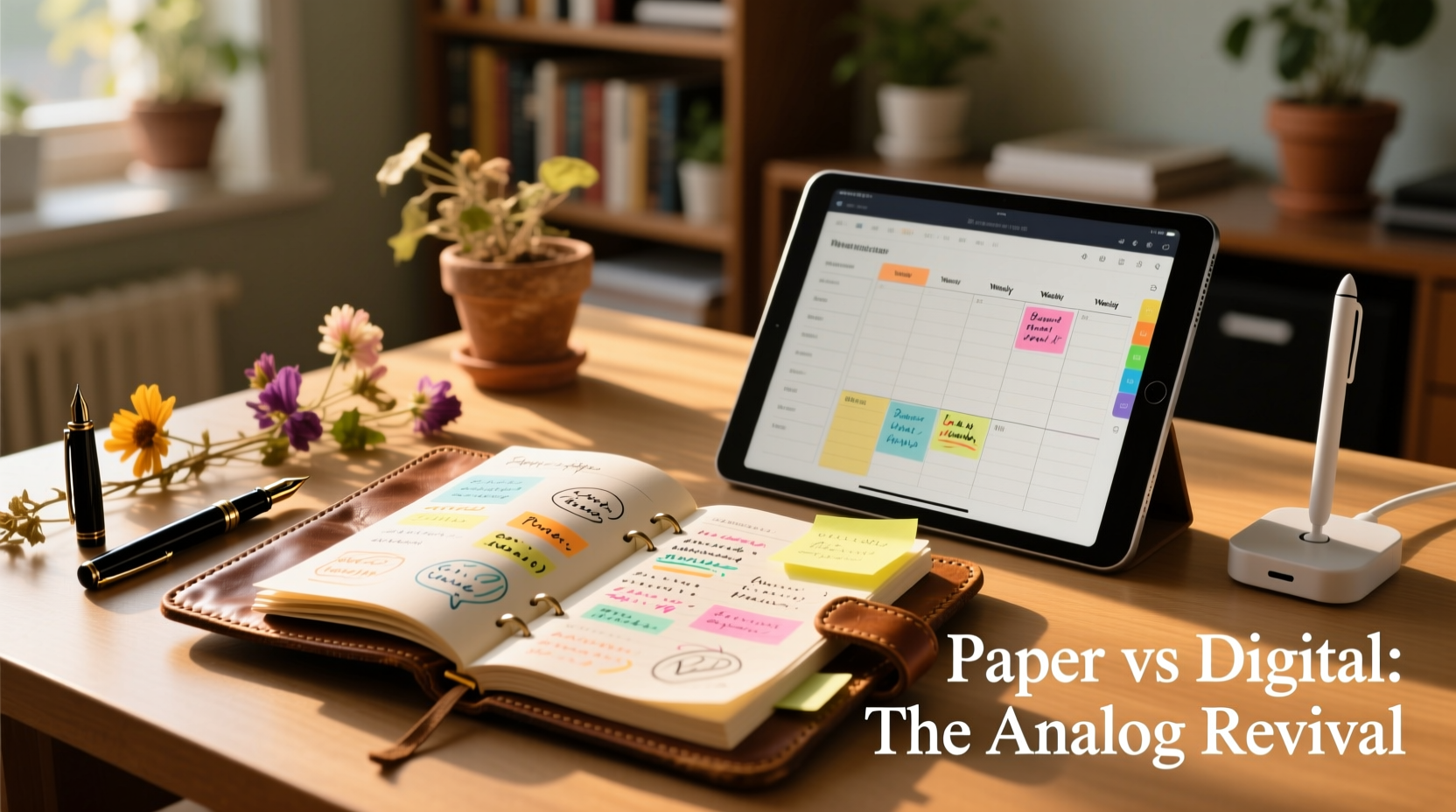
Neuroscience supports what many long-time journalers have known intuitively: writing by hand engages the brain differently than typing. Studies from Princeton University and UCLA show that people who take handwritten notes retain information better and process concepts more deeply than those who type them. This “generation effect” suggests that the physical act of forming letters strengthens memory encoding.
When applied to planning, this means that jotting down appointments, tasks, or goals in a paper planner activates regions of the brain associated with comprehension and retention. Unlike tapping an event into a calendar app—where input is fast and often automatic—writing it down forces a moment of pause, consideration, and intentionality.
“Handwriting creates a feedback loop between the brain and body that enhances focus and decision-making. It’s not just recording—it’s thinking.” — Dr. Sarah Lin, Cognitive Psychologist, Stanford University
Digital tools excel at speed and automation, but they often encourage shallow processing. Reminders pop up, notifications chime, and tasks get checked off without much thought. In contrast, paper planners demand active participation. You must decide what goes in, prioritize visually, and reflect on your day’s structure manually. This cognitive friction, once seen as inefficient, is now recognized as valuable for building executive function and self-awareness.
Why Digital Planners Fall Short (Despite Their Convenience)
Digital planners offer undeniable advantages: instant searchability, recurring events, location-based alerts, and seamless integration across devices. Yet, these strengths come with trade-offs that impact productivity and mental clarity.
- Distraction-prone environment: Opening a calendar app often means unlocking a smartphone—a gateway to emails, social media, and endless interruptions.
- Over-reliance on automation: When reminders do all the work, users become passive recipients rather than proactive planners.
- Lack of personalization: Most digital templates are rigid, limiting creative expression and emotional connection to one’s schedule.
- Sensory disconnect: Tapping icons lacks the tactile satisfaction and sensory reinforcement of turning pages or crossing off tasks with a pen.
Moreover, constant connectivity can create a false sense of control. Just because every meeting is color-coded and synced across three devices doesn’t mean you’re managing your time effectively. In fact, research published in the *Journal of Consumer Research* found that individuals using digital tools were more likely to over-schedule and underestimate task duration due to the illusion of infinite space and perfect recall.
Paper Planners: More Than Just Nostalgia
The resurgence of paper planners isn’t about rejecting technology—it’s about reclaiming agency over attention and time. Bullet journals, undated weekly spreads, habit trackers, and goal-setting dashboards have turned analog planning into a customizable, expressive practice.
Unlike standardized digital interfaces, paper allows for total flexibility. Need a mind map next to your to-do list? Draw it. Want to sketch a mood chart or paste in a concert ticket? Go ahead. This freedom fosters ownership and emotional investment in planning, transforming it from a chore into a ritual.
Brands like Leuchtturm1917, Moleskine, and Passion Planner have capitalized on this movement, offering structured yet adaptable formats that blend functionality with aesthetic appeal. But even basic notebooks are seeing renewed popularity among minimalists who prefer blank slates over pre-formatted grids.
A Real Shift in Work Culture
Consider Maya, a project manager at a tech startup in Portland. After two years of relying solely on Google Calendar and Asana, she found herself constantly reactive—responding to alerts, rescheduling missed deadlines, and feeling mentally drained by end-of-day reviews. On a colleague’s recommendation, she switched to a hybrid system: digital for team coordination, but a paper planner for her personal workflow.
Within weeks, Maya noticed changes. She began blocking time intentionally instead of filling every open slot. Her morning routine included 15 minutes with her planner, reviewing priorities before touching her phone. She started using symbols and colors to track energy levels alongside tasks. Most importantly, she felt more present during meetings because she wasn’t glancing at her screen to check the next agenda item.
“It sounds simple,” she says, “but writing things down made me slower—and that helped me be smarter about what actually mattered.”
Comparing Paper vs Digital: A Practical Breakdown
| Feature | Paper Planners | Digital Planners |
|---|---|---|
| Cognitive Engagement | High – promotes deeper processing and memory retention | Low – often leads to passive input and quick dismissal |
| Customizability | Unlimited – draw, doodle, adapt layouts freely | Limited – constrained by app design and templates |
| Portability & Backup | One physical copy; risk of loss or damage | Cloud-synced; accessible anywhere; easy backup |
| Distraction Level | Minimal – no notifications or competing apps | High – device access invites multitasking |
| Habit Tracking & Reflection | Highly visual and tactile; encourages consistency | Automated but impersonal; low emotional resonance |
| Learning Curve | None – intuitive from first use | Varies – some apps require setup and training |
This comparison isn’t about declaring a winner—it’s about matching tools to goals. For collaborative scheduling, real-time updates, and travel logistics, digital remains superior. But for personal growth, deep work planning, and mindful time management, paper often delivers better outcomes.
Building a Balanced Planning System: A Step-by-Step Guide
Many high-performers aren’t choosing one over the other—they’re integrating both. Here’s how to build a balanced system that leverages the strengths of each:
- Assess your planning needs: Identify which aspects of your life require collaboration (e.g., team meetings), mobility (e.g., travel), or introspection (e.g., goal review).
- Choose primary tools: Select one digital calendar for shared events and one paper planner for personal time blocking and priority setting.
- Sync weekly: Every Sunday, transfer key digital events to your paper planner. Use this as a planning ritual to visualize the week ahead.
- Create analog anchors: Designate specific times (e.g., morning coffee, bedtime) for paper planner use—no devices allowed.
- Review monthly: Reflect on what worked. Did you rely too much on reminders? Did your paper entries help you stay focused? Adjust accordingly.
Actionable Checklist: Optimize Your Planning Approach
Whether you lean analog, digital, or hybrid, use this checklist to refine your system:
- ☐ Audit your current planning method: Are you consistently using it? Do you forget tasks?
- ☐ Limit digital planner use to shared schedules only—keep personal planning offline.
- ☐ Choose a paper planner with enough space for notes, reflections, and adjustments.
- ☐ Dedicate the first 10 minutes of your day to reviewing your paper planner—no screens.
- ☐ Include non-negotiables like sleep, exercise, and downtime in your weekly layout.
- ☐ Perform a monthly “planner cleanup”—review accomplishments and reset goals.
- ☐ Experiment with bullet journaling techniques (signifiers, migration, rapid logging) if you want more structure within freedom.
Frequently Asked Questions
Isn’t paper inefficient compared to digital search and editing?
Yes, in terms of speed and retrieval, digital wins. But efficiency isn’t always the goal. Effectiveness—achieving meaningful results with focus and sustainability—is where paper shines. While you can’t Ctrl+F a notebook, the act of flipping through pages reinforces memory and context, helping you recall not just what you did, but how you felt doing it.
What if I lose my paper planner?
This is a valid concern. To mitigate risk, treat your planner as a working document, not an archive. At the end of each week, snap a photo of key pages or summarize achievements digitally. Some people maintain a lightweight Google Doc log for backup without replacing the analog experience.
Can I still be productive without syncing my calendar?
Absolutely. Many executives and creatives use paper as their primary tool and only consult digital calendars when coordinating with others. Productivity isn’t tied to technology—it’s tied to clarity, consistency, and alignment with personal rhythms. If your paper planner helps you say “no” to distractions and “yes” to priorities, it’s doing its job.
The Future of Planning: Intentionality Over Automation
The comeback of analog methods reflects a broader cultural shift. People are no longer satisfied with tools that merely save time—they want tools that improve the quality of their attention and decisions. As burnout rates climb and digital fatigue becomes widespread, the simplicity of a blank page and a reliable pen offers something rare: presence.
This isn’t anti-technology. It’s pro-mindfulness. The most advanced societies are beginning to recognize that human cognition thrives not on constant stimulation, but on deliberate pauses, tactile feedback, and intentional design. Paper planners, in their quiet way, support these conditions.
Companies are responding. Some startups now distribute branded notebooks during onboarding. Law firms and consulting agencies offer bullet journal workshops as part of wellness programs. Even schools are reintroducing handwriting exercises to boost student focus and retention.
Conclusion: Reclaim Your Time, One Page at a Time
The choice between paper and digital planners is ultimately about values. Do you want convenience at the cost of attention? Or are you willing to slow down slightly to gain clarity, reduce stress, and engage more deeply with your days?
Analog methods aren’t making a comeback because they’re cute or retro. They’re returning because they work—for focus, for memory, for emotional regulation. In a world that moves faster every year, sometimes the most revolutionary act is to write slowly, think clearly, and plan with purpose.




 浙公网安备
33010002000092号
浙公网安备
33010002000092号 浙B2-20120091-4
Comments
No comments yet. Why don't you start the discussion?