
In 2025, the divide between PC and console gaming remains one of the most debated topics among enthusiasts. With new hardware cycles stabilizing, cloud integration maturing, and game development practices evolving, the question is no longer just about graphics or exclusives—it’s about long-term value. For many players, especially those investing hundreds or even thousands into their setup, “value” means more than upfront price. It includes longevity, flexibility, upgrade potential, access to games, and overall experience. This article compares PC and console gaming across these dimensions to determine which platform offers the better return on investment this year.
Understanding Value Beyond Price
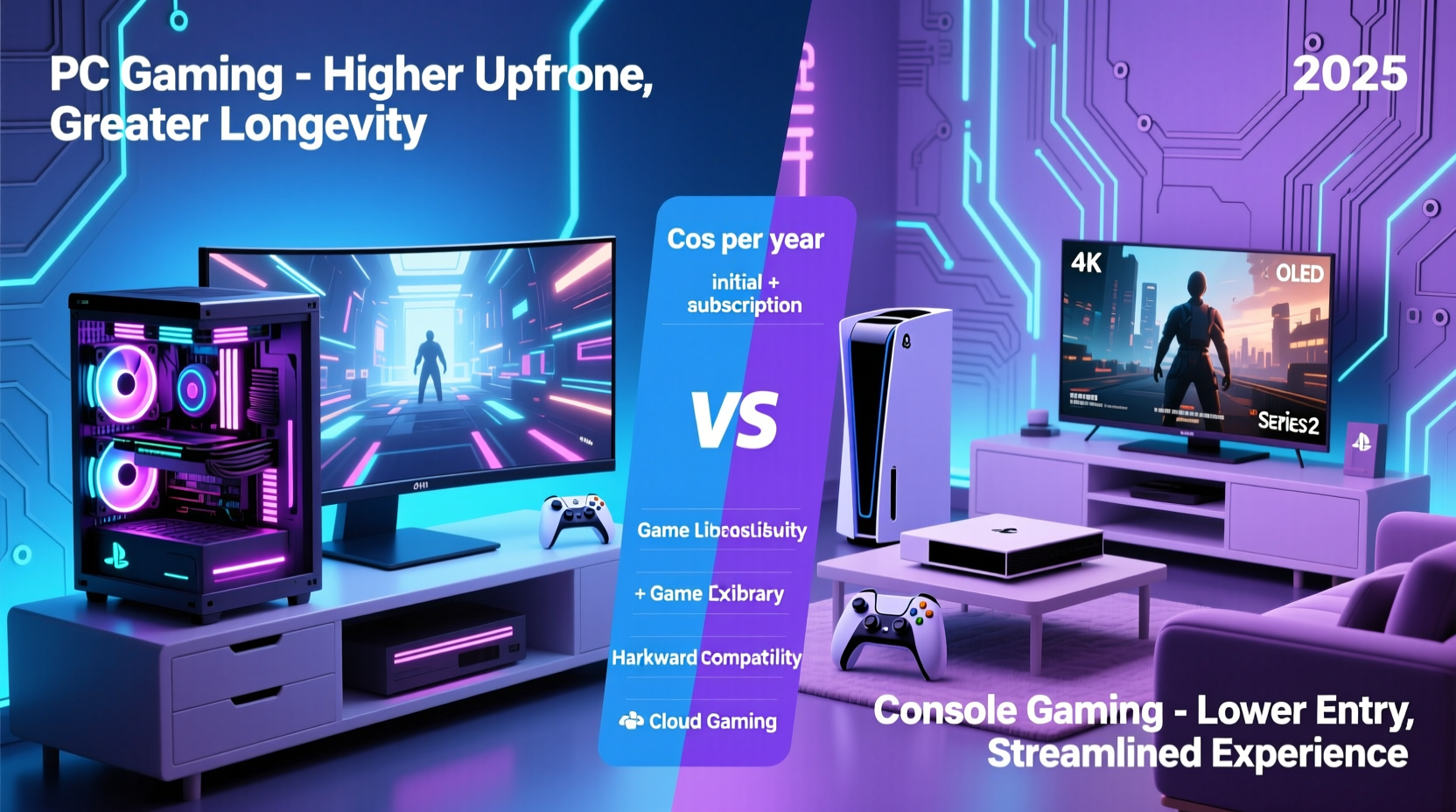
When evaluating value, it's essential to look beyond the sticker price. A $499 console may appear cheaper than a $1,200 gaming PC, but over five years, factors like repair costs, software accessibility, upgradability, and game library depth shift the equation significantly.
Value in gaming encompasses:
- Longevity: How long can the system remain relevant?
- Flexibility: Can it be used for other tasks like streaming, work, or VR?
- Upgrade Path: Is future-proofing possible without replacing the entire system?
- Game Access: What titles are available, at what price, and through which storefronts?
- Maintenance Cost: Are repairs expensive? Is backward compatibility supported?
A system that lasts longer, supports broader functionality, and provides consistent access to affordable games often delivers superior value—even if initial costs are higher.
Cost Comparison: Upfront Investment and Hidden Expenses
The most immediate difference lies in entry cost. In 2025, the latest generation consoles—PlayStation 5 Pro and Xbox Series X—are priced between $499 and $599. The standard models remain available around $399–$449, with digital editions slightly cheaper. These systems are plug-and-play, requiring minimal additional investment beyond a TV, controller, and possibly an external drive.
On the PC side, building or buying a competitive gaming rig starts at around $700 for budget builds capable of 1080p gaming. Mid-range systems ($1,000–$1,400) deliver 1440p performance with high frame rates, while high-end configurations exceed $2,000 for 4K and ray tracing capabilities.
However, hidden costs must be considered:
| Platform | Base Cost | Additional Costs | Expected Lifespan |
|---|---|---|---|
| Console (PS5/Xbox) | $399–$599 | Extra controllers ($70), external SSD ($120), subscription ($70/yr) | 5–7 years |
| Gaming PC (Mid-tier) | $1,200 | Monitor, peripherals, OS license, occasional upgrades (~$200/yr avg.) | 6–10 years (modular upgrades) |
| Budget Gaming PC | $700 | May require full GPU/CPU replacement within 3–4 years | 3–5 years |
While consoles offer lower initial outlay, they lack internal upgrade options. Once storage fills or performance lags behind new titles, users face limitations. PCs, by contrast, allow targeted upgrades—swapping GPUs, adding RAM, or upgrading storage—extending usability far beyond a single hardware cycle.
“Consoles are optimized appliances; PCs are customizable tools. One wins on simplicity, the other on sustainability.” — Mark Tran, Hardware Analyst at TechPulse Weekly
Performance and Future-Proofing in 2025
By 2025, both platforms have reached maturity in their current generations. Consoles now support advanced features like variable refresh rate (VRR), auto low latency mode (ALLM), and hardware-accelerated ray tracing. However, fixed hardware means developers optimize for known specs, leading to stable but capped performance.
PCs, meanwhile, benefit from continuous innovation. NVIDIA and AMD have released efficient mid-range GPUs (e.g., RTX 4060, RX 7700 XT) that offer excellent 1440p performance at accessible prices. Intel’s Lunar Lake processors and AMD’s Ryzen 8000 series bring improved power efficiency and AI acceleration, useful not only for gaming but also for content creation and multitasking.
More importantly, PC architecture allows adaptation:
- New APIs like DirectX 12 Ultimate and Vulkan enable better resource utilization.
- DLSS, FSR, and XeSS upscaling technologies let older or mid-tier cards run newer games smoothly.
- Modding communities extend game life and improve visuals on aging titles.
A well-built PC today can run games at high settings for 5+ years with selective upgrades. A console, even with optimizations, will struggle with demanding titles by year four unless replaced.
Game Library and Accessibility
One of the strongest arguments for PC gaming in 2025 is access. Platforms like Steam, Epic Games Store, GOG, and Microsoft Store offer vast libraries, frequent sales, and regional pricing advantages. Used or discounted AAA titles often drop below $10, and bundles provide dozens of games for under $20.
Consoles rely on first-party stores with less aggressive discounting. While PlayStation Plus and Xbox Game Pass offer subscription-based access to large catalogs, true ownership is limited. Cancel the subscription, and access disappears.
Consider this comparison:
| Factor | PC Gaming | Console Gaming |
|---|---|---|
| Ownership Model | Digital purchases are permanent (barring store shutdowns) | Digital purchases tied to account; some delisted titles become inaccessible |
| Sales Frequency | Weekly major sales (Steam, Humble, etc.) | Seasonal sales, less frequent |
| Backward Compatibility | Nearly all games via compatibility layers or emulation | Limited (e.g., PS5 plays PS4 games, not earlier) |
| Mod Support | Widespread (Nexus Mods, Steam Workshop) | Very limited (mostly unofficial, jailbroken systems) |
Additionally, cross-platform services like Xbox Cloud Gaming and GeForce NOW are blurring lines, allowing PC-quality experiences on TVs or mobile devices. But these still depend on having a strong internet connection and often require a base-level subscription or hardware investment.
Mini Case Study: Alex’s Multi-Year Experience
Alex bought a PS5 at launch in 2020, spending $499 plus $80 for a second controller and $120 for a 1TB SSD. Over five years, he spent $350 on games, mostly full-price digital copies. By 2025, he found newer titles required lowering settings or suffered long load times despite updates.
His friend Jamie built a $1,100 PC in 2022. She upgraded the GPU in 2024 for $350 and has since played every new release at max settings. Her total game spending was $220—most during Steam sales. She also uses the PC for video editing and remote work.
Over five years, Alex spent $1,049 with a closed ecosystem. Jamie spent $1,670 but gained a decade-long machine with dual-purpose utility. Depending on priorities, either could be seen as “better value”—but Jamie’s system offers more long-term flexibility.
Cross-Platform Trends and Ecosystem Lock-In
In 2025, Microsoft continues its push toward platform agnosticism. Games like Halo Infinite, Fable, and upcoming Starfield 2 are confirmed for both Xbox and PC, often day-one on Game Pass. Sony has followed suit, bringing select exclusives like Ghost of Tsushima Director’s Cut and Horizon: Forbidden West to PC—though typically 12–18 months after console release.
This softens the blow of exclusivity but raises concerns about monetization. Sony charges $70 for PC ports of games already owned on console, alienating fans who expected loyalty rewards. Meanwhile, Microsoft integrates PC and Xbox accounts seamlessly, allowing shared saves, achievements, and multiplayer networks.
Ecosystem lock-in remains a risk:
- Buying multiple PS5 exclusives ties you to PlayStation Network.
- Xbox Game Pass subscribers gain immense short-term value but lose access upon cancellation.
- PC gamers avoid subscriptions for ownership—but miss curated discovery features.
The trend favors hybrid usage: owning a console for exclusive titles and using a mid-tier PC for broader access and productivity.
Checklist: Choosing Based on Your Needs
Use this checklist to evaluate which platform suits your lifestyle:
- ✅ Do you want to play God of War, Spider-Man 2, or Final Fantasy XVI? → Consider PlayStation.
- ✅ Is playing Starfield, Forza Motorsport, or Avowed important? → Lean toward Xbox or PC.
- ✅ Do you value modding, ultrawide monitors, or high-refresh gameplay? → PC is best.
- ✅ Are you on a tight budget with no technical interest? → Console offers simplicity.
- ✅ Do you want one device for gaming, streaming, and work? → Build a PC.
- ✅ Do you travel often or play primarily on a TV? → Console or handheld (Steam Deck, ROG Ally).
- ✅ Do you hate dealing with drivers, updates, or troubleshooting? → Stick with console.
FAQ
Can a gaming PC last 10 years?
Not unchanged—but with component upgrades (GPU, RAM, storage), a well-maintained chassis and PSU can serve effectively for a decade. Most users replace parts incrementally rather than the whole system.
Are console games cheaper in the long run?
Initially yes, but long-term savings depend on usage. Subscriptions like Game Pass offer great value if used heavily, but digital purchases on console are rarely discounted as deeply as on PC.
Is PC gaming dying due to cloud services?
No. Cloud gaming complements but doesn’t replace local hardware. Latency, data caps, and image compression limit fidelity. High-end PC gaming remains unmatched for competitive and immersive experiences.
Step-by-Step: Building a Value-Focused Gaming Setup in 2025
If you're deciding how to maximize value, follow this timeline:
- Month 1: Define your budget ($700–$1,400 recommended). Prioritize GPU and CPU balance.
- Month 2: Research part compatibility. Use tools like PCPartPicker.com.
- Month 3: Assemble or order your build. Include a 650W+ 80+ Gold PSU for future upgrades.
- Month 4: Buy peripherals gradually. Start with a basic monitor and keyboard; upgrade later.
- Ongoing: Monitor sales. Buy games during Steam Summer Sale or Black Friday.
- Year 3–4: Upgrade GPU only. Keep case, PSU, storage, and motherboard if compatible.
- Year 6+: Evaluate CPU/motherboard/platform shift. Reuse power supply, cooling, and case if possible.
This phased approach spreads cost while maintaining performance relevance.
Conclusion: Which Delivers Better Value in 2025?
In 2025, PC gaming delivers better long-term value for most serious players. While consoles win on simplicity, affordability, and ease of use, they operate as closed systems with finite lifespans. PCs offer adaptability, ownership, expansive libraries, and multi-functionality that justify higher initial investment.
That said, value is personal. A casual gamer who enjoys living room sessions with family may find a PS5 Pro with a few exclusives more satisfying than managing a PC. But for those seeking control, customization, and sustained performance, the PC remains unmatched.
The smartest path? A hybrid model: own a console for exclusive experiences and a modest PC for flexibility and longevity. Or, if choosing one, opt for a mid-tier gaming PC—it pays dividends in freedom, function, and future readiness.




 浙公网安备
33010002000092号
浙公网安备
33010002000092号 浙B2-20120091-4
Comments
No comments yet. Why don't you start the discussion?