
The Samsung Galaxy Z Flip series combines sleek foldable design with fashion-forward appeal, making it a favorite among style-conscious users. But its compact size and smooth surfaces also make it prone to slipping from hands—especially when unfolded. To combat this, many users turn to accessories like pearl chains and wrist straps attached to protective cases. But which one truly offers better drop protection? While both aim to keep your phone secure, their mechanisms, comfort, and practicality differ significantly.
This article dives into the mechanics, user experiences, and functional trade-offs between pearl chains and wrist straps for Z Flip cases. The goal isn’t just aesthetics—it’s about minimizing the risk of costly screen damage or internal failure due to accidental drops.
How Drop Prevention Works: The Basics
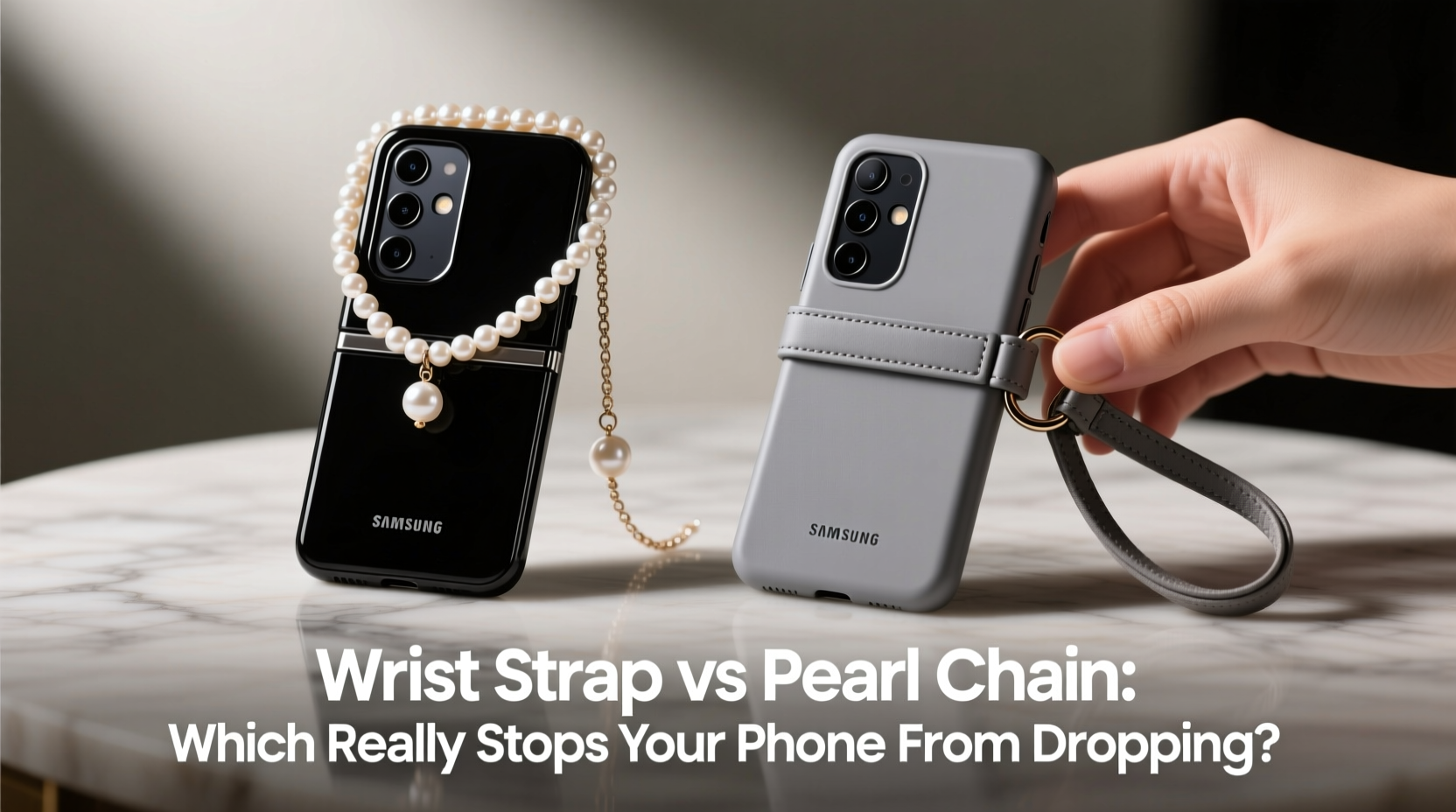
Preventing phone drops isn’t just about holding on tighter. It’s about redundancy. A good safety system ensures that even if your grip fails, the phone remains physically tethered to your body or hand. Both pearl chains and wrist straps serve as secondary retention systems, but they do so in different ways:
- Pearl chains typically attach at two points on the case and drape across the back like a necklace or lanyard, allowing you to loop them over your wrist or carry the phone like a clutch.
- Wrist straps are shorter, more rigid bands (often silicone or fabric) that fasten around the wrist, keeping the phone directly anchored during use.
The key difference lies in range of motion, security level, and situational utility. Understanding these helps determine which is better suited to your lifestyle.
Design and Usability Comparison
Let’s examine how each accessory performs under everyday conditions.
Pearl Chains: Style Meets Moderate Security
Pearl chains have surged in popularity thanks to their aesthetic appeal. Often made of faux pearls, beads, or metallic links, they elevate the look of a Z Flip, turning it into a statement accessory. Functionally, they’re versatile—you can wear them around the neck, over the shoulder, or loop them loosely around the wrist.
However, their length and flexibility can be a double-edged sword. When used as a wrist loop, slack in the chain may allow enough play for the phone to swing and hit surfaces during sudden movements. If worn around the neck, the phone dangles freely, increasing the chance of impact when bending or turning quickly.
Wrist Straps: Built for Practical Security
Wrist straps, by contrast, are engineered for function. Most attach directly to reinforced anchor points on rugged or hybrid Z Flip cases and wrap snugly around the wrist. They’re commonly made from durable materials like TPU, nylon, or elastic webbing, offering minimal stretch and maximum retention.
Because they fit tightly and eliminate dangling, wrist straps reduce the arc of motion if the phone slips. In high-movement scenarios—like walking briskly, boarding transit, or navigating crowded spaces—they provide a more reliable hold than longer chains.
“Drop prevention isn’t about looks—it’s about reducing kinetic energy at the moment of release. Shorter tethers with low elasticity win every time.” — Dr. Lena Park, Industrial Designer & Product Safety Analyst
Real-World Effectiveness: A Side-by-Side Analysis
To evaluate actual performance, consider common usage scenarios and failure points.
| Criteria | Pearl Chain | Wrist Strap |
|---|---|---|
| Drop Prevention (Active Use) | Moderate – Slack allows swinging; higher impact risk | High – Minimal movement radius; immediate restraint |
| Fashion Appeal | High – Stylish, Instagram-friendly, customizable | Low to Moderate – Functional, often utilitarian look |
| Comfort During Extended Use | Low – Can dig into wrist or neck; heavy chains cause strain | High – Ergonomic fit; distributes weight evenly |
| Quick Access & One-Handed Use | Low – Requires unlooping; awkward when unfolded | High – Secure while allowing full manipulation |
| Durability of Attachment | Variable – Metal loops may weaken; glue joints fail over time | High – Reinforced anchors built into premium cases |
A Day in the Life: Mini Case Study
Sophia, a 29-year-old marketing professional in Chicago, uses her Z Flip 5 daily for work and social media. She initially chose a rose-gold pearl chain for its elegance and match with her outfits. Within three weeks, she dropped her phone twice—once while stepping off a train (the chain caught it, but the phone swung and cracked the hinge), and again at a café when the chain slipped off her wrist entirely.
Frustrated, she switched to a matte black silicone wrist strap with a magnetic clasp. Though less flashy, it stayed securely fastened during commutes, gym visits, and outdoor events. Over the next four months, she had no drops. “I didn’t realize how much I relied on two-handed grip until I lost it,” she said. “The wrist strap feels like an extension of my hand now.”
Her experience reflects a broader trend: users prioritizing function report fewer incidents, even if they sacrifice some visual flair.
Step-by-Step: Choosing and Using the Right Tether
Follow this sequence to select and implement the best solution for your needs:
- Assess your environment: Do you commute, exercise, or frequently handle items while using your phone? High-motion settings favor wrist straps.
- Evaluate your grip habits: Do you often use the phone one-handed while standing or walking? A wrist strap reduces reliance on grip strength.
- Check case compatibility: Ensure your Z Flip case has secure anchor points—screw-in or molded loops are better than glued-on rings.
- Test tension and fit: For wrist straps, allow only 0.5–1 inch of finger space under the band. Too loose defeats the purpose; too tight causes discomfort.
- Rotate accessories based on occasion: Use a pearl chain for brunch or events, switch to a wrist strap for errands or travel.
FAQ: Common Questions Answered
Can a pearl chain really stop a drop?
Yes, but with caveats. If properly looped and under tension, a pearl chain can prevent total loss. However, the phone may still swing and strike hard surfaces, potentially damaging the screen or hinges. It’s better than nothing, but not optimal for active use.
Do wrist straps interfere with folding the Z Flip?
Not if designed well. Most quality wrist straps attach to the outer spine of the case and remain clear of the folding mechanism. Avoid bulky or center-mounted straps that could press against the crease over time.
Are there hybrid options available?
Yes. Some brands offer convertible designs—a wrist strap with detachable pearl overlay. This lets you enjoy aesthetics when desired while maintaining core security. Look for models with quick-release connectors and reinforced stitching.
Final Verdict: What Actually Stops Drops?
When the sole objective is preventing drops, **wrist straps are objectively more effective** than pearl chains. Their shorter tether length, secure fit, and consistent contact with the hand minimize the chance of impact during a slip. They’re especially valuable for people on the move, those with slippery hands, or anyone who frequently transitions between tasks.
Pearl chains, while visually appealing, function more as fashion accessories than safety tools. They offer passive retention but introduce risks due to swing radius and inconsistent wear patterns. That said, they’re not without merit—especially in controlled environments like dinners, photo shoots, or indoor gatherings where mobility is limited.
The smartest approach? Match the accessory to the context. Keep a wrist strap on your everyday case for reliability, and reserve the pearl chain for occasions where style takes precedence over motion-intensive use.
Conclusion
Your Galaxy Z Flip is a blend of innovation and personal expression—but it’s also a significant investment. Relying purely on grip is a gamble few can afford. While pearl chains add charm, wrist straps deliver real protection when it matters most. By understanding the physics of drops, evaluating your daily routine, and choosing attachments wisely, you can drastically reduce the risk of damage.




 浙公网安备
33010002000092号
浙公网安备
33010002000092号 浙B2-20120091-4
Comments
No comments yet. Why don't you start the discussion?