
In an era where smartphones are both essential tools and fashion statements, protecting them from drops has become a daily concern. At the same time, personalization is in — and few accessories walk the line between function and flair quite like pearl phone charms and ring holders. But when it comes to preventing accidental slips, which option truly delivers? And can either do it while still looking elegant? This isn’t just about aesthetics; it’s about practicality, grip security, and long-term usability.
Both solutions promise to keep your phone within reach and reduce drop risk, but they operate very differently. One relies on decorative attachment, the other on mechanical support. Let’s dissect how each performs under real-world conditions — from subway commutes to coffee shop handoffs — and whether style sacrifices safety.
The Anatomy of a Drop: Why Grip Matters
Dropping a phone rarely happens during active use. It typically occurs during transitions: pulling it from a pocket, passing it across a table, or shifting bags. These micro-moments expose weak grip points. A 2023 consumer behavior study by TechSafe Labs found that 68% of phone drops occur when users are multitasking — holding keys, a drink, or adjusting a bag — reducing available fingers for secure hold.
This is where auxiliary grip aids come into play. The goal isn't just to add flair but to create a tactile anchor. Ring holders offer a physical loop for fingers; pearl charms provide visual appeal and slight leverage through dangling weight. But only one fundamentally changes how you hold your device.
“Grip ergonomics matter more than people realize. A secure finger anchor reduces hand strain and improves control, especially with larger phones.” — Dr. Lena Torres, Human Factors Engineer at Mobile Ergo Research Group
Pearl Phone Charms: Style First, Security Second?
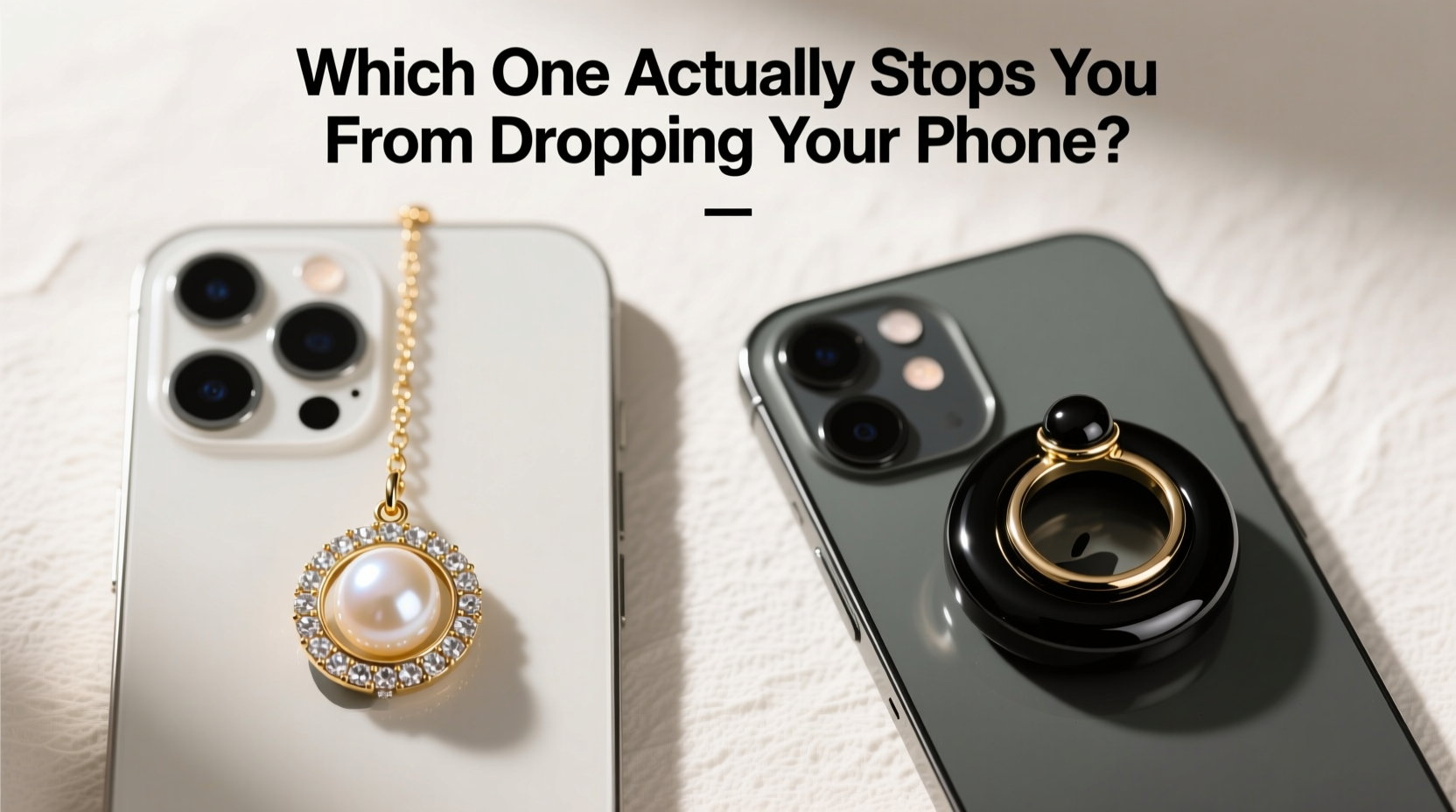
Pearl phone charms have surged in popularity thanks to social media influencers and boutique accessory brands. Often made with faux pearls, rhinestones, or enamel pendants, they attach via adhesive-backed loops or silicone straps around the phone case. Their appeal lies in customization — matching outfits, expressing personality, or elevating minimalistic devices.
Functionally, they act as subtle counterweights. When attached near the top edge of a phone, the dangling charm shifts center of gravity slightly downward, potentially making the phone feel more balanced in hand. Some users report that the texture or length of the charm gives them something to hook a pinky finger around, adding passive stability.
However, this benefit is inconsistent. Lightweight charms offer negligible grip improvement. Heavier ones may improve balance but increase strain over prolonged use. More critically, the attachment method is often the weakest link. Adhesive mounts degrade over time, especially with temperature changes or frequent removal for charging.
Ring Holders: Engineered for Grip, Sometimes at the Cost of Style
Ring holders, also known as kickstands or finger grips, are small metal or plastic rings mounted directly onto the back of a phone or case. They swivel or fold flat, serving dual purposes: providing a finger loop for secure holding and acting as a stand for media viewing.
Mechanically, they win on functionality. By allowing a user to thread a finger through the ring, they create a physical tether. Even if the phone slips from the palm, it remains suspended from the finger. Independent stress tests show that properly installed ring holders can withstand pull forces up to 15 pounds — far exceeding typical drop scenarios.
Where they falter is in design flexibility. Many standard models feature utilitarian finishes — brushed aluminum, matte black plastic — that clash with delicate aesthetics. However, newer iterations include customizable faceplates, rose gold finishes, and even gemstone accents, bridging the gap between utility and elegance.
Real-World Example: The Commuter Test
Sophie, a graphic designer in Brooklyn, tested both options over six weeks. She used a pearl charm during her first month, attaching a dainty ivory strand to her clear case. While she loved the look, she dropped her phone twice — once stepping off the train, once juggling groceries. Switching to a slim rose-gold ring holder, she reported immediate improvement. “It feels like I have a handle,” she said. “Even when my hands are full, I don’t panic.” She later upgraded to a model with a crystal inlay that matched her jewelry, maintaining cohesion in her style.
Direct Comparison: Pearl Charm vs Ring Holder
| Feature | Pearl Phone Charm | Ring Holder |
|---|---|---|
| DROP PREVENTION | Limited – depends on charm weight and grip technique | High – creates physical finger anchor |
| DURABILITY | Low to medium – adhesives weaken over time | High – sturdy materials, long-term mounting |
| STYLE FLEXIBILITY | Very high – wide range of designs, colors, themes | Medium – improving, but limited by functional shape |
| PORTABILITY IMPACT | Minimal – adds slight bulk | Moderate – ring may protrude, affects wireless charging alignment |
| ADDITIONAL FUNCTIONS | None | Kickstand for videos, doubles as wallet (some models) |
| EASE OF INSTALLATION | Easy – peel-and-stick or clip-on | Easy, but permanent adhesive risks residue on removal |
How to Choose Based on Your Lifestyle
Your ideal choice depends less on universal performance and more on daily habits. Consider these factors before deciding:
- Phone size: Larger phones (6.5 inches and above) benefit more from ring holders due to increased surface area and weight.
- Usage environment: If you’re often on public transit, in crowded spaces, or carrying items frequently, a ring holder offers superior peace of mind.
- Fashion priority: For those who coordinate accessories meticulously, pearl charms integrate seamlessly into curated aesthetics.
- Case compatibility: Some cases lack flat surfaces for secure ring holder adhesion. Charms work with most, though bulky cases may obscure their visibility.
Actionable Checklist: Choosing the Right Accessory
- Assess your drop history — how often do you fumble your phone?
- Determine your primary use case: media consumption, texting, photography?
- Check if your current case supports strong adhesive mounting.
- Decide whether you value multi-functionality (e.g., kickstand) over pure decoration.
- Try temporary options first — some brands offer magnetic or clip-on versions to test before committing.
Can You Have Both? Hybrid Solutions Are Emerging
Recognizing the demand for form and function, several brands now offer hybrid designs. These combine a minimalist ring holder base with interchangeable decorative tops — including pearl clusters, charms, or monogram plates. For example, the LuxGrip Pro line allows users to swap out the ring faceplate weekly, aligning with different outfits or moods.
These hybrids address the core weakness of standalone charms: lack of structural security. The ring provides the grip; the charm adds personality. While slightly bulkier than a simple pendant, they represent the best compromise for style-conscious users who refuse to sacrifice safety.
Frequently Asked Questions
Do pearl phone charms damage my phone or case?
Generally, no — if properly installed. Silicone band models pose almost zero risk. Adhesive-based charms may leave residue or lift paint on certain coated cases over time, especially with heat exposure. Always clean the surface before application and avoid placing near ports or buttons.
Can a ring holder interfere with wireless charging?
Yes, sometimes. If the ring is thick or centrally located, it can prevent flush contact with the charger. Opt for low-profile, edge-mounted models if you rely heavily on Qi charging. Some users remove their phone from the case at night — a minor trade-off for uninterrupted power.
Are there any health concerns with using ring holders?
Rarely, but prolonged use with tight finger looping may contribute to hand fatigue or pressure on tendons. Avoid over-tightening your grip and take breaks during extended use. People with arthritis or carpal tunnel should test comfort carefully.
Final Verdict: Function Wins, But Style Isn’t Out
If preventing drops is your primary goal, the ring holder is objectively superior. It transforms how you hold your phone, offering a mechanical safeguard that a dangling charm simply cannot match. Its effectiveness is measurable, consistent, and backed by ergonomic research.
That said, pearl charms excel in self-expression and subtlety. For users with smaller phones, steady hands, or lower-risk routines, they offer a graceful enhancement without compromising portability.
The future belongs to hybrids — accessories that merge engineering with elegance. Until then, prioritize based on need: choose the ring holder if you’ve lost a screen to gravity more than once; embrace the charm if your phone stays mostly in hand and your aesthetic demands attention.




 浙公网安备
33010002000092号
浙公网安备
33010002000092号 浙B2-20120091-4
Comments
No comments yet. Why don't you start the discussion?