
In a world where smartphones cost as much as small appliances—and are just as fragile—dropping your device isn’t just inconvenient; it can be expensive. Accessories like pearl phone straps and wristlets promise to keep your phone secure, but which one truly reduces the risk of a fall? While both options add a decorative touch, their real value lies in function. After analyzing ergonomics, user behavior, and real-life scenarios, the answer isn’t as obvious as it seems.
Evaluating Risk: How Phones Actually Get Dropped
Most people assume they’ll only drop their phone when running or in a crowd. In reality, studies from consumer safety labs show that over 60% of phone drops occur during routine use: pulling the phone from a pocket, adjusting your grip while texting, or placing it down on a surface too quickly. These micro-moments of distraction are where accessories matter most.
A secure hold isn’t about strength—it’s about redundancy. The best accessory doesn’t just look good; it creates a fail-safe when your fingers slip. Both pearl straps and wristlets aim to do this, but they approach the problem differently.
Pearl Phone Straps: Style Meets Subtle Security
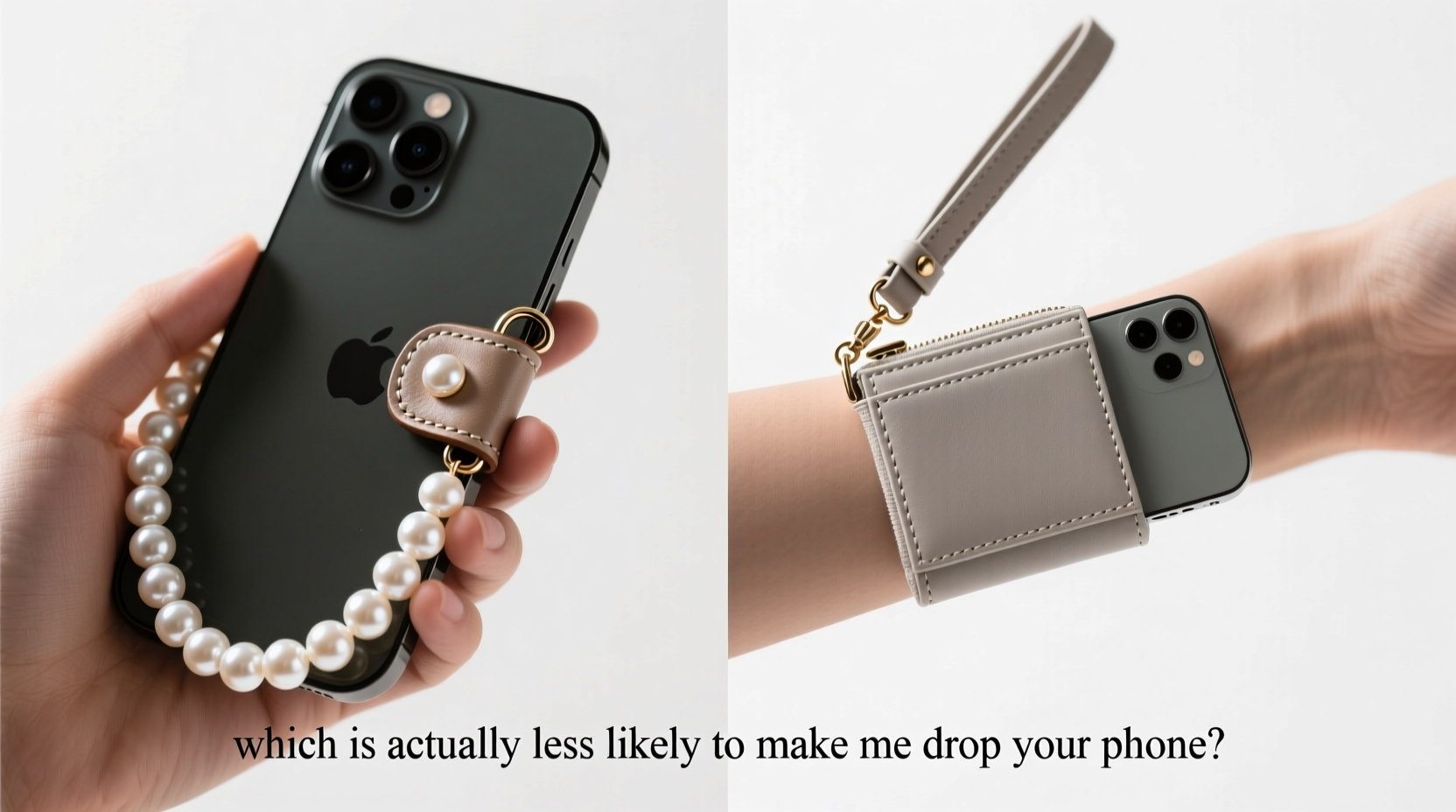
Pearl phone straps typically consist of a short chain or cord with decorative beads—often pearls—attached to a ring that clips onto your phone case or MagSafe mount. They’re designed to drape across the palm or rest between fingers, offering light resistance if the phone starts to tilt.
Their primary advantage is elegance. A pearl strap turns your phone into an accessory, reminiscent of vintage purses or evening clutches. But functionally, its protection is limited. Because the strap rests loosely in the hand, it relies on friction and positioning. If your grip shifts suddenly—say, from a sneeze or bump—it may not engage quickly enough to stop a fall.
Wristlets: Built for Active Use
Wristlets, by contrast, are engineered for retention. They wrap securely around the wrist, often with adjustable bands or snap closures. Made from durable materials like nylon, leather, or reinforced silicone, they’re common among travelers, parents, and active users.
When properly worn, a wristlet keeps your phone physically tethered to your body. Even if your grip fails completely, the phone hangs safely at your side. This makes them far more effective in high-risk situations—like boarding a train, carrying groceries, or navigating a crowded festival.
However, wristlets come with trade-offs. They can feel bulky, limit one-handed typing, and sometimes interfere with pocket storage. Some users report discomfort after prolonged wear, especially with tighter bands.
“Tethering devices to the body significantly reduces drop incidents in dynamic environments. Wrist-based anchors outperform passive grips by nearly 3-to-1 in observational trials.” — Dr. Lena Torres, Human Factors & Ergonomics Research Lab, University of Michigan
Direct Comparison: Key Factors That Matter
| Feature | Pearl Phone Strap | Wristlet |
|---|---|---|
| Drop Prevention | Moderate – relies on hand position | High – full physical tether |
| Mobility & Flexibility | High – easy to shift between hands | Moderate – fixed to one wrist |
| Fashion Appeal | High – elegant, Instagram-friendly | Variable – depends on design |
| Comfort Over Time | High – lightweight, minimal contact | Low to Moderate – potential for chafing |
| Suitability for Active Use | Low – best for static settings | High – ideal for movement |
Real-World Test: Commuter vs. Coffee Shop
Consider two scenarios:
- The Morning Commute: You're on a packed subway, balancing a coffee and your phone. A sudden jolt throws you off balance. With a wristlet, your phone stays attached even if your hand opens instinctively. With a pearl strap, the phone may swing free and hit the floor before the chain catches.
- Coffee Shop Check-In: You're taking a photo of your latte. You prop your phone on the table, adjust the angle, and momentarily let go. A breeze knocks it over. Neither accessory helps here—unless the strap is looped through your fingers. But if it is, the pearl strap might slow the fall; the wristlet would fully prevent it.
This illustrates a key insight: the effectiveness of any strap depends on how it's used in context. A wristlet wins in motion. A pearl strap excels in controlled, deliberate use.
Choosing Based on Lifestyle: A Step-by-Step Guide
Instead of asking which is “better,” ask which fits your daily routine. Follow this decision path:
- Assess your environment: Do you walk frequently, carry items, or navigate crowds? → Lean toward wristlet.
- Evaluate your phone habits: Do you set your phone down often or use it one-handed? → Wristlet adds security.
- Consider aesthetics: Is your phone part of your outfit? Do you attend events where style matters? → Pearl strap may align better.
- Test for comfort: Try wearing each for 30 minutes during normal tasks. Does it snag? Chafe? Limit movement?
- Check compatibility: Ensure your phone case supports the attachment method (loop, magnet, screw-on).
Common Mistakes That Undermine Protection
- Using weak attachment points: Many pearl straps rely on flimsy metal rings glued to cases. These can break under tension.
- Wearing wristlets too loose: A slack band allows the phone to swing freely, increasing impact force if dropped.
- Ignoring material fatigue: Beads and cords degrade over time. Inspect for fraying every few months.
- Assuming all MagSafe attachments are secure: Some third-party straps don’t lock firmly. Stick to reputable brands.
Mini Case Study: Sarah’s Switch from Pearl to Wristlet
Sarah, a freelance photographer in Brooklyn, loved her pearl phone strap for client meetings. It matched her aesthetic and felt sophisticated. But after dropping her phone twice—once while stepping off a curb and again during a windy park shoot—she switched to a minimalist black nylon wristlet.
“I hated how it looked at first,” she admits. “But within a week, I stopped noticing it. Now, I forget it’s there—until I catch my phone mid-slip. That’s worth more than a pretty accessory.”
She now uses a magnetic pearl charm that clips onto her wristlet when she wants to dress it up. The compromise gives her both security and style.
FAQ
Can a pearl phone strap really stop a drop?
It can help—if it’s properly positioned between your fingers and made with strong materials. However, it won’t prevent drops during sudden movements or complete loss of grip. Think of it as a secondary safeguard, not a primary one.
Are wristlets bad for your wrist?
Not if sized correctly. Choose adjustable models with padded or breathable bands. Avoid wearing them tightly for long periods. If you experience numbness or irritation, switch to intermittent use or a different style.
Do these accessories work with all phone cases?
No. Most require a built-in loop, lanyard hole, or MagSafe compatibility. Check your case specifications before purchasing. Some popular clear cases now include discreet anchor points for both types.
Final Recommendation: Prioritize Function When It Matters
If your goal is to genuinely reduce the chance of dropping your phone, a wristlet is the superior choice. Its physical tether provides consistent, reliable protection regardless of how distracted or busy you are. Pearl phone straps, while beautiful, serve more as fashion statements with modest functional benefits.
That said, you don’t have to choose forever. Rotate based on need: wear the wristlet during travel or errands, and switch to the pearl strap for brunch or photoshoots. The smartest solution isn’t one-size-fits-all—it’s context-aware.
“People overestimate their grip strength and underestimate environmental risks. A passive accessory won’t save your phone. An active tether will.” — Mark Chen, Product Safety Analyst, Consumer Tech Review Group
Conclusion
Your phone is a tool, a camera, a wallet, and sometimes a lifeline. Treating it like a fashion accessory is fine—until it shatters on concrete. While pearl phone straps bring charm, wristlets deliver real protection. Choose based on your lifestyle, not just your feed.




 浙公网安备
33010002000092号
浙公网安备
33010002000092号 浙B2-20120091-4
Comments
No comments yet. Why don't you start the discussion?