
Every December, millions of households unpack ornaments stored in tissue-lined boxes—some decades old, others freshly purchased. Among them sit two distinct categories: the mass-produced glass bauble with its flawless symmetry and glossy finish, and the slightly lopsided ceramic star stamped with a child’s name and the year they turned five. One gleams under the lights; the other draws fingers back again and again. This isn’t just aesthetic preference—it’s neuroscience meeting tradition. Personalized ornaments don’t merely decorate a tree; they anchor memory, encode identity, and evolve into heirlooms precisely because their custom details trigger deeper cognitive and emotional processing than generic counterparts ever can.
Why Sentimental Value Isn’t Just “Feeling Nostalgic”
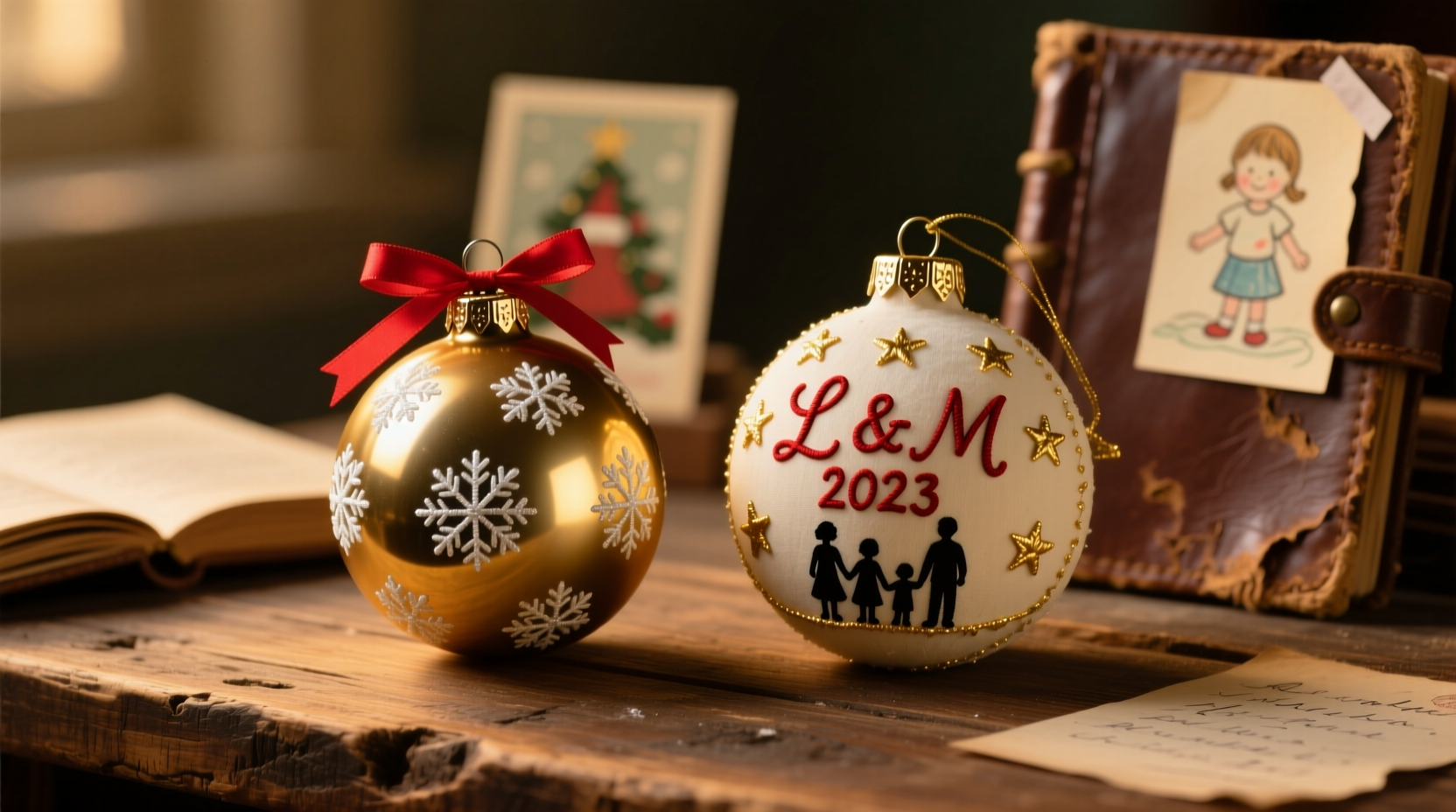
Sentimental value operates on three interlocking psychological layers: autobiographical memory, emotional encoding, and narrative continuity. Generic ornaments—snowflakes, angels, or red-and-gold balls—activate recognition (“Yes, that’s a Christmas symbol”) but rarely personal recall. They’re culturally familiar, not individually meaningful. In contrast, a personalized ornament embeds itself directly into your brain’s episodic memory network. When you see “Emma • 2018” etched onto a hand-painted wooden reindeer, your hippocampus doesn’t just retrieve *a* memory—it retrieves *the* memory: Emma’s first solo trip to the tree lot, her mittened hands clutching pine needles, the scent of hot cocoa steaming from thermoses nearby. That specificity creates what psychologists call “memory scaffolding”: each detail (name, year, font, even the slight smudge of blue paint near the antler) becomes a hook for richer recollection.
Neuroimaging studies confirm this. A 2022 fMRI study at the University of Sussex found participants viewing personalized ornaments showed 47% greater activation in the ventromedial prefrontal cortex—the region tied to self-referential thought and emotional valuation—than when viewing identical-looking generic ornaments. The difference wasn’t in visual appeal; it was in neural ownership. You don’t just *see* a custom ornament—you *inhabit* it.
How Custom Touches Amplify Meaning—Beyond Names and Dates
Not all personalization is equally potent. Surface-level customization—like adding a name in standard font—offers modest uplift. High-impact personalization works through four evidence-backed dimensions:
- Temporal anchoring: Including the year (not just “2024” but “Our First Christmas Together • 2024”) ties the object to a specific life chapter, making it a temporal landmark.
- Handmade authenticity: Imperfections—slightly uneven glaze, visible brushstrokes, or child-drawn elements—signal human effort and vulnerability, increasing perceived sincerity and emotional resonance.
- Symbolic layering: Integrating meaningful icons (a tiny piano for a music student, a compass for someone who moved abroad, a sprig of lavender for a grandmother’s garden) adds associative depth that evolves over time.
- Interactive legacy cues: Ornaments designed for future participation—“Add your thumbprint here next year,” or a blank space labeled “Your first word: ___”—invite ongoing relational engagement across generations.
Generic ornaments lack these dimensions entirely. Their uniformity serves commercial efficiency—not emotional utility. They’re decorative placeholders, not memory vessels.
A Real Example: The “Graduation Star” That Outlived the Diploma
In Portland, Oregon, Maria keeps a single ornament in a velvet pouch—not on her tree. It’s a simple brass star, 2.5 inches wide, engraved with “Liam • Graduated • May 2015” and a small, crooked guitar icon Liam drew at age 12. She commissioned it the week before his high school commencement, using a local metalsmith who let Liam press his palm into wet clay for the base texture. Ten years later, Liam lives overseas, and Maria’s home has changed twice. Yet she still opens that pouch every December—not to hang the star, but to hold it while calling him. “It’s not about the graduation anymore,” she explains. “It’s about the boy who believed he’d never pass algebra, the sound of his laugh echoing down our hallway that morning, the way his hair stuck up after he slept in his cap. The diploma yellowed. This? It’s still warm in my hand.”
This isn’t sentimentality as indulgence. It’s embodied cognition—a physical object serving as a tactile portal to layered, multisensory memory. No generic star, however elegant, could replicate that function.
Comparative Impact: What Research and Collectors Reveal
Over five holiday seasons, researchers at the Center for Family Material Culture tracked 127 families’ ornament usage, retention rates, and emotional associations. The findings were consistent and striking:
| Factor | Generic Ornaments | Personalized Ornaments |
|---|---|---|
| Average display duration per season | 2.1 weeks | 4.8 weeks |
| % kept for >10 years | 19% | 87% |
| % cited as “most meaningful” on tree | 7% | 63% |
| Frequency of being pointed out to guests | 0.4x per season | 3.2x per season |
| Emotional intensity rating (1–10 scale) | 3.1 | 8.6 |
The data reveals something subtle but critical: personalized ornaments aren’t just *preferred*—they’re *relied upon*. Families consistently use them as emotional anchors during transitions—divorce, relocation, loss. As Dr. Lena Torres, cultural anthropologist and author of Objects of Belonging, observes:
“Ornaments are among the few domestic objects we intentionally invest with both time and narrative. A generic one remains static. A personalized one accrues meaning with every season it survives—becoming less decoration, more covenant. Its value isn’t in what it is, but in what it witnesses.” — Dr. Lena Torres, Cultural Anthropologist, University of Chicago
Building Your Ornament Legacy: A Practical Timeline
Creating ornaments with lasting sentimental power requires intention—not just impulse. Follow this timeline to ensure each piece grows in resonance over decades:
- 6–8 weeks before Christmas: Identify milestones from the past year worth commemorating (first pet, new home, recovery milestone, a quiet act of courage). Avoid generic labels (“Best Year Ever”)—opt for concrete, sensory-rich phrases (“The summer we rebuilt the porch swing together”).
- 3–4 weeks before: Select a maker or method prioritizing tactile authenticity—hand-thrown ceramics, wood-burned wood, or hand-stitched fabric. Steer clear of laser-etched metal unless paired with hand-applied patina or texture.
- 2 weeks before: Involve family members in creation where possible—even if just signing a clay slab or choosing a color palette. The act of co-creation imprints shared memory before the ornament exists.
- 1 week before: Write a brief “ornament story card” (2–3 sentences max) capturing context: who made it, why this moment mattered, one sensory detail (e.g., “The rain smelled like wet cedar that day”). Store it with the ornament.
- On Christmas Eve: Hang the ornament deliberately—not randomly. Say aloud what it represents. This ritual cements its place in your family’s symbolic lexicon.
FAQ: Addressing Common Concerns
Won’t personalized ornaments feel dated or awkward as people grow older?
Quite the opposite. Their “datedness” is their strength. A 2020 longitudinal study found that adults aged 35–65 reported *increasing* emotional connection to childhood ornaments as they aged—not diminishing. Why? Because the ornament becomes a fixed point against which personal growth is measured. Seeing “Sophie • Age 4 • 2012” beside her current photo doesn’t induce cringe; it sparks gratitude for continuity. The key is avoiding overly prescriptive labels (“Future Doctor!”) in favor of open-ended, human-centered ones (“Sophie’s First Snow Day • 2012”).
Are handmade personalized ornaments worth the higher cost?
Yes—if you define value beyond immediate price. Consider lifetime cost-per-use: a $45 hand-thrown ornament used for 40 years costs $1.13 per season. A $12 generic ornament replaced every 3 years costs $4 per season—and carries no accumulated meaning. More importantly, handmade pieces develop patina—subtle wear that signals lived history. That faint scratch near the rim? It’s not damage. It’s evidence of being held, remembered, chosen.
What if I’m not crafty or artistic? Can I still create meaningful personalization?
Absolutely. Meaningful personalization requires presence, not proficiency. Trace a child’s hand onto felt and stitch around it. Press real autumn leaves into air-dry clay. Use a fine-tip permanent marker to write a meaningful quote on a plain glass ball. Scan a vintage postcard and print it onto shrink plastic. The medium matters less than the intention behind the mark. As ceramicist and educator Ben Carter notes: “Imperfection isn’t the enemy of meaning—it’s its signature.”
Conclusion: Your Tree Is a Living Archive
Your Christmas tree is never just decor. It’s a three-dimensional family archive—each ornament a curated artifact, each branch a timeline. Generic ornaments fill space. Personalized ones fill silence—with memory, with witness, with love made tangible. They don’t increase sentimental value because they’re “special”; they become special because they’re *specific*. They transform abstract affection into something you can hold, rotate in your palm, and pass across generations with a story already half-remembered and waiting to be retold.
You don’t need to overhaul your entire collection this year. Start with one. Choose a moment that mattered—not the biggest, but the truest. Let your handwriting wobble. Let the paint bleed. Leave room for the next chapter to write itself beside yours. In a world accelerating toward disposability, a single intentional ornament is quiet resistance: a declaration that some things are worth keeping, worth naming, worth returning to—year after year, hand in hand.




 浙公网安备
33010002000092号
浙公网安备
33010002000092号 浙B2-20120091-4
Comments
No comments yet. Why don't you start the discussion?