
The smartphone market moves fast, and what felt cutting-edge two years ago can seem outdated today. If you're still using a Google Pixel 3, you might be wondering whether upgrading to a Samsung Galaxy S20 — or any device from that generation — is truly worth the investment. The Pixel 3 was praised for its clean software, excellent camera, and strong AI features, while the S20 brought flagship specs like 5G, high-refresh-rate displays, and triple-camera setups. But does raw power always translate to better daily use?
This isn’t just about megapixels or processor speeds. It’s about real-world performance, longevity, software support, and whether the upgrade delivers meaningful improvements for your lifestyle.
Performance & Hardware: A Generational Leap
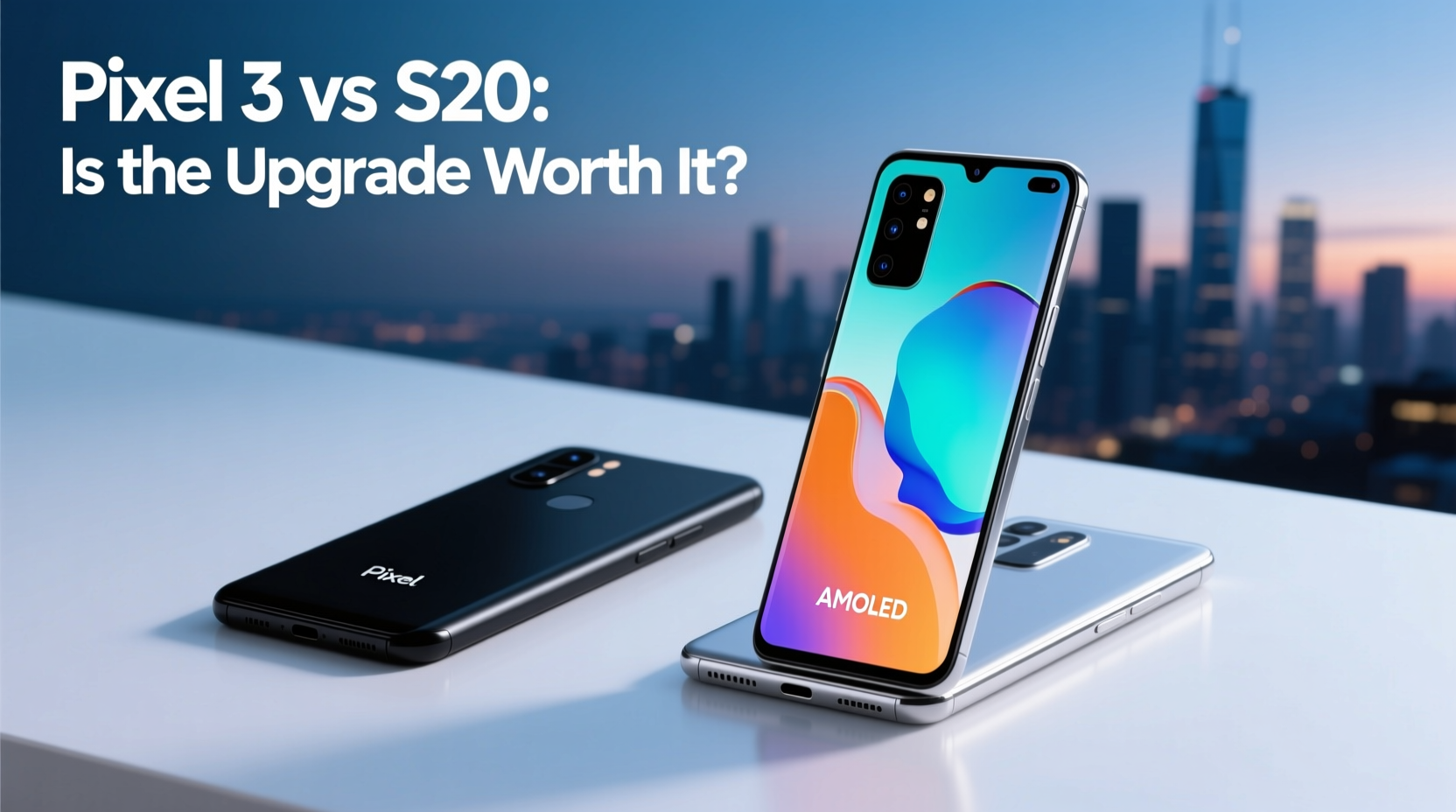
The Pixel 3 launched in 2018 with the Qualcomm Snapdragon 845, which was top-tier at the time. By 2020, the Galaxy S20 arrived with the more powerful Snapdragon 865 (or Exynos 990 in some regions), offering a 25–30% improvement in CPU and GPU performance. This translates to smoother multitasking, faster app launches, and better gaming performance.
Beyond the chipset, the S20 introduced a 120Hz refresh rate display, a feature absent on the Pixel 3’s 60Hz screen. Scrolling feels noticeably smoother, and animations are more fluid. However, many users report that after initial excitement, they often switch back to 60Hz to preserve battery life.
RAM is another differentiator. The Pixel 3 came with 4GB, which was sufficient for stock Android but could struggle with heavy multitasking. The S20 started at 8GB, allowing for more background apps and future-proofing against increasingly demanding software.
Camera Comparison: Quality vs Quantity
The Pixel 3 set a new standard for computational photography. Despite having only a single rear camera (plus a secondary ultra-wide on the XL), it consistently outperformed devices with multiple lenses thanks to Google’s HDR+ and Night Sight algorithms. Its portrait mode and low-light performance were industry-leading.
The S20, by contrast, features a triple-camera system: 12MP wide, 64MP telephoto, and 12MP ultra-wide. On paper, this gives it more versatility. You get 3x hybrid zoom and up to 30x digital zoom, which the Pixel 3 lacks entirely. However, zoomed photos often appear soft or overly processed.
In daylight, both phones produce excellent results, but the S20 offers more flexibility with framing due to its ultra-wide lens. In low light, the Pixel 3 still holds up remarkably well, especially for point-and-shoot scenarios where simplicity matters.
“Google’s software-driven approach proves that hardware quantity doesn’t always beat quality processing.” — Mark Roper, Mobile Imaging Analyst at DXOMARK
Battery Life and Charging: Real-World Endurance
The Pixel 3 has a modest 2,915mAh battery, which barely lasted a full day for heavy users. Fast charging helps, but wireless charging is limited to 10W, and reverse charging isn’t supported.
The S20 packs a 4,000mAh battery — nearly 40% larger — and supports 25W fast charging, 15W wireless charging, and even reverse wireless charging. In practice, this means the S20 easily lasts a full day, even with 5G and 120Hz enabled, and charges significantly faster.
If your current frustration with the Pixel 3 is running out of juice by mid-afternoon, the S20 solves that problem decisively.
Software Experience and Longevity
One of the biggest advantages of the Pixel 3 was guaranteed Android updates for three years, including timely security patches. While it received Android 11 as its final major OS update, it no longer receives official support, making it vulnerable to newer threats and incompatible with some modern apps.
The S20 series was promised four years of OS upgrades and five years of security updates. As of 2024, most S20 models have reached end-of-life, but during their supported lifespan, they offered longer software relevance than the Pixel 3.
Stock Android fans may miss the clean interface of the Pixel, but Samsung’s One UI has matured considerably, offering deep customization without bloat. Features like DeX, enhanced privacy controls, and better split-screen multitasking give the S20 an edge for productivity.
Detailed Feature Comparison
| Feature | Google Pixel 3 | Samsung Galaxy S20 |
|---|---|---|
| Release Year | 2018 | 2020 |
| Processor | Snapdragon 845 | Snapdragon 865 / Exynos 990 |
| RAM | 4GB | 8GB / 12GB |
| Display | 5.5\", 1080p, 60Hz OLED | 6.2\", 1440p, 120Hz Dynamic AMOLED |
| Rear Cameras | 12.2MP (main) | 12MP (main) + 64MP (tele) + 12MP (ultra-wide) |
| Front Camera | 8MP | 10MP |
| Battery | 2,915mAh | 4,000mAh |
| Charging | 18W wired, 10W wireless | 25W wired, 15W wireless, reverse charging |
| OS Support | Ended (last: Android 11) | Ended (last: Android 14) |
| Water Resistance | IP67 | IP68 |
Real-World Scenario: Should You Upgrade?
Consider Sarah, a freelance photographer who used her Pixel 3 for four years. She loved the camera’s consistency and the pure Android experience. But by 2022, she noticed apps loading slower, battery draining faster, and newer editing tools failing to run smoothly. She upgraded to an S20 (refurbished) for under $300.
Her workflow improved immediately: faster export times, better multitasking between Lightroom and messaging apps, and the ability to shoot in higher resolution with more zoom options. While she missed some Pixel-exclusive features like Call Screen, the overall performance gain made the transition worthwhile.
For users like Sarah — those pushing their phone beyond basic tasks — the upgrade pays off. But if you mostly browse, message, and take occasional photos, the Pixel 3 might still suffice, especially if you’ve optimized settings for performance.
Upgrade Checklist: Is the S20 Right for You?
- ✅ Need longer battery life and faster charging?
- ✅ Want better multitasking and app responsiveness?
- ✅ Value zoom, ultra-wide shots, or 8K video recording?
- ✅ Use your phone for productivity (DeX, split-screen, etc.)?
- ✅ Prioritize hardware durability and IP68 water resistance?
If you answered yes to three or more, the S20 represents a tangible upgrade. If not, consider whether a mid-range 2023–2024 device might offer better value today.
Frequently Asked Questions
Can the Pixel 3 still handle everyday tasks in 2024?
Yes, but with caveats. Basic functions like calling, texting, and light browsing work, but app load times are slower, and newer apps may not be optimized. Security risks increase without updates.
Is the S20 camera better than the Pixel 3’s?
In versatility, yes — especially with zoom and ultra-wide capabilities. However, the Pixel 3 still produces excellent point-and-shoot photos, particularly in low light, thanks to superior software processing.
Should I upgrade directly from Pixel 3 to a newer model instead?
Absolutely. If budget allows, skipping to a Pixel 6 or later (or Samsung S21/S22+) gives far greater longevity, ongoing software support, and modern features like face unlock, improved biometrics, and 5G efficiency.
Final Verdict: Is Upgrading Worth It?
Upgrading from a Pixel 3 to an S20 is objectively a significant step forward in hardware, battery, and camera flexibility. The S20 delivers a more modern smartphone experience — one that handles multitasking, media consumption, and photography with greater ease.
However, “worth it” depends on your needs and expectations. If you’re frustrated with sluggish performance or short battery life, the upgrade makes sense — especially if purchasing secondhand. But if you're already considering newer models, the S20 might feel outdated itself, lacking long-term support and efficient 5G.




 浙公网安备
33010002000092号
浙公网安备
33010002000092号 浙B2-20120091-4
Comments
No comments yet. Why don't you start the discussion?