
In 2018 and early 2019, smartphone photography entered a pivotal phase. The Google Pixel 3 XL had redefined what consumers expected from a single rear camera, relying on advanced computational photography rather than hardware excess. Meanwhile, Samsung’s Galaxy S10 arrived as the flagship of a brand long known for packing high-megapixel sensors, multiple lenses, and optical innovations. But when it came to real-world photo quality—especially in challenging lighting—did Samsung finally close the gap with Google’s AI-driven magic?
This question isn’t just nostalgic. It marks a turning point in mobile imaging: the moment hardware met software head-on, and software began winning. To understand whether Samsung caught up, we need to examine not just specs, but results—how each phone handled dynamic range, night photography, portrait mode, and color science under everyday conditions.
The Rise of Computational Photography
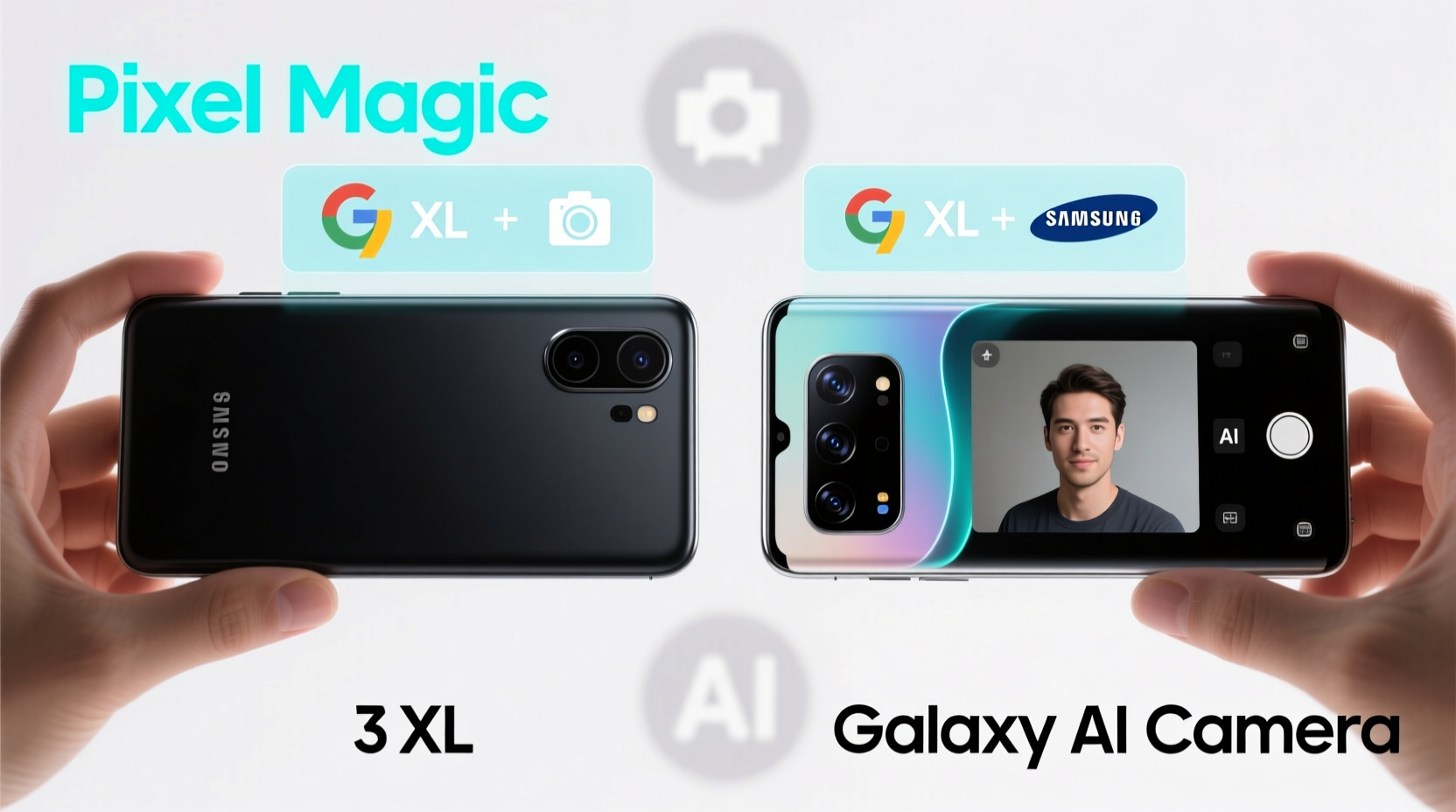
Before comparing the two devices, it’s essential to recognize the paradigm shift introduced by Google. While competitors focused on adding more cameras and higher megapixels, Google invested heavily in machine learning, HDR+, and multi-frame processing. The Pixel 3 XL, despite having only a single 12.2MP rear sensor, consistently outperformed phones with triple-lens arrays thanks to its superior software pipeline.
Google’s approach relied on capturing multiple frames at different exposures, aligning them using AI, and merging them into a final image with exceptional dynamic range and noise suppression. This technique allowed the Pixel 3 XL to retain detail in shadows and highlights far better than most rivals at the time.
“Google didn’t win because of better hardware—it won by treating the camera as a computing problem.” — Dr. Lin Xiao, Imaging Technology Analyst at DisplayMate
Samsung, historically strong in display and sensor technology, had been slower to prioritize software optimization. The Galaxy S10, launched in March 2019, featured a triple rear camera setup: 12MP main (f/1.5–f/2.4), 12MP telephoto (f/2.4), and 16MP ultra-wide (f/2.2). On paper, this was a significant advantage over the Pixel’s lone lens. But real-world performance told a more nuanced story.
Low-Light Performance: Night Sight vs. Night Mode
One of the most dramatic battlegrounds was low-light photography. The Pixel 3 XL introduced Night Sight in late 2018—a feature that could brighten dark scenes without flash, preserving natural colors and minimizing noise. By holding the phone steady (or placing it on a surface), users could capture surprisingly clear images in near-darkness.
Samsung responded with its own “Night Mode” on the Galaxy S10, which also used multi-frame exposure stacking. However, early versions were inconsistent. In direct comparisons, the Pixel often produced cleaner shadows, more accurate white balance, and less smudging in fine details like tree branches or text on signs.
The S10’s variable aperture (f/1.5–f/2.4) helped in very dim environments by letting in more light, but Samsung’s noise reduction algorithms tended to oversmooth textures, giving photos a plastic look. The Pixel, meanwhile, preserved grain in a way that felt more organic—even artistic.
Daylight and Dynamic Range Comparison
In well-lit conditions, both phones delivered excellent results, but with distinct styles. The Galaxy S10 favored vibrant, saturated colors—a hallmark of Samsung’s AMOLED tuning. Skies appeared deeper blue, greens more lush, and skin tones slightly warmed. While pleasing to some, this could veer into artificial territory, especially in high-contrast scenes.
The Pixel 3 XL took a more neutral, documentary-style approach. Colors were accurate rather than exaggerated. More importantly, its HDR+ processing excelled at balancing bright skies with shadowed foregrounds, often retaining detail where the S10 would blow out highlights or crush dark areas.
| Feature | Pixel 3 XL | Galaxy S10 |
|---|---|---|
| Main Sensor | 12.2MP, f/1.8, 1.4µm pixels | 12MP, f/1.5–2.4, 1.4µm pixels |
| Additional Lenses | None (rear) | Telephoto + Ultra-Wide |
| Night Mode Quality | Excellent detail, natural tone | Good brightness, softer textures |
| Dynamic Range | Best-in-class (2018–2019) | Very good, occasional clipping |
| Portrait Mode Edge Detection | Precise, minimal errors | Occasional hair or background mistakes |
Portrait Mode and Depth Accuracy
The Galaxy S10’s dual-aperture main lens and dedicated telephoto sensor gave it a hardware edge in portrait photography. It could simulate optical zoom and offered depth control after shooting. However, edge detection—the ability to separate subject from background—was where the Pixel often shined.
Thanks to its machine learning models trained on vast datasets, the Pixel 3 XL handled complex edges (like flyaway hair or glasses) with remarkable precision, even with just one camera. The S10, while generally good, sometimes struggled with fine details, creating halos or incorrectly blurring parts of the subject.
Moreover, the Pixel’s portrait mode included an innovative “Top Shot” feature that captured moments before and after shutter press, using AI to suggest the best facial expressions—something Samsung lacked at launch.
Mini Case Study: Street Photography in Barcelona
A travel photographer tested both phones during a week-long trip through Barcelona in spring 2019. Shooting narrow alleys with harsh sunlight and deep shadows, they found the Pixel 3 XL required fewer adjustments post-capture. One image of a street musician in a shaded plaza retained texture in his wool coat and clarity in the guitar strings—details lost in the S10’s version, where shadows were lifted but muddied.
However, when photographing the Sagrada Família from a distance, the S10’s telephoto lens provided a tighter composition without digital zoom degradation. The ultra-wide also proved useful for tight interior shots in Gothic churches, where stepping back wasn’t possible.
Verdict? The Pixel won on image fidelity; the S10 on versatility.
Did Samsung Catch Up?
By mid-2019, Samsung had improved its software significantly. Firmware updates refined Night Mode and enhanced HDR processing. Yet, independent reviews from DxOMark and tech journalists still ranked the Pixel 3 XL ahead in overall photo consistency, particularly in mixed lighting and indoor scenarios.
Samsung didn’t truly match Google’s computational lead until the Galaxy S20 series in 2020, when it adopted more aggressive AI processing, better alignment algorithms, and learned from Google’s success in prioritizing software over sheer hardware count.
In essence: no, the Galaxy S10 did not fully catch up to the Pixel 3 XL’s camera magic. It competed closely in specific areas—zoom, wide-angle coverage, and video stabilization—but fell short in the core aspects of still photography: dynamic range, color accuracy, and intelligent exposure decisions.
Actionable Checklist: Maximizing Camera Performance on Either Device
- Enable HDR+ (Pixel) or HDR (S10) for outdoor shots with bright skies
- Use Night Mode only when hands are steady or phone is supported
- Avoid digital zoom on the Pixel; rely on cropping if necessary
- Leverage the S10’s ultra-wide lens for architecture or group shots
- Shoot in Pro mode to manually adjust white balance and exposure
- Keep lenses clean—grease spots severely impact HDR processing
Frequently Asked Questions
Can the Galaxy S10 beat the Pixel 3 XL in any camera category?
Yes. The S10 offers a telephoto lens for 2x optical zoom and an ultra-wide lens (123° field of view), neither of which the Pixel 3 XL has. For variety in framing, the S10 provides more flexibility.
Is the Pixel 3 XL still worth using for photography in 2024?
As a daily driver, probably not—battery degradation and lack of updates are concerns. But for pure photo quality in daylight and decent low-light shots, its computational engine still holds up remarkably well, especially if you value natural color reproduction.
Why did Google succeed where others failed?
Google treated photography as a data problem. Its team used machine learning to train models on millions of images, optimizing for perceptual quality—not just technical metrics. Competitors were focused on hardware arms races, while Google optimized the entire image-processing stack from capture to output.
Conclusion: The Legacy of a Camera Rivalry
The battle between the Pixel 3 XL and Galaxy S10 wasn’t just about megapixels or lenses—it was a clash of philosophies. Google proved that smart software could outshine powerful hardware. Samsung, while offering more tools, hadn’t yet mastered the invisible art of computational harmony.
Today, every major manufacturer uses AI-enhanced photography because of what Google demonstrated with the Pixel 3 XL. Samsung eventually adapted, and now leads in some areas like video and zoom. But in 2019, the crown for still image quality remained firmly in Mountain View.




 浙公网安备
33010002000092号
浙公网安备
33010002000092号 浙B2-20120091-4
Comments
No comments yet. Why don't you start the discussion?