
When Google launched the Pixel 4 XL in 2019, it carried forward the brand’s reputation for class-leading computational photography. Samsung, on the other hand, released the Galaxy S20 Plus in early 2020 with a triple-camera system featuring high-resolution sensors and advanced zoom capabilities. On paper, the S20 Plus appears to have a hardware advantage. But does that translate into noticeably better photos? Or does Google’s software-first approach still dominate? This comparison dives into real-world performance, low-light behavior, zoom quality, and user experience to answer whether the camera on the S20 Plus is truly superior—or if the Pixel 4 XL still holds its ground.
Hardware Comparison: Specs Tell Only Half the Story
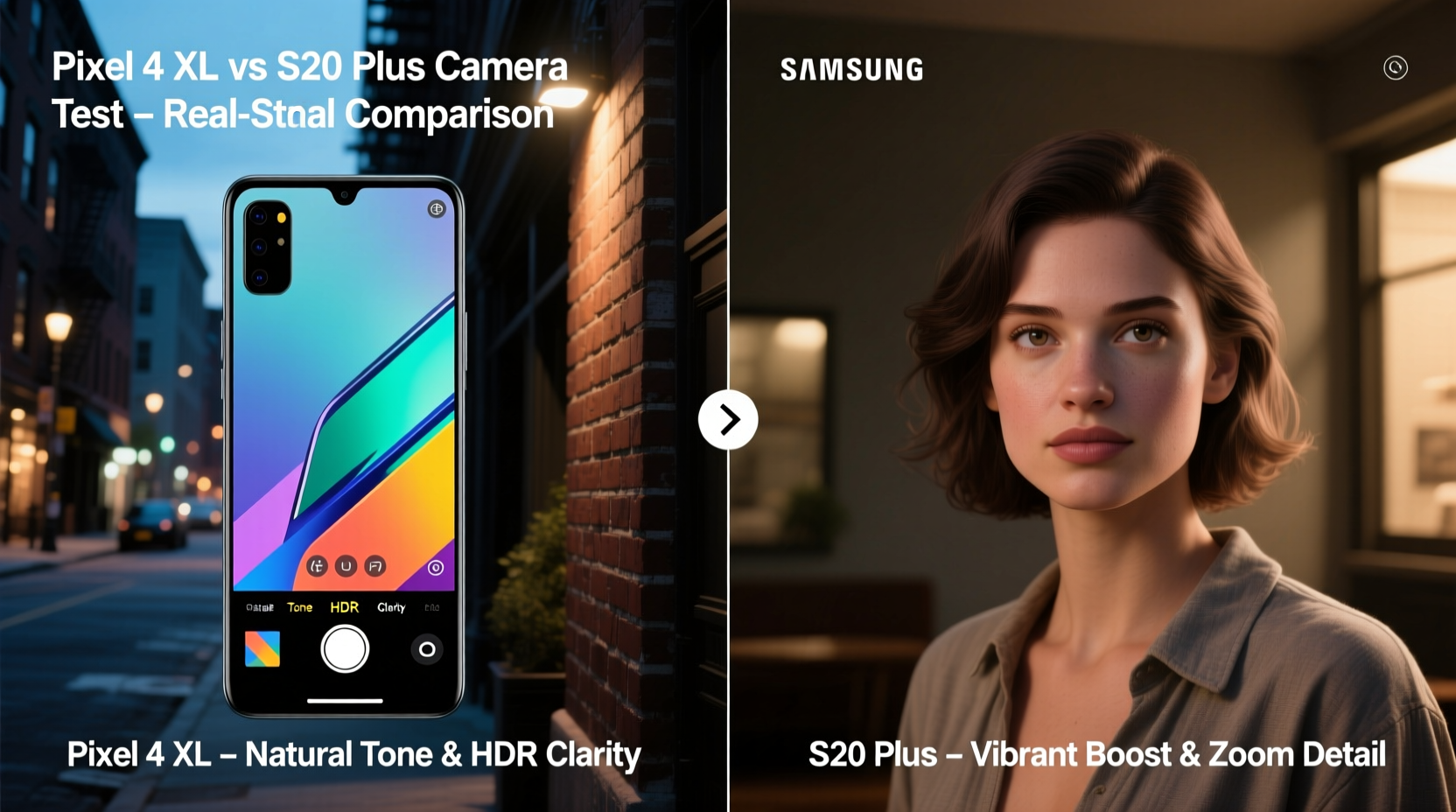
The physical camera setups differ significantly between these two devices. The Pixel 4 XL uses a dual-lens system: a 12.2 MP main sensor and a 16 MP telephoto lens. It lacks an ultra-wide camera, which by 2020 had become standard among flagship phones. In contrast, the S20 Plus features a triple rear setup: a 64 MP telephoto, a 12 MP wide, and a 12 MP ultra-wide sensor. It also supports 3x hybrid zoom and up to 30x digital zoom using Space Zoom technology.
At first glance, the S20 Plus seems to have a clear edge. More megapixels, more lenses, and greater zoom flexibility suggest a more versatile camera system. However, megapixels alone don’t define photo quality. Sensor size, pixel binning, image processing algorithms, and software tuning play equally important roles.
| Feature | Pixel 4 XL | Samsung S20 Plus |
|---|---|---|
| Main Sensor | 12.2 MP, f/1.7, Dual Pixel PDAF | 12 MP, f/1.8, Dual Pixel PDAF, OIS |
| Telephoto | 16 MP, f/2.4, 2x optical zoom | 64 MP, f/2.0, 3x hybrid zoom, OIS |
| Ultra-Wide | Not available | 12 MP, f/2.2, 120° FoV |
| Zoom Capability | Up to 8x Super Res Zoom | Up to 30x Space Zoom |
| Night Mode | Yes (on all lenses) | Yes (improved Multi Frame) |
The S20 Plus clearly wins in versatility. The ultra-wide lens opens creative framing options, while the higher optical zoom multiplier gives it an advantage for distant subjects. Yet, the Pixel 4 XL compensates with superior software optimization—especially in challenging lighting.
Image Quality: Daylight vs Low Light
In well-lit conditions, both phones produce excellent results. The S20 Plus tends to oversharpen slightly and boost saturation for a more dramatic look, which some users prefer for social media. The Pixel 4 XL takes a more natural approach: colors are accurate, dynamic range is well-balanced, and skin tones remain true to life.
Where the difference becomes pronounced is in low-light environments. Google’s Night Sight mode, refined over several generations, continues to set the benchmark. Even without a dedicated night sensor, the Pixel 4 XL captures brighter, cleaner, and more detailed images after dark than most competitors—including the S20 Plus.
“Google has mastered the art of balancing noise reduction and detail preservation. Their HDR+ pipeline remains unmatched in consistency.” — David Gewirtz, Imaging Technology Analyst, ZDNet
The S20 Plus does offer a competitive Night Mode, but it often introduces a cooler white balance and can smear fine textures when processing multiple frames. In scenes with motion—such as cityscapes with moving lights or indoor shots with people—the Pixel handles ghosting artifacts more gracefully.
Zoom and Ultra-Wide Performance
This is where the S20 Plus shines. Its 3x hybrid zoom delivers genuinely usable telephoto shots, especially in daylight. At 10x zoom, details begin to soften, but the AI-enhanced Space Zoom can still identify recognizable faces or signage at distances where the Pixel 4 XL struggles beyond 5x.
For nature photographers, event attendees, or travelers trying to capture distant subjects, this extended reach is invaluable. Wildlife shots, concert stages, or architectural details benefit from the extra magnification without requiring third-party accessories.
Equally important is the inclusion of the ultra-wide lens. The S20 Plus captures a full 120-degree field of view, making it ideal for landscapes, interiors, or group photos in tight spaces. The Pixel 4 XL offers no such option, forcing users to step back or stitch panoramas manually—a less convenient workflow.
However, ultra-wide images on the S20 Plus do show noticeable vignetting and distortion near edges. While Samsung applies correction, some warping remains visible in straight lines like doorframes or horizons. The Pixel’s lack of ultra-wide is a limitation, but its single wide lens maintains edge-to-edge sharpness and minimal distortion.
Real-World Example: Concert Photography Test
A freelance music journalist tested both phones at a dimly lit indie concert. Stage lighting was dynamic—shifting between reds, blues, and strobes—with performers moving constantly.
The Pixel 4 XL captured clean exposures with accurate color rendition. Faces were well-defined, and background details remained visible thanks to strong shadow recovery. Motion blur was minimal due to fast shutter handling in Night Sight.
The S20 Plus produced brighter initial shots, but aggressive sharpening introduced halos around light sources. In zoomed-in attempts to capture close-ups from the back of the venue, the 3x telephoto delivered usable results, though facial details softened compared to the Pixel’s processed 2x zoom output. Ultimately, the journalist preferred the Pixel’s consistency but appreciated the S20 Plus’s ability to frame tighter shots without cropping.
User Experience and Software Features
Beyond raw image quality, usability matters. The Pixel 4 XL runs a stock Android interface with a simple, responsive camera app. Features like Astrophotography mode, Top Shot, and Motion Auto Focus enhance creativity without cluttering the UI. Google’s AI-driven suggestions help users compose better shots in real time.
Samsung’s One UI offers more manual controls—pro mode, RAW capture, scene optimizer, and AR stickers—but the abundance of options can overwhelm casual users. Some features, like Single Take, record multiple formats simultaneously, consuming storage quickly.
One area where the S20 Plus pulls ahead is video. It supports 8K recording at 24fps, whereas the Pixel 4 XL maxes out at 4K 60fps. While 8K is overkill for most consumers today, the higher bitrate and dynamic range in S20 Plus videos provide better post-production flexibility.
Checklist: Choosing Based on Your Needs
- Choose the Pixel 4 XL if: You prioritize photo quality in low light, value natural color science, and prefer a clean, intuitive camera experience.
- Choose the S20 Plus if: You frequently shoot distant subjects, need an ultra-wide lens, or want advanced video capabilities including 8K.
- Consider storage needs—S20 Plus 8K videos consume ~600MB per minute.
- Evaluate long-term software support—the S20 Plus received four OS updates vs Pixel 4 XL’s three.
- Test both in your typical shooting environments before deciding.
Frequently Asked Questions
Is the Pixel 4 XL camera still good in 2024?
Yes, particularly for still photography. Its Night Sight and HDR+ algorithms remain competitive, and many users continue to prefer its natural-looking output over newer models that favor aggressive enhancement.
Can the S20 Plus zoom really beat the Pixel 4 XL?
In optical and hybrid zoom ranges (up to 5x), yes. The S20 Plus captures more detail at distance due to its superior hardware. Beyond that, both rely on digital zoom, where results degrade rapidly.
Why does the Pixel take better low-light photos with fewer megapixels?
Because image quality depends more on pixel size, sensor efficiency, and multi-frame processing than resolution. Google combines multiple underexposed frames intelligently, preserving highlights and lifting shadows without amplifying noise.
Conclusion: It Depends on What “Better” Means to You
So, is the Samsung S20 Plus camera really that much better than the Pixel 4 XL? The answer isn't straightforward. If \"better\" means more lenses, higher zoom, and advanced video specs, then yes—the S20 Plus offers broader functionality. But if \"better\" means consistently excellent still photos, especially in challenging lighting, the Pixel 4 XL proves that software mastery can outweigh hardware advantages.
The truth is, both cameras excel in different domains. The S20 Plus is a technical powerhouse built for versatility. The Pixel 4 XL is a photographic artist, crafting compelling images through intelligent processing. Your choice should depend on how you use your phone to capture the world—not just spec sheets.




 浙公网安备
33010002000092号
浙公网安备
33010002000092号 浙B2-20120091-4
Comments
No comments yet. Why don't you start the discussion?