
In the high-end smartphone arena, few matchups generate as much debate as Google’s Pixel 6 Pro facing off against Samsung’s Galaxy Note 20 Ultra. One represents a bold new direction for Android with aggressive AI integration and clean software; the other, a refined flagship from a veteran manufacturer known for polish and productivity. But as the Pixel 6 Pro challenges Samsung's dominance, questions arise: Is Samsung losing its competitive edge? Or is the Pixel simply riding a wave of hype without delivering long-term value?
This isn’t just about megapixels or processor speeds. It’s about ecosystem maturity, user experience, longevity, and whether innovation still favors legacy players or disruptors.
Design & Build: Premium Materials, Different Philosophies
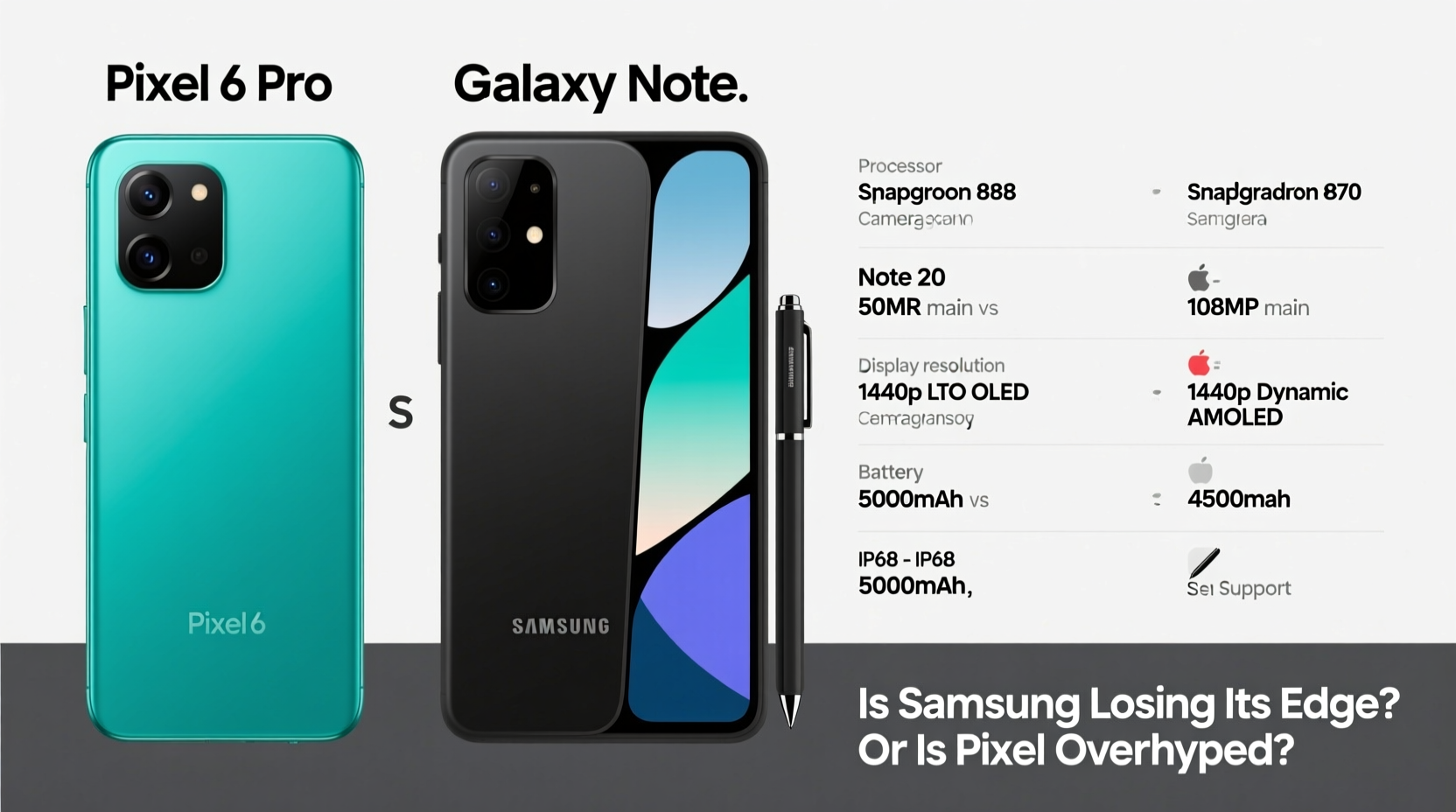
The Galaxy Note 20 Ultra exudes confidence in its design—flat edges, a sleek matte finish, and an S Pen embedded seamlessly into the chassis. Its aluminum frame and glass back feel solid, and at the time of release, it represented the pinnacle of Samsung’s industrial design. The flat display reduces accidental touches and enhances stylus precision, appealing to creatives and professionals.
In contrast, the Pixel 6 Pro introduces a striking horizontal camera bar across the back, dividing opinions. While some praise its boldness, others find it bulky and prone to smudges. The aluminum frame and Gorilla Glass Victus offer durability, but the curved display can lead to glare and accidental inputs. Still, Google has undeniably raised its design game—this is no longer a “functional but forgettable” device.
Performance & Software: Stock Android vs Feature-Rich Customization
Under the hood, the Pixel 6 Pro runs on Google’s custom Tensor chip—the company’s first self-designed SoC. Built specifically for machine learning tasks like speech recognition, photo enhancement, and real-time translation, Tensor delivers exceptional AI performance. However, in raw CPU and GPU benchmarks, it often trails behind the Snapdragon 865+ found in the Note 20 Ultra.
Samsung’s device, despite being older, still handles multitasking, gaming, and app switching with ease. But where the Pixel shines is in software fluidity and update reliability. With guaranteed Android updates for three years and monthly security patches, Pixel owners get timely access to new features.
Samsung has improved its update policy, offering up to four years of OS upgrades. Yet, Google’s stock Android experience remains cleaner, faster, and less cluttered. Bloatware is absent. Animations are smoother. And features like Call Screen, Live Translate, and Magic Eraser leverage the Tensor chip in ways no other phone can replicate.
“Google isn’t just building phones—they’re building AI companions. The Pixel 6 Pro is the first device that truly understands context.” — David Kim, Senior Mobile Analyst at TechInsight Group
Camera Comparison: Computational Photography vs Versatility
The camera battle is perhaps the most debated. The Pixel 6 Pro consistently scores near the top of DxOMark rankings, thanks to Google’s computational photography magic. Night Sight, HDR+, and Super Res Zoom produce stunning results, especially in low light. Portrait mode separates subjects with uncanny accuracy, and video stabilization rivals dedicated gimbals.
Meanwhile, the Note 20 Ultra packs a versatile triple-lens system: 108MP main sensor, 12MP ultra-wide, and a 12MP periscope telephoto with 5x optical zoom (up to 50x digital). In daylight, its detail retention is superb. The periscope lens offers superior optical reach compared to the Pixel’s hybrid zoom, which relies more on cropping and AI enhancement.
However, in challenging lighting or fast-moving scenes, the Pixel often produces more natural color tones and better dynamic range. Samsung sometimes oversharpenens or over-saturates, giving photos a “processed” look.
| Feature | Pixel 6 Pro | Note 20 Ultra |
|---|---|---|
| Main Sensor | 50MP (large pixel binning) | 108MP (Nonacell technology) |
| Telephoto Zoom | 4x optical / 20x super-res | 5x optical / 50x digital |
| Low-Light Performance | Excellent (Night Sight) | Very Good |
| Video Recording | 4K/60fps with cinematic pans | 8K/24fps, excellent stabilization |
| Unique Features | Magic Eraser, Face Unblur | S Pen video annotations, Director’s View |
Battery Life & Charging: Real-World Endurance
The Note 20 Ultra comes with a 4,500mAh battery, supporting 25W wired charging and 15W wireless. In typical use, it lasts a full day, though heavy users may need a midday charge. Fast charging is efficient, but Samsung removed chargers from the box starting with this generation.
The Pixel 6 Pro boasts a larger 5,000mAh battery and adaptive battery management powered by AI. Google claims 24-hour battery life under normal conditions—and in practice, many users report making it through a full day even with mixed usage. However, early firmware versions suffered from poor standby drain. Updates have largely resolved these issues, but inconsistent optimization remains a concern.
Charging speed is comparable, with 23W wired and 21W wireless supported. Neither supports ultra-fast 65W+ charging seen in competitors, but both support reverse wireless charging—a handy feature for topping up earbuds or smartwatches.
Ecosystem & Longevity: Who Offers Better Value Over Time?
This is where the debate intensifies. Samsung’s ecosystem—DeX, Knox security, Seamless integration with Windows via Link to Windows, and multi-device workflows—is mature and business-ready. The S Pen transforms the Note 20 into a mobile workstation. For enterprise users or productivity-focused individuals, it’s hard to beat.
Google’s ecosystem is growing rapidly. The Pixel 6 Pro integrates tightly with Google Photos, Assistant, and Workspace apps. Features like Direct My Call (AI-powered customer service navigation) and Now Playing (automatic song detection) add subtle but meaningful conveniences. However, Google lacks a desktop mode equivalent to DeX, and its cross-device continuity still lags behind Apple or Samsung.
Yet, Google promises longer software support relative to hardware lifespan. The Pixel 6 Pro will receive updates until 2025—same as the Note 20 Ultra. But given that the Pixel launched later, it effectively offers fresher software longevity.
Mini Case Study: The Freelance Designer’s Dilemma
Maya, a freelance graphic designer, used her Note 20 Ultra daily for sketching concepts with the S Pen, managing client emails, and editing photos. When she switched to a Pixel 6 Pro for its superior night photography, she initially struggled. The lack of palm rejection on the curved screen made drawing uncomfortable, and she missed instant screen-off notes with the S Pen.
After two months, however, she adapted. She began using Google Keep with voice-to-text for quick ideas and leveraged Magic Eraser to clean up product mockups. While she still misses the stylus precision, she now appreciates the seamless backup to Google Photos and the phone’s ability to auto-caption videos during client reviews.
Her verdict? “The Pixel wins on convenience and intelligence. But if I were doing tablet-level illustration work daily, I’d go back to the Note in a heartbeat.”
Is Samsung Losing Its Edge?
Not exactly—but it’s facing pressure. Samsung continues to innovate: brighter displays, advanced zoom lenses, foldable form factors. But in the traditional flagship space, Google has disrupted expectations by prioritizing AI and software over sheer hardware specs.
Samsung’s strength lies in versatility and refinement. The Note 20 wasn’t trying to reinvent the wheel—it aimed to perfect it. But in doing so, it played it safe. Meanwhile, the Pixel 6 Pro took risks: a new chip, a polarizing design, and features that either wow or frustrate.
The perception of Samsung “losing its edge” stems not from declining quality, but from slower innovation in core UX areas. Features like live transcription, call screening, and AI photo editing—once exclusive to Pixels—are only now trickling into Samsung’s lineup.
Frequently Asked Questions
Is the Pixel 6 Pro worth upgrading to from the Note 20?
If you value AI-powered features, cleaner software, and future-proof updates, yes. But if you rely heavily on the S Pen or prefer Samsung’s display and zoom capabilities, the upgrade may not be essential.
Does the Pixel 6 Pro outperform the Note 20 in daily use?
In general responsiveness and smart features, often yes. But for specific tasks like long-range zoom, stylus input, or 8K video, the Note 20 retains advantages.
Is Samsung behind in software innovation?
In AI integration and bloat-free experiences, yes. But Samsung leads in connectivity, multitasking, and enterprise tools. The gap depends on what you prioritize.
Final Verdict: Not Hype, But a Shift in What Matters
The Pixel 6 Pro isn’t overhyped—it’s redefining expectations. It proves that raw specs aren’t everything. A phone can be slightly slower on paper yet feel faster in practice because of intelligent software. Google has shown that AI, when integrated thoughtfully, can enhance real-world usability in ways benchmark scores can’t capture.
Samsung hasn’t lost its edge, but it’s being challenged in new territory. Where it once competed on hardware superiority, it now faces competition on intelligence, simplicity, and long-term relevance.
The truth is, both phones excel in different domains. The Note 20 Ultra remains one of the most complete productivity devices ever made. The Pixel 6 Pro is the first Android phone that feels like it anticipates your needs before you voice them.




 浙公网安备
33010002000092号
浙公网安备
33010002000092号 浙B2-20120091-4
Comments
No comments yet. Why don't you start the discussion?