
The smartphone market moves fast, but not every upgrade delivers meaningful improvements. If you're still using a Samsung Galaxy S20 — a flagship released in early 2020 — and are considering jumping to Google’s Pixel 7 Pro, the question isn’t just about specs. It’s about value, usability, and whether the differences justify the cost in today’s context.
The S20 was a powerhouse in its time, offering top-tier performance, a high-refresh-rate display, and a versatile camera system. The Pixel 7 Pro, released in late 2022, represents Google’s vision of AI-driven photography, clean Android software, and long-term support. But does the leap from one to the other make sense now — especially with both devices aging in their own right?
Performance & Hardware: Generational Gaps and Real-World Use
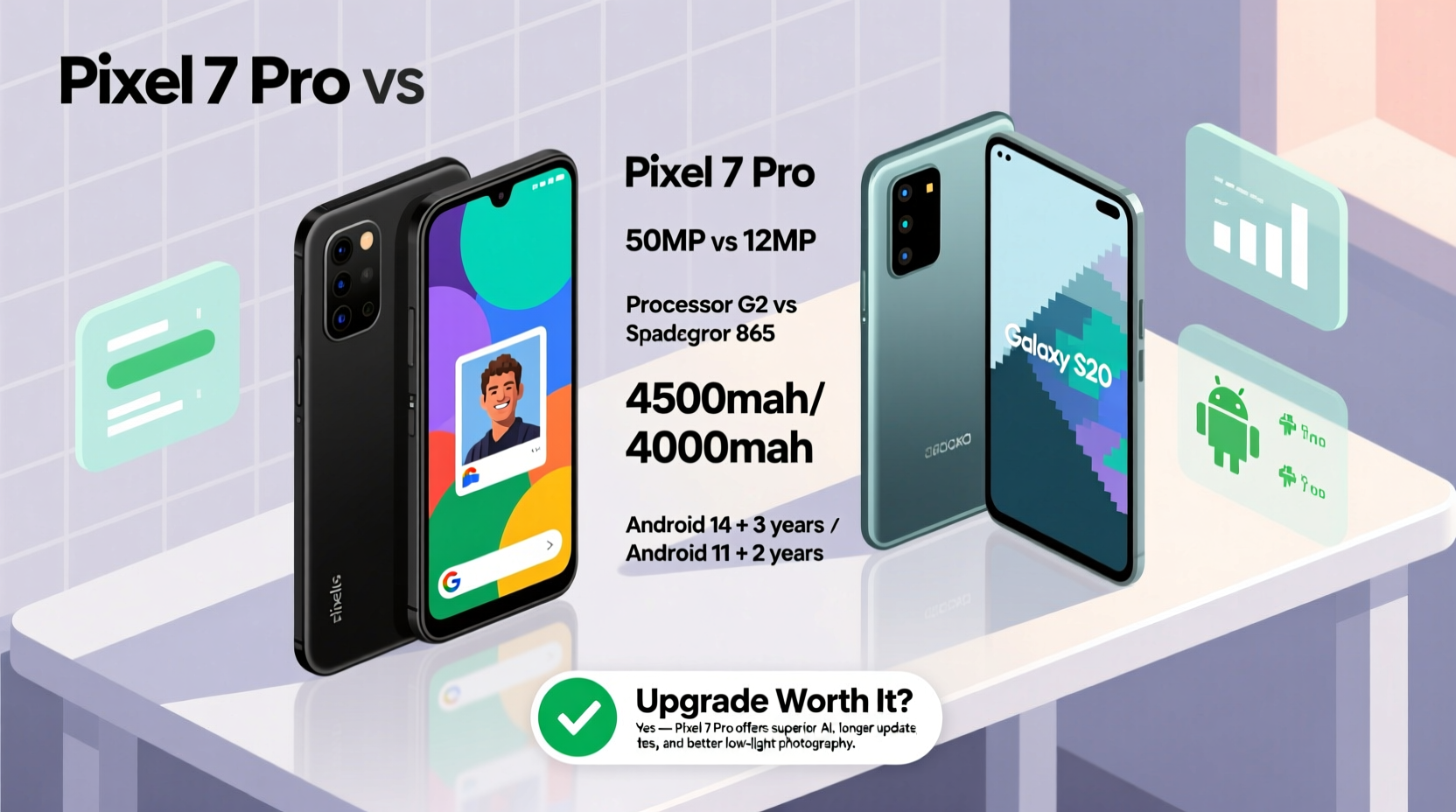
The core difference starts under the hood. The Galaxy S20 launched with Qualcomm’s Snapdragon 865, while the Pixel 7 Pro features Google’s custom Tensor G2 chip. While raw CPU benchmarks may show modest gains, the real divergence lies in efficiency, AI processing, and sustained performance.
The Tensor G2 is built for machine learning tasks — improving speech recognition, photo enhancement, and on-device language processing. In daily use, this translates to faster app launches, smoother multitasking, and better background intelligence (like call screening or live translate). Meanwhile, the S20’s Snapdragon 865, though still capable for basic tasks, shows signs of aging in memory management and thermal throttling during extended use.
Battery life also favors the Pixel 7 Pro. With a 5000mAh battery compared to the S20’s 4000mAh, and more efficient power management via Android 13+, users report consistently longer screen-on time. Real-world testing shows the Pixel 7 Pro lasting 1.5 times longer than the S20 in mixed usage scenarios.
Camera Comparison: Computational Photography vs. Versatility
Cameras are where the Pixel 7 Pro shines brightest. Despite having fewer lenses than the S20, Google’s computational photography engine produces more consistent, natural-looking photos across lighting conditions.
The S20’s 64MP telephoto, 12MP wide, and 12MP ultrawide setup was impressive for 2020, but struggles in low light and lacks advanced HDR tuning. The Pixel 7 Pro uses a 50MP main sensor with larger pixels, a 48MP periscope telephoto (offering true 5x optical zoom), and a 12MP ultrawide. More importantly, its software enhancements — like Magic Eraser, Super Res Zoom, and Night Sight — deliver results that often outperform hardware-limited rivals.
“Google has redefined what mobile photography means by prioritizing software intelligence over megapixel counts.” — David Chang, Mobile Imaging Analyst at TechLens
In daylight, both phones capture excellent shots, but the Pixel renders colors more naturally and preserves detail in shadows. At night, the gap widens: the Pixel’s Night Sight mode brightens scenes without excessive noise, while the S20 tends to produce grainy, over-smoothed images.
Software & Longevity: The Hidden Value Factor
Perhaps the most compelling reason to upgrade is software support. Samsung promised four years of OS updates for the S20, which ends with Android 14. That means no official Android 15 update — a significant limitation in 2024 and beyond.
In contrast, the Pixel 7 Pro guarantees updates until 2027, including both OS upgrades and monthly security patches. This ensures compatibility with future apps, improved privacy controls, and access to new AI features as they roll out.
Android 14 on the Pixel 7 Pro also introduces granular permission controls, better customization, and smoother integration with Google services like Assistant, Photos, and Wallet. The S20, stuck on Android 13 or 14 depending on region, lacks many of these refinements and runs One UI, which some users find bloated compared to stock Android.
Detailed Feature Comparison
| Feature | Samsung Galaxy S20 | Google Pixel 7 Pro |
|---|---|---|
| Release Year | 2020 | 2022 |
| Chipset | Snapdragon 865 | Google Tensor G2 |
| RAM / Storage | 8/12GB • 128/256GB | 12GB • 128/256/512GB |
| Battery Capacity | 4000 mAh | 5000 mAh |
| Display | 6.2” FHD+ AMOLED • 120Hz | 6.7” QHD+ LTPO OLED • 120Hz |
| Rear Cameras | 12MP + 64MP + 12MP | 50MP + 48MP + 12MP |
| Front Camera | 10MP | 10.8MP |
| Software Support Until | 2024 (Android 14) | 2027 (Android 17 expected) |
| Water Resistance | IP68 | IP68 |
| Fingerprint Sensor | Ultrasonic | Under-display Optical |
Real-World Scenario: Should You Upgrade?
Consider Maria, a freelance photographer who used her S20 daily for two years. By 2023, she noticed slower app responses, inconsistent autofocus in dim light, and declining battery life — dropping below 4 hours of screen time. She hesitated to upgrade, thinking “it still works.”
After switching to a Pixel 7 Pro, her workflow transformed. Faster image processing allowed instant sharing of edited photos. Night mode captured usable shots during evening events. And the promise of three more years of updates gave her confidence in the investment.
Her experience reflects a broader trend: users upgrading from 2020-era flagships report noticeable improvements not just in speed, but in reliability and peace of mind regarding future usability.
Upgrade Checklist: Is It Time for You?
Ask yourself these questions before making the switch:
- Does your S20 struggle with multitasking or app loading?
- Have you experienced battery degradation (under 4 hours screen time)?
- Are you missing out on newer features like AI editing or secure check-in?
- Do you want guaranteed software updates beyond 2024?
- Is camera quality important for social media, work, or travel?
If you answered yes to two or more, an upgrade is likely justified.
Frequently Asked Questions
Will the Pixel 7 Pro feel significantly faster than the S20?
Yes, particularly in AI-powered tasks like voice typing, photo search, and real-time translation. General navigation is smoother due to better RAM management and optimized software.
Can the S20 still handle everyday tasks in 2024?
Absolutely. For calls, messaging, browsing, and light app use, the S20 remains functional. However, newer apps may become less compatible over time, and performance will continue to degrade.
Is the higher price of the Pixel 7 Pro justified?
If you value long-term usability, superior cameras, and seamless software, yes. The extra cost pays for three additional years of support and cutting-edge AI features absent on older devices.
Final Verdict: To Upgrade or Not?
For most S20 owners in 2024, upgrading to the Pixel 7 Pro isn’t just about better specs — it’s about staying current. The combination of extended software support, vastly improved photography, and stronger battery life makes the Pixel 7 Pro a compelling successor.
However, if your S20 still performs well and you don’t rely heavily on camera or future-proofing, holding off is reasonable. But if you’re experiencing slowdowns, poor battery life, or frustration with outdated software, the upgrade delivers tangible benefits that go beyond marketing claims.




 浙公网安备
33010002000092号
浙公网安备
33010002000092号 浙B2-20120091-4
Comments
No comments yet. Why don't you start the discussion?