
The battle between Google’s Pixel 7 and Samsung’s Galaxy S22 Plus isn’t just about specs—it’s a clash of philosophies. One champions clean software and computational photography; the other delivers premium hardware and versatility. With both devices priced in the upper mid-tier to flagship range, consumers are left asking: is Samsung losing its edge, or is Google receiving too much praise for playing it safe?
This isn’t a simple “which phone is better” question. It’s about understanding what each brand prioritizes—and whether those priorities still align with what users actually need.
Performance and Hardware: Raw Power vs Smart Optimization
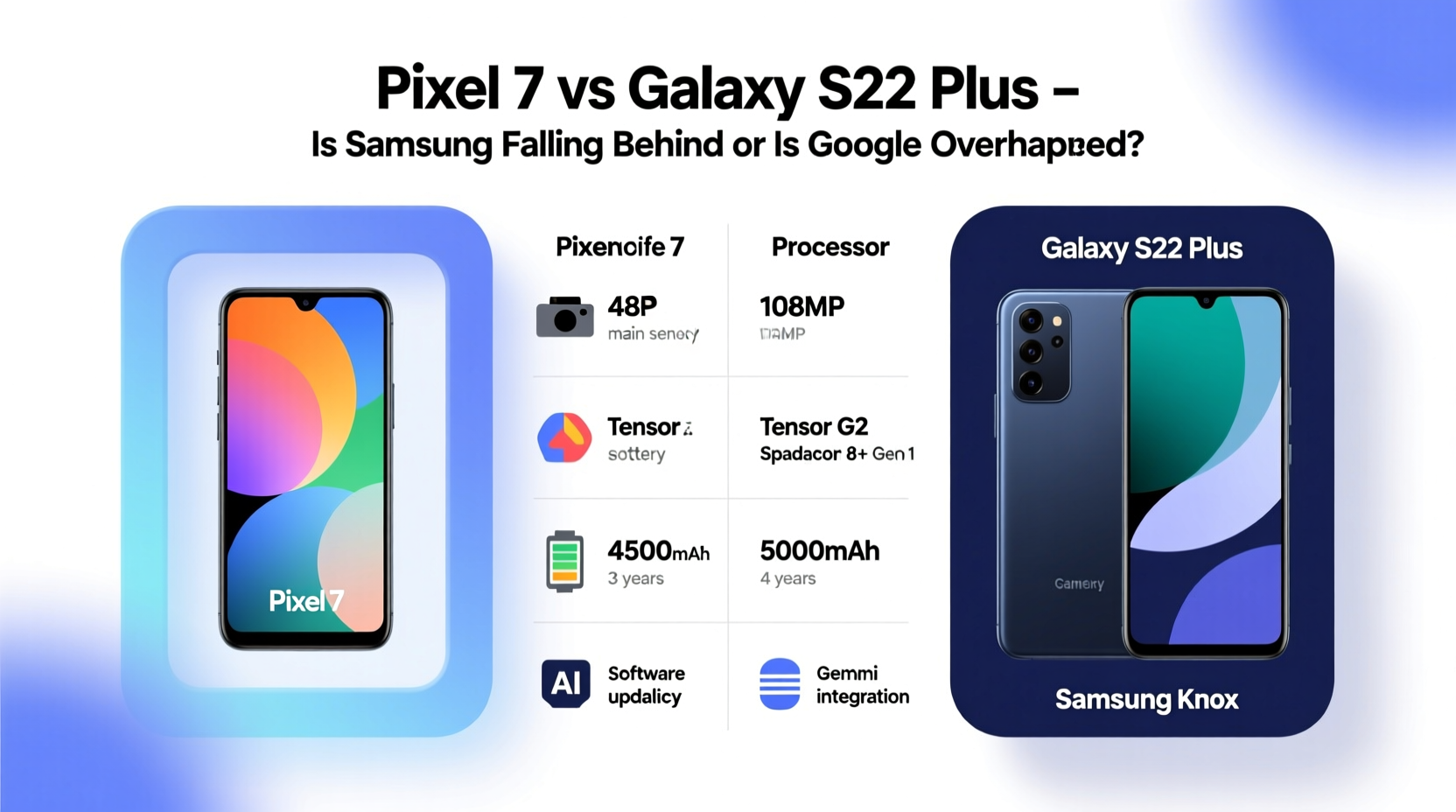
Samsung equips the Galaxy S22 Plus with the Snapdragon 8 Gen 1 (or Exynos 2200 in select regions), a powerhouse chip designed for heavy multitasking, gaming, and AI processing. Paired with 8GB of RAM and up to 256GB of UFS 3.1 storage, the S22 Plus offers robust future-proofing.
In contrast, the Pixel 7 runs on Google’s custom Tensor G2 chip—engineered not for peak speed, but for machine learning tasks like voice recognition, photo enhancement, and real-time translation. While it lags behind the Snapdragon 8 Gen 1 in raw benchmarks, the Tensor G2 excels in efficiency and AI-driven features.
Real-world usage tells a nuanced story. The S22 Plus handles graphically intensive games more smoothly and sustains performance longer under load. However, the Pixel 7 rarely feels sluggish thanks to aggressive software optimization and near-instant app launches.
“Hardware matters, but user experience is shaped by how well that hardware is tuned. Google may not win on paper, but they often win in practice.” — David Lin, Mobile Systems Analyst at TechPulse Insights
Camera Showdown: Computational Magic vs Versatility
When it comes to cameras, Google has long punched above its weight. The Pixel 7’s dual rear setup—50MP main + 12MP ultrawide—is modest on paper, yet consistently delivers some of the best point-and-shoot photography in the industry. Night Sight, HDR+, and Super Res Zoom make low-light and distant shots remarkably clear.
Samsung counters with a triple-lens array on the S22 Plus: 50MP main, 12MP ultrawide, and 10MP 3x telephoto. This gives it a tangible advantage in zoom capability and framing flexibility. Its AI-powered scene optimizer enhances colors aggressively, which some users love and others find oversaturated.
In head-to-head daylight tests, both phones perform admirably. But in dynamic lighting—backlit subjects, mixed indoor/outdoor scenes—the Pixel 7 often produces more natural exposure and better shadow detail. Samsung tends to boost contrast and sharpen edges, which can look artificial upon close inspection.
For video, the S22 Plus supports 4K at 60fps with advanced stabilization, while the Pixel 7 matches that but adds cinematic pans and improved audio focusing via its AI mic system.
| Feature | Pixel 7 | Galaxy S22 Plus |
|---|---|---|
| Main Sensor | 50MP (f/1.85) | 50MP (f/1.8) |
| Ultrawide | 12MP (f/2.2) | 12MP (f/2.2) |
| Telephoto | No dedicated lens | 10MP (3x optical zoom) |
| Night Mode | HDR+ with astrophotography | AI-enhanced night shots |
| Video Recording | 4K @ 60fps, front & rear | 4K @ 60fps, OIS+EIS |
Software and Longevity: Stock Android vs Feature-Rich Skin
The Pixel 7 runs stock Android 13 with guaranteed updates until 2025 for OS upgrades and 2027 for security patches—a standout in an industry where support often ends after three years. Google’s minimalist interface ensures smooth navigation, faster feature rollouts (like Call Screen and Now Playing), and seamless integration with Google services.
The Galaxy S22 Plus ships with Samsung’s One UI 4.1 (upgradable to newer versions) atop Android 12. While feature-rich—with split-screen multitasking, DeX support, and customizable themes—One UI can feel bloated to purists. Samsung promises four major Android updates and five years of security patches, matching Google’s commitment.
However, update delivery is slower on Samsung devices. It often takes weeks or months after Google releases a patch for Samsung to deploy it, whereas Pixel owners get fixes within days.
User Experience and Real-World Use: A Day in the Life
Consider Maria, a freelance photographer who travels frequently. She used the Galaxy S22 Plus for six months before switching to the Pixel 7. Her reasoning? Simplicity.
“I loved the zoom on the S22 Plus when shooting landscapes from a distance,” she says. “But I was constantly annoyed by pre-installed apps I couldn’t remove and delays in getting the latest Android features. The Pixel just works. My photos transfer instantly to the cloud, and the battery lasts all day even when I’m editing on the go.”
On the other hand, James, a tech reviewer and power user, stuck with the S22 Plus. “I use Samsung DeX to turn my phone into a desktop, run dual apps side-by-side, and take advantage of the S Pen-like Air Gestures. The extra screen real estate and hardware flexibility keep me productive.”
This contrast highlights a broader trend: Google appeals to users who value reliability and ecosystem cohesion, while Samsung caters to those who want control and adaptability.
Battery, Display, and Design: Subtle but Significant Differences
The Galaxy S22 Plus packs a 4,500mAh battery with 25W fast charging and wireless charging support. The Pixel 7 has a slightly smaller 4,355mAh cell but manages power efficiently thanks to Tensor G2’s adaptive learning. Both offer around 1.5 days of moderate use.
Charging speed favors Samsung—though neither includes a charger in the box. The S22 Plus also supports reverse wireless charging, allowing it to power accessories like earbuds or smartwatches.
Display-wise, the S22 Plus boasts a 6.6-inch Dynamic AMOLED 2X panel with a 120Hz refresh rate and peak brightness of 1,750 nits. The Pixel 7’s 6.3-inch OLED screen also hits 120Hz but peaks at 1,300 nits, making it less ideal in direct sunlight.
Design is subjective. The Pixel 7’s recycled aluminum frame and matte finish resist fingerprints and feel distinct. The S22 Plus uses Gorilla Glass Victus and a sleeker, more traditional flagship aesthetic. Both are IP68-rated for water and dust resistance.
FAQ
Is the Pixel 7 worth it over the Galaxy S22 Plus?
Yes, if you prioritize clean software, reliable camera performance, and long-term updates. No, if you need superior zoom, brighter display, or advanced multitasking features.
Does Samsung still lead in innovation?
Samsung leads in hardware diversity and foldable technology, but Google is setting the pace in AI integration and privacy-focused software features. Innovation depends on how you define it.
Can the Pixel 7 compete with Samsung flagships?
It competes differently. It doesn’t match Samsung in spec sheets, but it delivers a cohesive, intelligent experience that many users prefer over raw power.
Checklist: Choosing Between Pixel 7 and Galaxy S22 Plus
- ✅ Need best-in-class point-and-shoot camera? → Pixel 7
- ✅ Want optical zoom and versatile lenses? → Galaxy S22 Plus
- ✅ Prefer stock Android and fast updates? → Pixel 7
- ✅ Value multitasking and DeX functionality? → Galaxy S22 Plus
- ✅ Prioritize display brightness and outdoor visibility? → Galaxy S22 Plus
- ✅ Care about eco-materials and sustainability? → Pixel 7
- ✅ Use Google services heavily (Photos, Assistant, etc.)? → Pixel 7
Conclusion: Not Falling Behind—Just Diverging Paths
Samsung isn’t falling behind. It’s choosing a different race. Where Google focuses on refining the essentials—camera, software, updates—Samsung expands the boundaries of what a smartphone can do, from foldables to desktop-like experiences.
The Pixel 7 isn’t overhyped; it’s redefining expectations. It proves that top-tier performance doesn’t require the fastest chip, and great photos don’t demand multiple lenses. Meanwhile, the Galaxy S22 Plus remains a testament to engineering ambition—powerful, polished, and packed with features.
The truth is, neither company has won outright. They serve different ideals. Your choice depends not on marketing, but on how you use your phone every day.




 浙公网安备
33010002000092号
浙公网安备
33010002000092号 浙B2-20120091-4
Comments
No comments yet. Why don't you start the discussion?