
When choosing between the Google Pixel 7a and the Samsung Galaxy A15, one of the biggest differentiators is price — and with it, expectations. The Pixel 7a typically costs $499 at launch, while the Galaxy A15 starts around $250. That’s a $250 gap, largely justified by Google’s reputation for computational photography. But does the Pixel’s camera really deliver enough of an advantage to justify nearly double the price?
This isn’t just about megapixels or sensor size. It’s about real-world photo quality, low-light performance, consistency, and long-term software support. For many buyers, especially those who prioritize photography, the answer could sway their decision. Let’s break down what each phone offers and whether Google’s imaging expertise makes the premium worthwhile.
Camera Hardware: Specs Tell Only Part of the Story
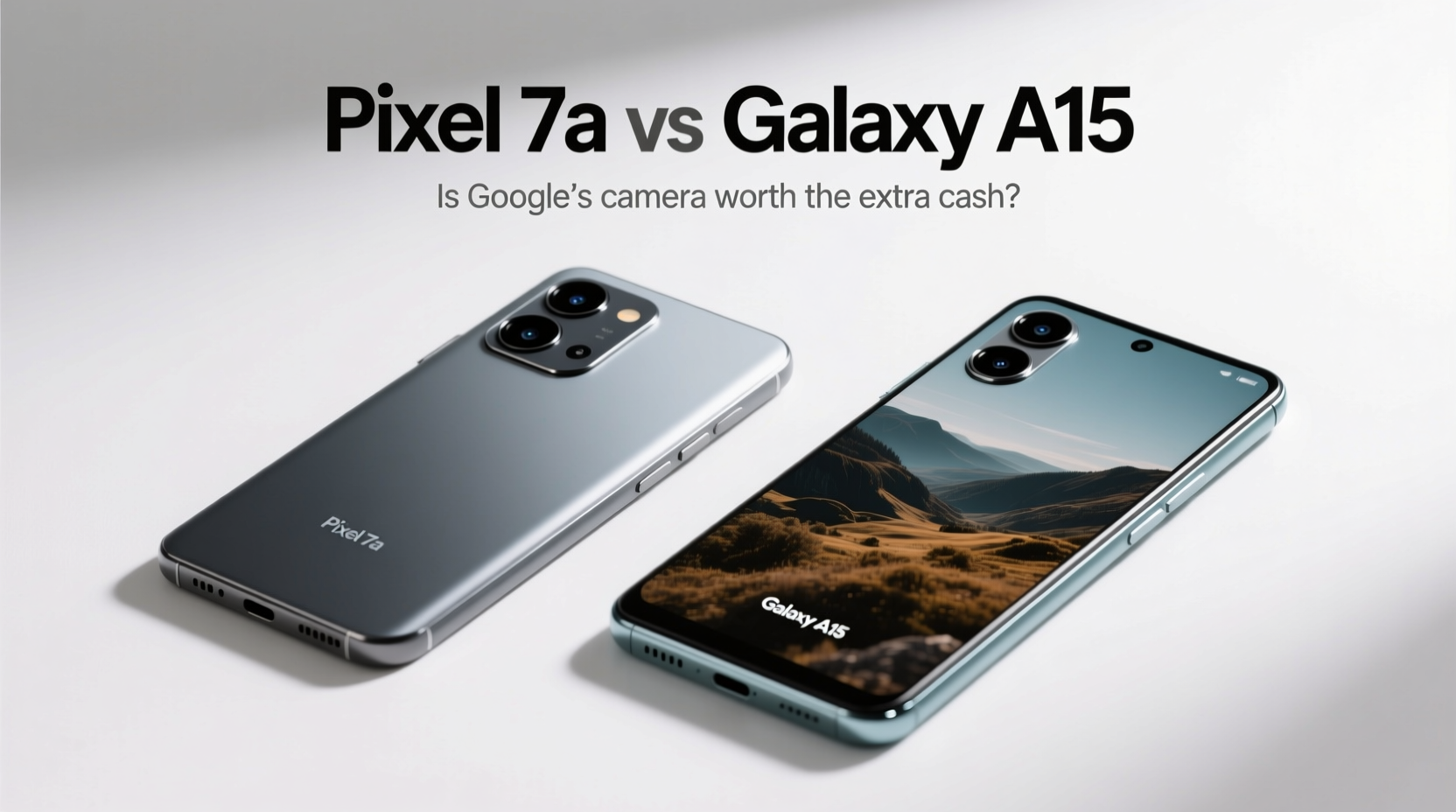
On paper, both phones come with multi-lens setups, but the hardware gap reflects their price difference.
| Feature | Google Pixel 7a | Samsung Galaxy A15 |
|---|---|---|
| Main Sensor | 64MP (f/1.8, OIS) | 50MP (f/1.8) |
| Ultrawide | 13MP (f/2.2, 120° FoV) | 5MP (f/2.2, 115° FoV) |
| Front Camera | 13MP (f/2.0) | 13MP (f/2.0) |
| Video Recording | 4K @ 60fps, HDR, Cinematic Pan | 1080p @ 30fps, no advanced stabilization |
| Dedicated Image Processor | Google Tensor G2 + HDR+ pipeline | MediaTek Dimensity 6100+ |
The Pixel 7a features optical image stabilization (OIS), which the Galaxy A15 lacks. This alone improves sharpness in low light and during handheld shooting. More importantly, the Tensor G2 chip powers Google’s proprietary HDR+ and Night Sight algorithms — not just enhancements, but core components of how the camera functions.
Samsung relies more on standard processing with some AI scene optimization. While the A15’s 50MP main sensor sounds competitive, without strong software tuning, high-resolution sensors can produce noisy or over-sharpened images, especially in suboptimal lighting.
Real-World Photo Performance: Daylight, Low Light, and Beyond
In daylight, both phones capture decent photos. The Galaxy A15 produces punchy, saturated colors typical of Samsung’s tuning — sometimes oversaturated, particularly greens and reds. Skin tones can lean orange under mixed lighting. The Pixel 7a, meanwhile, delivers natural color reproduction, better dynamic range, and finer detail retention, even when zooming into 100% crops.
Low-light performance is where the divide becomes stark. The Pixel 7a’s Night Sight mode brightens dark scenes while preserving texture and minimizing noise. Shadows reveal detail instead of turning into black blobs. The Galaxy A15 struggles here: exposures are often too dark, or when boosted, introduce significant grain and color smearing.
“Google has spent over a decade refining machine learning models for photography. Their ability to reconstruct clean images from minimal light data sets them apart.” — Rajiv Mehta, Mobile Imaging Analyst at DXOMARK
Consider this scenario: You're at a dimly lit café taking a photo of your friend across the table. The Pixel 7a will capture a well-exposed face, balanced background lighting, and accurate skin tones. The Galaxy A15 likely produces a darker image, requiring flash — which flattens depth and creates harsh highlights.
Zoom performance also favors the Pixel. While neither phone has a telephoto lens, the 7a uses its 64MP sensor to crop digitally with less quality loss. At 2x zoom, results remain usable. The A15’s 50MP-to-12MP binning process doesn’t offer the same flexibility, leading to softer edges when zooming.
Software, Features, and Longevity
Beyond stills, the Pixel 7a supports advanced video features like 4K recording at 60fps, cinematic pans, and Face Unblur — a feature that fixes motion blur on faces after capture. The Galaxy A15 maxes out at 1080p and lacks stabilization beyond basic EIS, making footage shaky in motion.
Google also provides seven years of OS and security updates for the Pixel 7a — a major advantage. Samsung promises four years for the A15, which is respectable but shorter. Over time, software improvements enhance camera performance. Pixel users have seen measurable gains in Night Sight and Portrait Mode through updates alone.
The A15 runs One UI Core on Android 13 (upgradable to Android 14), but future update velocity may slow due to its mid-range chipset. Feature drops like improved night photography or AI editing tools are unlikely to reach this device.
Checklist: What to Evaluate Before Choosing
- Do you frequently take photos in low light? → Pixel 7a wins.
- Is 4K video important for social media or vlogging? → Choose Pixel.
- Are you on a tight budget and use your phone mostly for calls and messaging? → Galaxy A15 may suffice.
- Do you value long-term software support? → Pixel offers 7 years.
- Do you prefer vibrant, stylized photos over realism? → Samsung’s profile may appeal.
Value Proposition: Is the $250 Premium Justified?
The Galaxy A15 excels as a budget-friendly option with solid battery life, a 90Hz display, and reliable day-to-day performance. But its camera is clearly entry-level. If photography ranks high on your priority list, the A15 will disappoint over time.
The Pixel 7a’s $499 price tag seems steep next to $250, but consider longevity. At roughly $71 per year over seven years of updates, it amortizes into a sustainable investment. The Galaxy A15 might need replacing in three years due to software obsolescence or camera limitations.
Moreover, Google’s ecosystem adds value: unlimited original-quality photo backups, Magic Eraser, Best Take, and Photo Unblur are exclusive tools that enhance usability. These aren’t gimmicks — they solve real problems like removing photobombers or fixing group shots with blinking faces.
Mini Case Study: Travel Photography on a Budget
Lena, a college student planning a weekend trip, considered both phones. She wanted something affordable but capable of capturing memories without needing a DSLR. She opted for the Pixel 7a despite the higher cost, using student financing to spread payments.
During her trip, she shot sunsets, indoor museum exhibits, and nighttime street food stalls. In every scenario, the Pixel delivered consistent results. She used Photo Unblur to fix a shaky shot of her friends laughing and applied Magic Eraser to remove a passerby from a scenic bridge photo. “I felt like I had a pro camera in my pocket,” she said later. “The Galaxy version wouldn’t have given me those tools — or the image quality.”
FAQ
Can the Galaxy A15 compete with the Pixel 7a in good lighting?
Yes, in ideal daylight conditions, the A15 takes acceptable photos with vivid colors. However, dynamic range and fine detail still lag behind the Pixel. HDR handling is less refined, often blowing out skies or losing shadow detail.
Does the Pixel 7a’s camera improve over time?
Absolutely. Google rolls out camera-focused updates regularly. For example, a 2023 update improved Night Sight speed by 30%. The A15 receives fewer functional upgrades, mostly limited to security patches.
Is the front camera significantly better on the Pixel?
Both have 13MP sensors, but the Pixel includes portrait mode with natural bokeh and better low-light selfies thanks to Night Sight Selfie. The A15’s front camera performs adequately but lacks refinement in complex lighting.
Final Verdict: When the Extra Cash Makes Sense
The Galaxy A15 is a competent budget phone for casual users who don’t prioritize photography. It handles basics well — messaging, browsing, streaming — and offers a smooth 90Hz screen. But if you care about capturing moments clearly, consistently, and creatively, the Pixel 7a is worth the investment.
Google’s camera isn’t just better; it’s smarter. It anticipates issues before you notice them and corrects them automatically. Whether it’s reducing glare, enhancing facial details, or stabilizing video, the experience feels effortless. That kind of polish doesn’t come cheap — but it also doesn’t age quickly.
For anyone who values photos as memories, not just files, the Pixel 7a’s camera justifies the extra $250. It’s not merely a phone with a good camera — it’s a dedicated photography tool disguised as a mid-range device.




 浙公网安备
33010002000092号
浙公网安备
33010002000092号 浙B2-20120091-4
Comments
No comments yet. Why don't you start the discussion?