
The smartphone market has long been dominated by two giants: Google with its Pixel line and Samsung with its Galaxy series. The release of the Pixel 7a and the Samsung Galaxy S21 FE reignited a debate that’s more than just specs on paper—can Google now claim superiority over Samsung in key areas like software, camera quality, and long-term usability? While both phones sit in the upper mid-range bracket, their philosophies diverge sharply. One emphasizes clean software and computational photography; the other offers versatility and hardware flexibility. This isn’t just about which phone is “better”—it’s about whether Google’s focused approach has finally overtaken Samsung’s broader ecosystem strategy.
Design and Build: Simplicity vs. Versatility
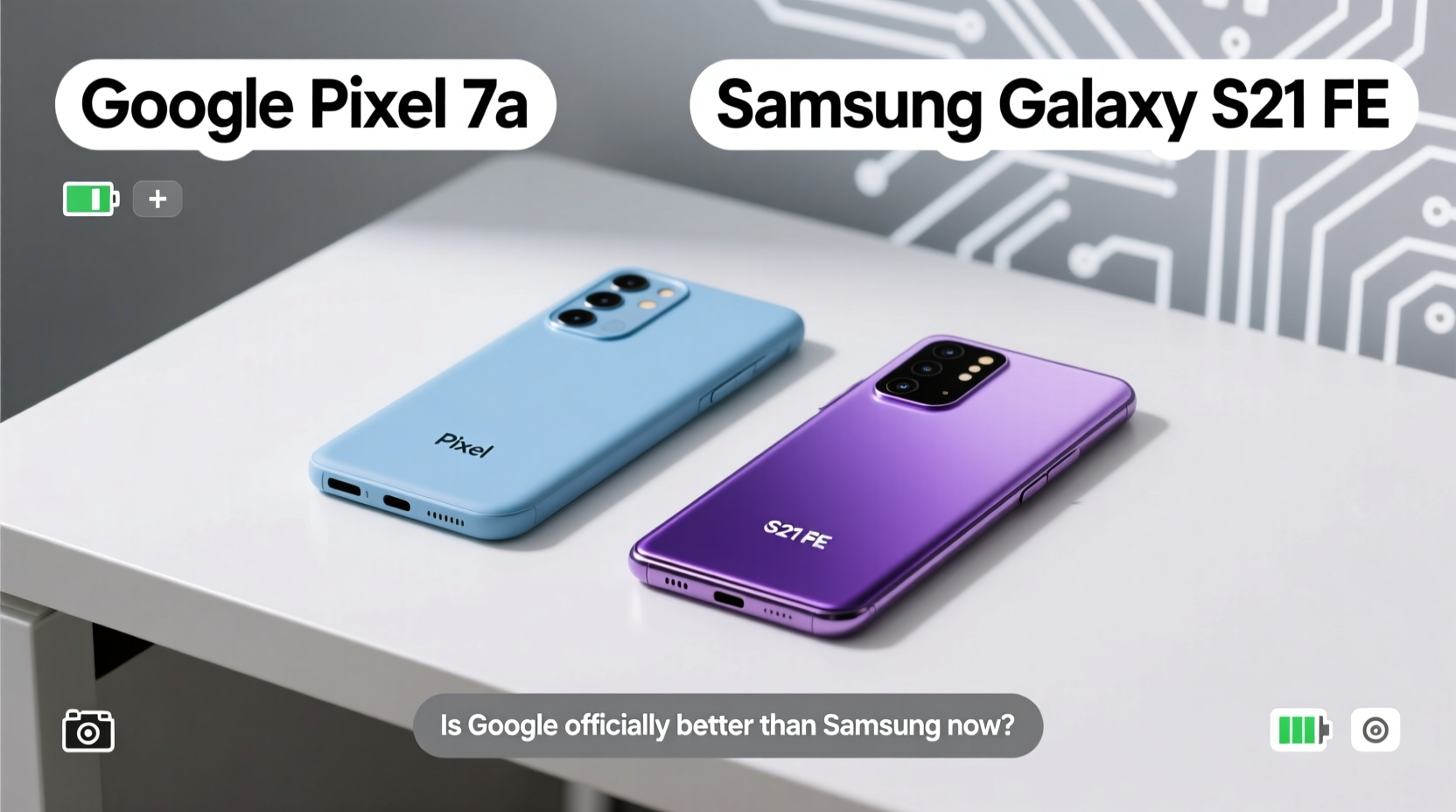
The Pixel 7a embraces Google’s minimalist design language: aluminum frame, recycled glass back, and a flush camera bar. It feels premium despite its price point. At 6.1 inches, it’s compact enough for one-handed use, and the flat display improves screen protector compatibility. IP76 rating means it’s dust and water resistant—a rarity at this price.
In contrast, the S21 FE opts for Samsung’s plastic-backed approach to keep costs down. The contoured display and curved edges give it a flagship feel, but they also make it prone to accidental touches and harder to protect. It’s slightly larger at 6.4 inches and carries an IP68 rating, marginally better for submersion. However, the polycarbonate back doesn’t convey the same sense of durability or luxury as the Pixel’s glass.
Performance and Hardware: Tensor vs. Exynos/Snapdragon
Under the hood, the Pixel 7a runs on Google’s second-generation Tensor G2 chip. It’s not the fastest processor in raw benchmarks—especially compared to the Snapdragon 888 or Exynos 2100 in the S21 FE—but it’s optimized for AI-driven features like speech recognition, photo enhancement, and on-device translation. Real-world performance is smooth, though sustained gaming can lead to throttling due to thermal constraints.
The S21 FE, depending on region, uses either the Snapdragon 888 (in the US) or Exynos 2100 (internationally). Both are significantly faster in CPU and GPU tasks. Gamers and power users will notice quicker app launches and better multitasking. However, the Snapdragon 888 has well-documented heat issues, and the Exynos variant, while powerful, lags in efficiency and modem performance.
“Hardware alone doesn’t define user experience. Software optimization can close the gap between spec sheets and real-life responsiveness.” — Marcus Lin, Mobile Performance Analyst at TechPulse Insights
Camera Comparison: Computational Photography vs. Flexibility
This is where the battle gets interesting. The Pixel 7a features a dual-camera setup: a 64MP main sensor and a 13MP ultrawide. What sets it apart is Google’s computational photography. Night Sight, Magic Eraser, and Real Tone produce consistently excellent photos—even in low light—with natural color reproduction and dynamic range.
The S21 FE packs a triple-lens system: 12MP main, 12MP ultrawide, and an 8MP telephoto with 3x hybrid zoom. It lacks the Pixel’s AI magic but offers greater compositional flexibility. The telephoto lens allows tighter framing, useful for portraits or distant subjects. However, its low-light performance trails behind, and Samsung’s processing often oversaturates colors or smudges details in HDR scenarios.
In side-by-side tests, the Pixel wins in consistency and realism. The S21 FE shines when zoom or wider angles are needed—but only if lighting is favorable.
| Feature | Pixel 7a | S21 FE |
|---|---|---|
| Main Camera | 64MP, f/1.9 | 12MP, f/1.8 |
| Ultrawide | 13MP, f/2.2 | 12MP, f/2.2 |
| Telephoto | No | 8MP, 3x hybrid zoom |
| Low-Light Performance | Excellent (Night Sight) | Good (Night Mode) |
| Video Recording | 4K @ 60fps, strong stabilization | 4K @ 60fps, minor wobble |
Software and Longevity: Android Pure vs. Feature-Rich Skins
Google’s biggest advantage lies in software. The Pixel 7a ships with stock Android 13 (upgradable to Android 17), offering a clean, bloat-free interface. Updates arrive instantly—security patches monthly and OS upgrades guaranteed for four years. Features like Call Screen, Hold for Me, and Now Playing are exclusive to Pixels and deeply integrated into daily use.
Samsung’s One UI 5 (based on Android 13) adds layers of customization and functionality: split-screen multitasking, DeX support, and advanced privacy tools. But it comes with pre-installed apps and delayed updates. While Samsung promises four OS upgrades and five years of security patches for the S21 FE, actual delivery varies by carrier and region. Users often wait weeks—or months—after Pixel owners get updates.
For those who value timeliness, simplicity, and longevity, the Pixel’s software edge is undeniable.
Real-World Example: Sarah’s Upgrade Dilemma
Sarah, a freelance photographer, used a Galaxy S10 for four years. When it slowed down and stopped receiving updates, she considered the S21 FE for its zoom and display. But after testing both phones at a store, she chose the Pixel 7a. “The night shots were sharper, and I didn’t want to wait six weeks for an Android update,” she said. “Plus, Magic Eraser saved me hours of editing.” Six months later, she reports smoother performance, fewer crashes, and appreciates the consistent update schedule.
Battery and Charging: Efficiency Over Raw Power
The S21 FE holds a 4500mAh battery versus the Pixel 7a’s 4385mAh. On paper, that suggests longer life. In practice, results are closer. The Pixel’s Tensor G2 is less power-hungry in idle states, and its 90Hz display adapts more efficiently. Users report 1.5 days of moderate use on the 7a. The S21 FE, with its brighter 120Hz display and less efficient chipset, often requires daily charging.
Charging speed favors Samsung: 25W fast charging vs. Google’s 18W. Neither includes a charger in the box. Wireless charging is supported on both, but the Pixel enables reverse charging to power earbuds or watches—small but useful.
Checklist: Choosing Between Pixel 7a and S21 FE
- Pick the Pixel 7a if:
- You value clean, bloat-free Android
- Camera quality in low light is a priority
- You want guaranteed, timely software updates
- You prefer a compact, premium build
- AI-powered features matter (e.g., transcription, photo editing)
- Pick the S21 FE if:
- You need a telephoto lens for zoomed shots
- You prefer a larger screen and higher refresh rate
- You’re invested in Samsung’s ecosystem (Galaxy Buds, Watch, etc.)
- You play graphics-heavy games regularly
- You want faster wired charging
Frequently Asked Questions
Is the Pixel 7a worth upgrading to from the S21 FE?
If you prioritize software experience, camera consistency, and update reliability, yes. The upgrade may feel subtle in raw power, but the improvements in AI features, photo quality, and system fluidity are meaningful over time.
Does the S21 FE still receive updates?
Yes, Samsung has committed to four major Android upgrades and five years of security patches for the S21 FE. However, rollout timing lags behind Pixels, especially on carrier networks.
Can the Pixel 7a compete with Samsung flagships in camera performance?
In many conditions—especially low light and portrait mode—it does. While it lacks optical zoom, Google’s computational photography closes the gap significantly. For most users, the Pixel delivers more reliable results without manual tweaking.
Conclusion: Has Google Surpassed Samsung?
“Better” depends on what you value. Google hasn’t surpassed Samsung in every category, but in critical areas—software purity, update speed, camera intelligence, and long-term usability—the Pixel 7a represents a compelling evolution. Samsung still leads in hardware flexibility, display technology, and ecosystem integration. Yet, for users who want a phone that just works, with minimal fuss and maximum photographic capability, Google’s focused strategy is proving effective.
The Pixel 7a isn’t just competitive—it redefines what a mid-tier phone can offer. Meanwhile, the S21 FE, while capable, feels like a transitional device in Samsung’s lineup, overshadowed by newer models and hampered by inconsistent software delivery.




 浙公网安备
33010002000092号
浙公网安备
33010002000092号 浙B2-20120091-4
Comments
No comments yet. Why don't you start the discussion?