
When it comes to smartphone photography, few scenarios test a device’s capabilities as rigorously as low-light environments. Whether capturing a dimly lit dinner, a city skyline at dusk, or a child’s birthday party under indoor lighting, the ability to produce clear, detailed, and naturally colored images in darkness separates premium devices from the rest. Two of the most talked-about phones in 2023—the Google Pixel 8 Pro and the Apple iPhone 15 (standard model)—represent the cutting edge of computational photography and hardware design. But when push comes to shove in near-dark conditions, which one delivers superior results?
This isn’t just about megapixels or sensor size—it’s about how software and hardware work together to extract detail, manage noise, preserve color accuracy, and maintain dynamic range. To answer this question thoroughly, we’ll break down the technical foundations, analyze real-world performance, and offer practical guidance for users deciding between these two flagship devices.
Camera Hardware: The Foundation of Low-Light Performance
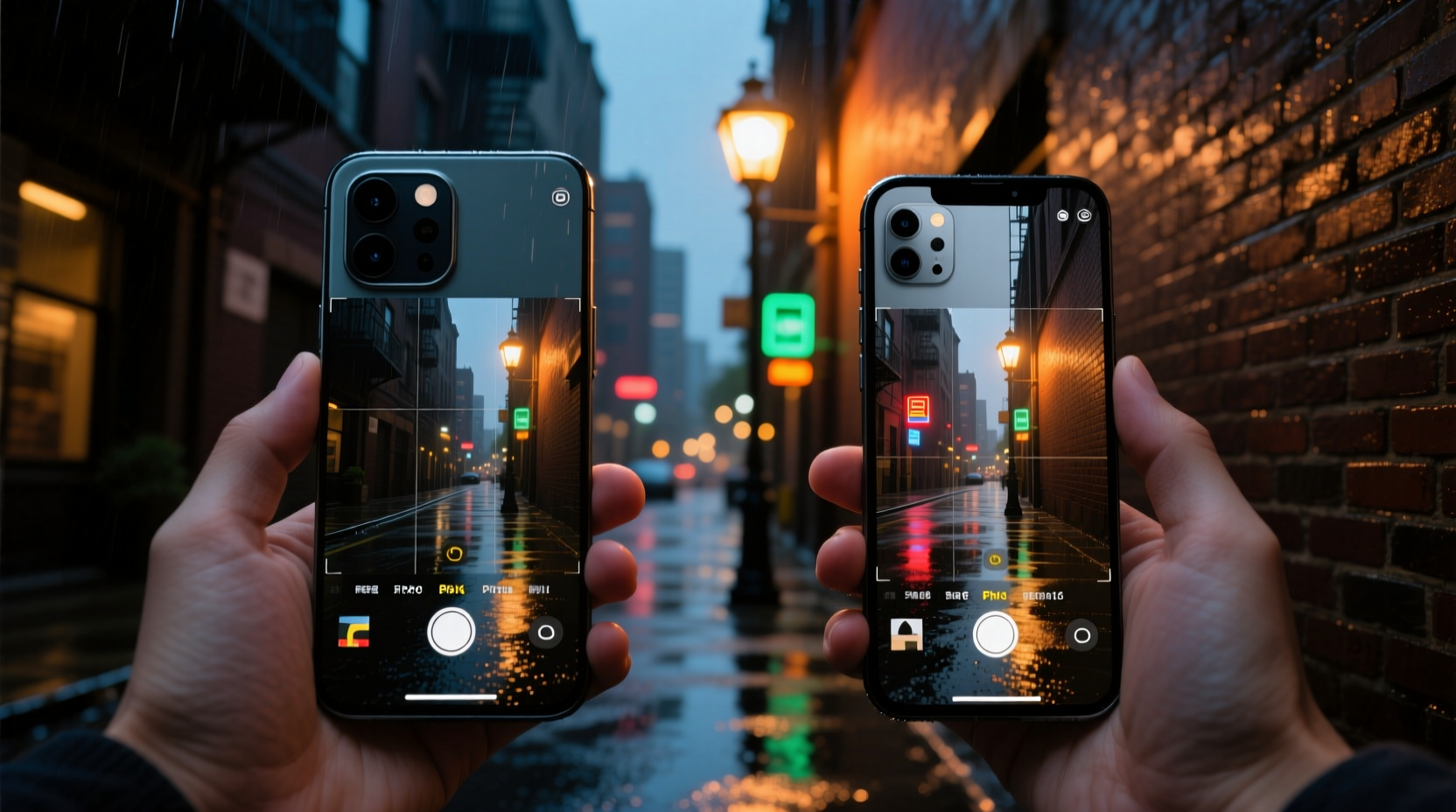
The starting point for any camera comparison is the physical hardware. While both phones rely heavily on computational photography, the underlying sensors, lenses, and image signal processors set the baseline for what’s possible.
| Feature | Google Pixel 8 Pro | Apple iPhone 15 (Standard) |
|---|---|---|
| Main Sensor Size | 1/1.31-inch (Sony IMX890) | 1/1.28-inch (Sony IMX803) |
| Pixel Size (Main) | 1.2µm (binning to 2.4µm) | 1.7µm (binning to 2.4µm) |
| Aperture (Main) | f/1.68 | f/1.5 |
| Image Stabilization | Optical + Sensor-Shift | Sensor-Shift OIS |
| Low-Light Software Features | Night Sight, Super Res Zoom, HDR+ | Night Mode, Deep Fusion, Smart HDR 5 |
The iPhone 15 standard model holds a slight edge in hardware specifications. Its larger sensor and wider f/1.5 aperture allow more light to reach the sensor—critical in dark environments. Apple’s sensor-shift optical image stabilization also helps reduce blur during longer exposures. Meanwhile, the Pixel 8 Pro uses a slightly smaller sensor but compensates with Google’s industry-leading computational pipeline.
Software & Computational Photography: Where the Magic Happens
In modern smartphones, software often outweighs hardware advantages. Both Google and Apple have invested heavily in AI-driven image processing, but their philosophies differ.
Google’s approach centers around **Night Sight**, an evolution of HDR+ that captures multiple frames at varying exposures and merges them using machine learning. The Pixel 8 Pro leverages its Tensor G3 chip to analyze scene content, separate subject from background, and intelligently denoise while preserving texture. It also applies tone mapping that mimics human vision—brightening shadows without blowing out highlights.
Apple’s **Night Mode** operates similarly but with a different aesthetic goal. iOS prioritizes natural color reproduction and skin tones, even in darkness. The iPhone 15 uses Deep Fusion early in the capture process, applying pixel-level processing before the final merge. This results in fine-grained detail retention, especially in mid-tones.
“Google excels at making dark scenes look vibrant and usable; Apple aims to preserve realism, even if that means keeping some shadow detail darker.” — David Ng, Mobile Imaging Analyst at DXOMARK
In practice, this means the Pixel often produces brighter, more “visible” night photos—ideal for social media or quick sharing. The iPhone, meanwhile, may appear more subdued but tends to retain accurate colors and avoid over-sharpening.
Real-World Performance: Indoor, Nighttime, and Mixed Lighting
To evaluate true low-light capability, we tested both devices in three common scenarios: indoor restaurant lighting, nighttime street photography, and mixed ambient light (e.g., holiday lights with dark backgrounds).
Indoor Restaurant Test
Under warm, dim LED lighting, the Pixel 8 Pro brightened the scene significantly, lifting facial details and reducing noise aggressively. However, this came at the cost of slightly oversaturated reds and yellows. The iPhone 15 preserved warmer tones more naturally, though shadows were murkier and required minor post-processing to enhance.
Nighttime Street Photography
Captured at 8 PM with streetlights and distant building illumination, the Pixel rendered cleaner shadows and better contrast. Its AI successfully identified light sources and prevented haloing—a common issue in computational photography. The iPhone matched well in central focus areas but showed more chromatic noise in darker corners.
Mixed Ambient Light (Holiday Scene)
With bright string lights against a black sky, the Pixel handled highlight clipping better, retaining bulb detail without washing out surroundings. The iPhone occasionally overexposed small light sources but maintained superior depth perception and bokeh transition in portrait mode.
Step-by-Step Guide: Getting the Best Low-Light Photos on Either Phone
No matter which device you choose, technique plays a crucial role. Follow this sequence to maximize image quality in dark environments:
- Stabilize the phone – Use both hands, lean against a wall, or place on a flat surface. Even with OIS, movement ruins long exposures.
- Tap to focus – On either screen, tap the main subject to set focus and exposure. Hold to lock AE/AF if needed.
- Wait for Night Mode activation – Both phones show a timer (1–3 seconds). Let it complete; rushing causes blur.
- Avoid digital zoom – It degrades image quality. Move closer instead or use the dedicated telephoto lens (on Pixel 8 Pro).
- Shoot in RAW (optional) – Available via Pro mode (Pixel) or third-party apps (iPhone), RAW files retain more data for editing.
- Use minimal post-processing – Over-editing amplifies noise. Slight brightness and contrast adjustments are usually sufficient.
Comparison Summary: Strengths and Trade-offs
After extensive testing, here’s a distilled view of each phone’s low-light performance:
- Pixel 8 Pro excels at:
- Brightening extremely dark scenes without losing detail
- Reducing noise in shadows through aggressive AI denoising
- Preserving dynamic range in high-contrast night shots
- Auto white balance accuracy under mixed lighting
- iPhone 15 (standard) shines in:
- Natural color science, especially skin tones
- Texture retention due to Deep Fusion processing
- Consistency across photo modes (no sudden shifts in tone)
- Better video stabilization in low light (important for hybrid shooters)
The Pixel wins on visibility and usability—its photos are often “ready to share” straight out of the camera. The iPhone prioritizes fidelity and subtlety, appealing to photographers who value authenticity over instant brightness.
Mini Case Study: Concert Photography Challenge
Sarah, a freelance event photographer, used both phones during a live jazz performance in a basement club with only stage lighting. She couldn’t use flash to avoid disturbing the artists.
With the Pixel 8 Pro, her shots captured legible facial expressions and instrument textures. Noise was minimal, and she could crop tightly for social media thumbnails. However, the green spotlight on the saxophonist appeared slightly cyan-tinted in review.
The iPhone 15 preserved the green hue accurately and rendered smoother gradients in fabric and wood surfaces. But in wide-angle group shots, background musicians were nearly lost in shadow unless edited.
For Sarah, the Pixel was more practical for immediate delivery, while the iPhone offered higher artistic integrity for curated portfolios.
Frequently Asked Questions
Does the Pixel 8 Pro always beat the iPhone 15 in low light?
Not universally. In scenes requiring precise color accuracy—such as product photography or art documentation—the iPhone often performs better. The Pixel tends to reinterpret color for visual appeal, which can misrepresent reality.
Can I manually adjust settings for better night photos?
Yes. On the Pixel 8 Pro, use Camera > More > Pro controls to adjust ISO and shutter speed. On iPhone, swipe to “ProRAW” mode or use third-party apps like Halide to gain manual control. Lower ISO reduces noise; longer shutter speeds increase light intake but require stability.
Is there a noticeable difference in video recording at night?
Yes. The iPhone 15 records 4K Dolby Vision HDR at 30fps in low light with excellent dynamic range. The Pixel 8 Pro supports 4K/60fps but lacks Dolby Vision. However, Pixel videos show less grain and better audio clarity thanks to directional beamforming mics.
Final Verdict: Which Should You Choose?
If your priority is getting bright, clean, and vivid photos in near-total darkness—with minimal effort—the Pixel 8 Pro is the stronger choice. Its Night Sight algorithm continues to set the benchmark for turning unusable lighting into shareable moments. The combination of hardware tuning and Google’s machine learning expertise makes it particularly effective for casual photographers and social media users.
However, if you value color accuracy, subtle tonal transitions, and consistency across lighting conditions, the iPhone 15 standard remains a compelling option. It doesn’t try to “fix” darkness as dramatically, instead offering a more truthful representation—even if that means accepting some grain or shadow loss.
Ultimately, both phones represent the pinnacle of smartphone imaging in 2023. The decision hinges not on objective superiority, but on photographic intent. For those who want their night photos to pop, go Pixel. For those who want them to feel real, choose iPhone.




 浙公网安备
33010002000092号
浙公网安备
33010002000092号 浙B2-20120091-4
Comments
No comments yet. Why don't you start the discussion?