
When it comes to choosing a premium Android smartphone in 2024, two devices stand out at opposite ends of the price spectrum: the Google Pixel 8 Pro and the Samsung Galaxy S24 FE. The Pixel 8 Pro starts at $999, while the S24 FE launches at $699 — a $300 difference that demands serious consideration. But does the higher price translate into a significantly better experience? For many users, the answer isn’t just about specs — it’s about how the phone fits into daily life, long-term reliability, and personal priorities like photography, updates, and ecosystem integration.
This isn’t a battle of underdog versus elite. It’s a choice between focused innovation and broad versatility. The Pixel 8 Pro represents Google’s vision of AI-driven simplicity and computational photography excellence. The S24 FE, meanwhile, offers Samsung’s most refined mid-tier flagship yet — packing high-end features into a more accessible package. To determine whether the Pixel is worth the extra cost, we need to examine real-world performance, software support, camera quality, design, and long-term value.
Design and Build: Premium Feel vs Practical Durability
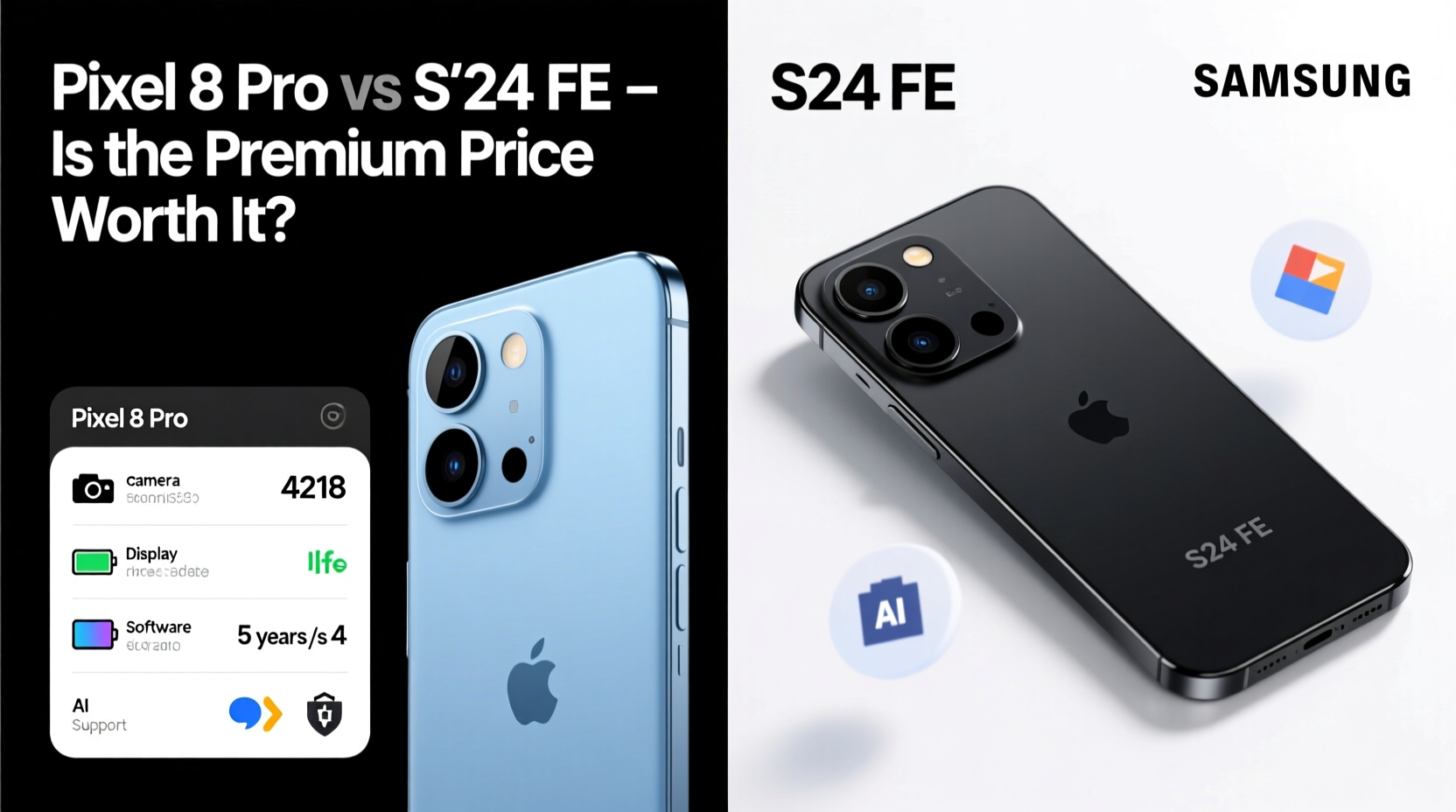
The Pixel 8 Pro makes no compromises on materials. Its aluminum frame, Gorilla Glass Victus 2 front and back, and IP68 rating signal a device built for longevity and elegance. The slightly curved display enhances grip, and the unique matte finish resists fingerprints — a small but meaningful detail for those who value a clean look. At 195g, it’s not light, but the weight feels balanced and substantial.
In contrast, the S24 FE opts for Gorilla Glass 5 on the front and plastic on the back, with an aluminum frame. While still IP68 rated and durable, the polycarbonate back attracts fingerprints and can feel less refined in hand. However, that same material makes it lighter (196g) and potentially more impact-resistant in drops. The flat display improves usability with screen protectors and gloves but lacks the premium edge of the Pixel’s design.
If build quality and aesthetic refinement are priorities, the Pixel 8 Pro pulls ahead. But if you’re someone who uses cases anyway and values practicality over prestige, the S24 FE doesn’t leave much behind.
Camera Performance: Computational Magic vs Versatility
Photography is where the Pixel 8 Pro justifies much of its premium pricing. Its triple-lens system — 50MP main, 48MP ultrawide, 48MP telephoto with 5x optical zoom — is backed by Google’s latest Tensor G3 chip and advanced HDR processing. The result? Consistently accurate colors, exceptional dynamic range, and best-in-class Night Sight and Portrait mode performance.
The S24 FE, equipped with a 50MP main, 12MP ultrawide, and 10MP telephoto (3x optical zoom), delivers strong results in daylight. Samsung’s processing tends to oversaturate slightly, which some prefer for social media, but it struggles in mixed lighting and low-light scenarios compared to the Pixel. The lack of ultra-zoom capability beyond 3x becomes noticeable when photographing distant subjects.
Where the Pixel truly shines is in AI-powered features like Best Take (swap faces in group photos), Audio Eraser (remove background noise from videos), and Photo Unblur. These aren't gimmicks — they solve real problems. For example, capturing a child’s fleeting expression only to find it blurry is frustrating. With the Pixel, Photo Unblur can reconstruct sharpness from motion blur using temporal data.
“Google’s computational photography has redefined what smartphone cameras can do. It’s not just about megapixels — it’s about intelligently enhancing moments.” — David Kim, Mobile Imaging Analyst at DXOMARK
Performance and Software: Longevity vs Flexibility
The Pixel 8 Pro runs on Google’s custom Tensor G3, optimized specifically for AI tasks and image processing. It’s not the fastest chip in raw benchmarks — the S24 FE’s Exynos 2400 or Snapdragon 8 Gen 3 variants outperform it in CPU-heavy workloads — but it excels in efficiency and machine learning applications. Features like real-time call screening, live translation, and AI-generated wallpapers rely on this dedicated architecture.
Samsung’s One UI 6.1, based on Android 14, offers deeper customization, multi-window support, DeX functionality, and broader accessory integration. For power users who multitask across apps or use their phone as a desktop replacement, this flexibility is invaluable. However, One UI can feel bloated to minimalists, and Samsung’s update policy guarantees only four OS upgrades — one fewer than the Pixel’s six years.
Here’s a critical differentiator: Google promises OS updates until 2030 and security patches until 2031. Samsung supports the S24 FE until 2028 for OS and 2030 for security. If you plan to keep your phone longer than three years, the Pixel’s extended support adds tangible value.
| Feature | Pixel 8 Pro | S24 FE |
|---|---|---|
| OS Update Guarantee | 6 years (until 2030) | 4 years (until 2028) |
| Security Updates | 7 years (until 2031) | 5 years (until 2030) |
| Chipset | Tensor G3 | Exynos 2400 / Snapdragon 8 Gen 3 |
| RAM | 12GB | 8GB |
| Storage Options | 128GB, 256GB, 512GB | 128GB, 256GB |
| Wireless Charging | Yes (with reverse charging) | No |
Real-World Example: Travel Photography Decision
Consider Sarah, a travel blogger who frequently shoots in challenging conditions — sunsets in Santorini, markets in Marrakech, night scenes in Tokyo. She previously used a mid-tier Samsung and found her images lacked consistency. After upgrading to the Pixel 8 Pro, she noticed immediate improvements: automatic HDR adjustments preserved sky details without blowing out highlights, Night Sight captured vibrant neon signs without noise, and Best Take saved several otherwise unusable group shots.
She did miss Samsung’s multi-window feature when editing photos while referencing notes, but overall, the camera’s reliability outweighed the loss of multitasking. For her workflow, the $300 premium translated into fewer retakes, faster editing, and higher engagement on her content. In her case, the Pixel wasn’t just worth the extra cost — it paid for itself in improved output quality.
Value Analysis: Who Should Choose Which?
The decision ultimately hinges on your usage pattern and priorities. Below is a checklist to help determine which phone aligns with your needs.
Choose the Pixel 8 Pro if:
- You prioritize camera quality, especially in low light or portraits.
- You want six years of guaranteed software updates.
- You rely on AI features like Live Translate, Call Screen, or Assistant voice commands.
- You value a clean, bloatware-free version of Android.
- You use wireless charging or share battery with wearables.
Choose the S24 FE if:
- You want flagship-level performance at a lower price.
- You prefer Samsung’s ecosystem (Galaxy Watch, Buds, DeX).
- You enjoy deep customization and multitasking tools.
- You don’t mind replacing your phone every 3–4 years.
- You prioritize battery life (S24 FE has a larger 4,500mAh cell vs 5,050mAh in Pixel).
Frequently Asked Questions
Is the Pixel 8 Pro camera really that much better?
Yes — particularly in dynamic range, low-light clarity, and portrait accuracy. While the S24 FE takes good photos in ideal conditions, the Pixel consistently delivers superior results across diverse environments, thanks to Google’s computational photography algorithms.
Can the S24 FE run demanding games smoothly?
Absolutely. Powered by either the Exynos 2400 or Snapdragon 8 Gen 3 (depending on region), the S24 FE handles AAA mobile titles like Genshin Impact and Call of Duty: Mobile at high settings without issue. Its gaming performance exceeds the Pixel 8 Pro in sustained loads due to better thermal management.
Does the extra $300 for the Pixel cover future-proofing?
In part, yes. The six-year update promise means you’ll receive Android 15 through Android 20, ensuring compatibility with future apps and security standards. This reduces e-waste and long-term ownership cost, making the Pixel a smarter investment if you keep phones longer.
Final Verdict: Worth It — But Only for the Right User
The Pixel 8 Pro is not universally worth the extra $300. For casual users who prioritize battery life, gaming, and affordability, the S24 FE is an outstanding alternative — arguably the best mid-tier flagship Samsung has ever made. But for creators, photographers, and those invested in Google’s ecosystem, the Pixel’s combination of AI capabilities, camera excellence, and industry-leading software support delivers measurable value.
The premium isn’t just about hardware — it’s about confidence. Confidence that your photos will turn out well, that your phone will stay secure for years, and that new features will continue arriving long after others have stopped updating. If those assurances matter to you, then yes, the Pixel 8 Pro is worth the extra cost.




 浙公网安备
33010002000092号
浙公网安备
33010002000092号 浙B2-20120091-4
Comments
No comments yet. Why don't you start the discussion?