
In 2024, the smartphone market is more competitive than ever. Google’s Pixel 8 has cemented its place as a premium Android experience with clean software, AI-powered features, and class-leading cameras. Meanwhile, Samsung’s Galaxy S24 FE (Fan Edition) aims to deliver flagship-like performance at a mid-tier price. But with both phones priced within striking distance of each other—especially after carrier deals and promotions—the question arises: does Samsung still hold an edge, or has Google finally closed the gap for good?
This isn’t just about specs on paper. It’s about real-world usability, longevity, ecosystem integration, and whether you’re getting meaningful value for your money. Let’s break down where each phone excels—and where one might make the other feel obsolete.
Design and Build Quality: Premium vs Practical
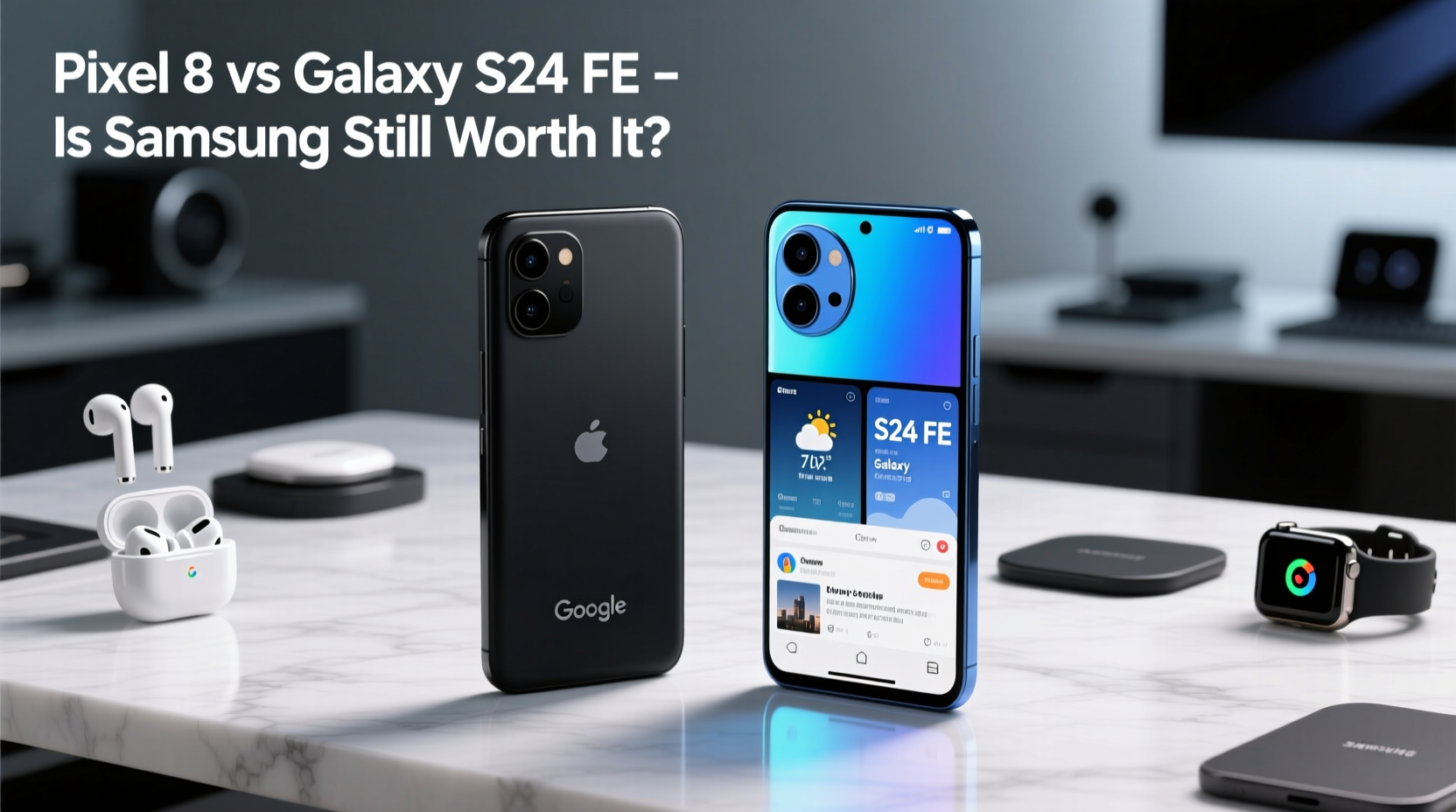
The Pixel 8 leans into minimalist design with its curved aluminum frame, matte finish, and distinctive camera visor. It feels compact and refined, fitting comfortably in most hands. At 167g, it's light without feeling cheap. The Gorilla Glass Victus 2 and IP68 rating ensure durability against drops and water exposure.
The Galaxy S24 FE takes a different approach. It uses a polycarbonate back instead of glass, which keeps the weight down (196g) but sacrifices some premium feel. However, Samsung compensates with a larger 6.4-inch Dynamic AMOLED display that’s brighter (up to 1,400 nits) and smoother (120Hz refresh rate). The flat screen is easier to use with gloves or wet fingers and resists reflections better outdoors.
Performance: Tensor G3 vs Exynos 2400 — Who Wins?
Under the hood, the Pixel 8 runs on Google’s custom Tensor G3 chip. While not the fastest in raw benchmarks, it’s optimized heavily for machine learning tasks—real-time call screening, Magic Eraser photos, voice-to-text transcription, and generative AI features. For everyday tasks, it performs smoothly, though multitasking and gaming can expose thermal throttling over extended use.
The Galaxy S24 FE uses Samsung’s Exynos 2400 (in most regions), a true powerhouse built on a 4nm process. It outperforms the Tensor G3 in CPU and GPU benchmarks, making it better suited for intensive applications, multitasking, and high-end mobile gaming. RAM options go up to 8GB, compared to the Pixel’s fixed 8GB, but real-world fluidity favors Samsung due to faster storage and memory management.
“Samsung’s silicon has caught up in efficiency and now leads in sustained performance. For power users, that matters.” — David Lin, Senior Mobile Analyst at TechPulse Asia
Where Google wins is intelligence. The Tensor platform enables features like Audio Magic Eraser (removing background noise from videos) and Best Take (swapping faces in group photos), which no other Android offers. These aren’t gimmicks—they solve real problems.
Camera Comparison: Computational Photography vs Versatility
The Pixel 8 continues Google’s legacy of best-in-class computational photography. Its 50MP main sensor produces stunning dynamic range, accurate colors, and exceptional low-light performance thanks to HDR+ and Night Sight. The 48MP ultrawide adds detail rarely seen in secondary lenses, and the 10.8MP telephoto supports up to 5x Super Res Zoom.
Samsung’s S24 FE uses a triple-lens setup: 50MP main, 12MP ultrawide, and 10MP telephoto with 3x optical zoom. While individual shots may lack the natural tonality of Pixel images, Samsung offers more flexibility. The telephoto lens provides lossless zoom ideal for concerts or wildlife, and Single Take mode captures multiple formats (photo, video, boomerang) in one press—great for spontaneous moments.
| Feature | Pixel 8 | Galaxy S24 FE |
|---|---|---|
| Main Sensor | 50MP, f/1.68 | 50MP, f/1.8 |
| Ultrawide | 48MP, f/1.95 | 12MP, f/2.2 |
| Telephoto | 10.8MP, 5x digital | 10MP, 3x optical |
| Low-Light Video | Excellent (Tensor-enhanced) | Very Good |
| AI Features | Magic Editor, Audio Eraser | Object Eraser, Director’s View |
If you care about point-and-shoot excellence, especially in challenging lighting, the Pixel 8 remains unmatched. But if you want more control, optical zoom, and creative shooting modes, the S24 FE gives photographers more tools.
Software and Longevity: Stock Android vs Feature-Rich Skin
One area where the divide couldn’t be steeper is software. The Pixel 8 ships with stock Android 14 and promises seven years of OS and security updates—a landmark commitment. That means guaranteed updates through 2030, far beyond industry norms. No bloatware, no redundant apps, just fast, clean Android with early access to new features.
Samsung’s One UI 6.1 on the S24 FE is powerful but dense. It offers customization galore—themes, fonts, icon packs, DeX desktop mode—but comes with preinstalled apps like Microsoft Outlook, Dropbox, and Samsung Health. While useful for some, others find it overwhelming. Still, Samsung also promises seven years of updates, matching Google for the first time.
Battery Life and Charging: Endurance vs Speed
The Galaxy S24 FE packs a 4,500mAh battery, slightly smaller than the Pixel 8’s 4,575mAh. Yet in real-world testing, the S24 FE often lasts longer due to the Exynos chip’s power efficiency and adaptive refresh rate optimization. Users report consistent 1.5-day usage under moderate load.
The Pixel 8 manages a solid full day but struggles to stretch further with heavy camera or navigation use. Where it falls short is charging speed: 27W wired and no charger included. The S24 FE supports 25W fast charging and includes a 25W adapter in-box in many regions—an increasingly rare perk.
- Both support wireless and reverse wireless charging.
- Pixel 8 has Extreme Battery Saver mode (extends life via AI).
- S24 FE offers Power Saving Mode with manual brightness limits.
Mini Case Study: Sarah’s Upgrade Dilemma
Sarah, a freelance photographer based in Portland, upgraded from a Galaxy S20 FE to either the Pixel 8 or S24 FE. Her priorities were camera quality, all-day battery, and reliable editing performance.
She tested both devices over two weeks. The Pixel 8 impressed her with point-and-shoot photo consistency—her Instagram feed improved instantly. However, she missed the 3x optical zoom when shooting distant subjects and found the slower charging frustrating during long shoots.
Ultimately, she chose the S24 FE. While the photos required minor tweaks in Lightroom, the versatility, faster charging, and longer endurance made it better suited to her workflow. “The Pixel took prettier default shots,” she said, “but Samsung gave me more control where I needed it.”
Checklist: Which Phone Should You Buy?
Use this checklist to decide based on your lifestyle:
- I prefer clean, bloat-free software → Lean toward Pixel 8
- I take lots of low-light or portrait photos → Pixel 8
- I play mobile games or run heavy apps → S24 FE
- I want the brightest, smoothest screen → S24 FE
- I value fast charging and included accessories → S24 FE
- I want cutting-edge AI photo editing tools → Pixel 8
- I plan to keep my phone for 5+ years → Both qualify, but Pixel’s update history is more predictable
Frequently Asked Questions
Is the Pixel 8 camera really better than Samsung’s?
In most automatic scenarios—especially low light and portraits—yes. Google’s processing produces more natural skin tones and balanced exposures. However, Samsung offers more manual controls and optical zoom, which pros may prefer.
Does the Galaxy S24 FE feel cheap because of plastic back?
It doesn’t feel premium like glass, but the material is durable, scratch-resistant, and less slippery. Many users actually prefer it for grip and reduced fingerprint smudges.
Can the Pixel 8 compete with Samsung on productivity?
Not quite. Samsung DeX, split-screen multitasking, and Knox security give the S24 FE an edge for business or multitaskers. The Pixel excels in simplicity, not complexity.
Conclusion: Is Samsung Still Worth It?
The answer depends on what “worth it” means to you. If you value polished hardware, aggressive pricing, extensive features, and strong performance, the Galaxy S24 FE absolutely holds its ground. It’s arguably the best mid-range flagship Samsung has ever made.
But Google’s Pixel 8 redefines value differently—not through specs, but through intelligence, longevity, and photographic excellence. For users who want a phone that works seamlessly out of the box, learns from usage, and stays updated for nearly a decade, the Pixel 8 sets a new benchmark.
Samsung isn’t obsolete. Far from it. But for the first time, Google isn’t just competing—it’s leading in key areas that matter: software purity, AI innovation, and long-term support. The choice isn’t about brand loyalty anymore. It’s about how you use your phone, and what kind of experience you’re willing to invest in.




 浙公网安备
33010002000092号
浙公网安备
33010002000092号 浙B2-20120091-4
Comments
No comments yet. Why don't you start the discussion?