
The smartphone market moves fast, and choosing between a new mid-range flagship like the Google Pixel 8a and a high-end legacy device like the Samsung Galaxy S21 Ultra can be surprisingly complex. One was built to dominate in 2021; the other arrives in 2024 with modern AI features and Google’s latest software vision. For users entrenched in the Samsung ecosystem, the question isn’t just about specs—it’s whether switching to Android’s purest experience offers enough upside to justify leaving behind power, expandability, and familiarity.
This isn’t just a battle of old versus new. It’s a clash of philosophies: raw hardware muscle against intelligent software optimization, flexibility against simplicity, and legacy performance against future-proof updates. Let’s break down what really matters when deciding if the Pixel 8a is worth making the switch.
Performance and Hardware: Power vs Efficiency
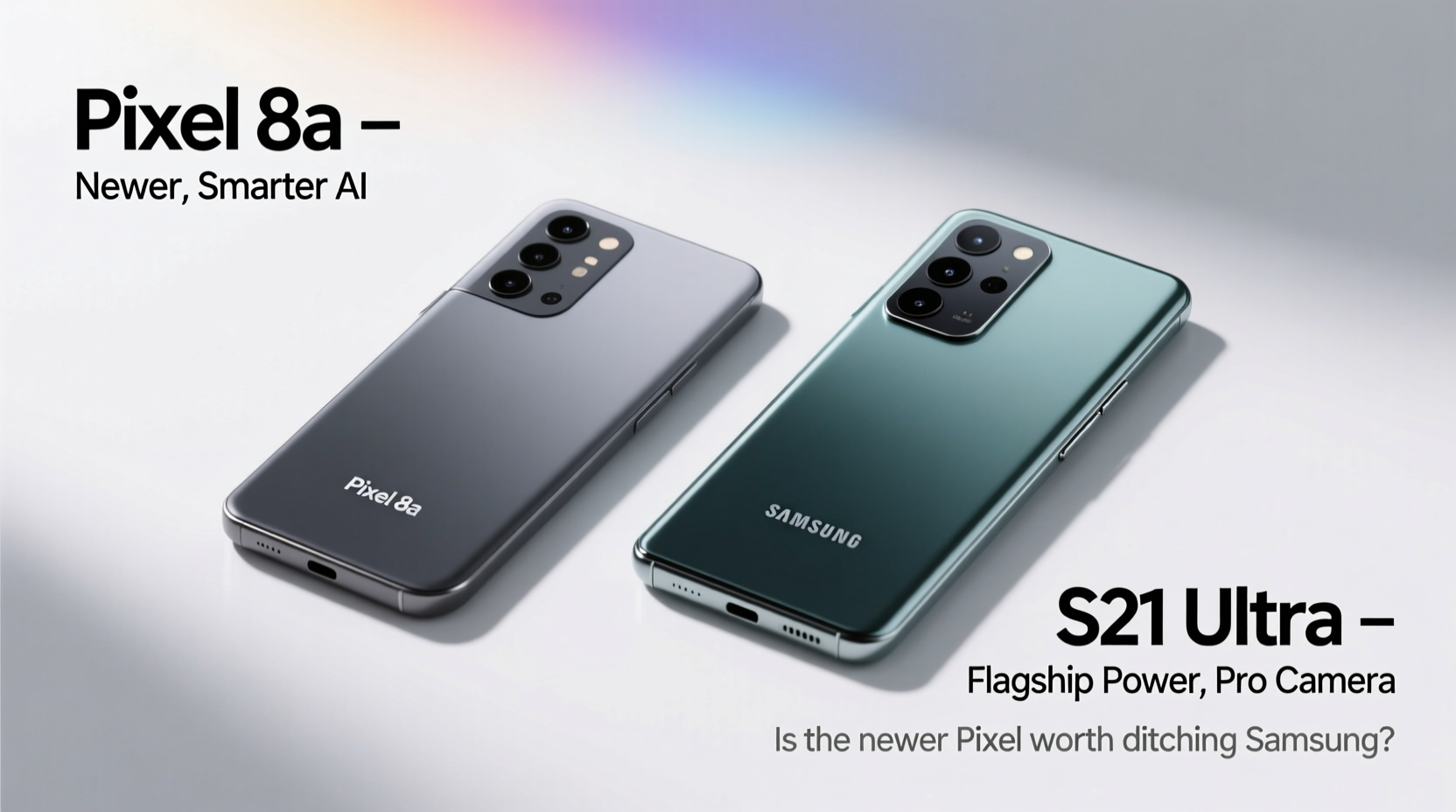
The S21 Ultra runs on either the Exynos 2100 or Snapdragon 888 (depending on region), both of which were top-tier chips in 2021. At launch, this phone handled multitasking, gaming, and photo processing with ease. Even today, it remains capable—especially if you’re not pushing extreme graphical limits. However, being three years older means thermal throttling can occur under sustained load, and efficiency isn’t on par with current-gen silicon.
In contrast, the Pixel 8a uses Google’s Tensor G3, an AI-focused chipset designed to optimize real-time tasks like voice transcription, photo enhancement, and on-device language processing. While it doesn’t match the peak CPU/GPU performance of the S21 Ultra, its machine learning capabilities are far ahead. Everyday responsiveness feels snappier due to tighter software-hardware integration, and background AI features run seamlessly without draining the battery excessively.
Camera Comparison: Computational Magic vs Versatility
The S21 Ultra set a benchmark for camera versatility with its quad-lens system: 108MP main sensor, dual telephoto lenses (3x and 10x optical zoom), ultra-wide, and laser autofocus. It excels in daylight, captures stunning detail, and offers unparalleled zoom range—ideal for travel, wildlife, or architecture photography.
The Pixel 8a, meanwhile, has a single rear camera setup: a 64MP main sensor and a 13MP ultra-wide. No telephoto lens. On paper, that seems like a downgrade. But Google’s computational photography—HDR+, Night Sight, Super Res Zoom, and now Magic Eraser and Best Take—often closes the gap dramatically. In low light, the Pixel frequently outperforms even higher-end phones by combining multiple frames and using AI to reconstruct details.
For most users who take photos in mixed lighting and share them primarily online, the Pixel 8a delivers more consistent, natural-looking results with minimal effort. The lack of optical zoom is a trade-off, but digital zoom up to 5x is usable thanks to AI sharpening.
“Google’s camera algorithms have reached a point where hardware limitations are being overcome through intelligence, not megapixels.” — David Ng, Mobile Imaging Analyst at TechLens
Battery Life and Charging: Real-World Endurance
The S21 Ultra packs a 5,000mAh battery and supports 25W wired charging, 15W wireless, and reverse wireless charging. With moderate use, it easily lasts a full day, though heavy usage—especially at 120Hz—can drain it faster. Over time, battery degradation affects longevity, particularly for units purchased at launch.
The Pixel 8a comes with a 4,400mAh battery—smaller on paper—but benefits from the efficiency of the Tensor G3 and a 60Hz OLED display. Google claims up to 24 hours of use, and real-world testing shows it reliably hits 1.5 days with light-to-moderate use. It supports 18W wired charging and 7.5W wireless, which is slower than Samsung’s offering.
Where the Pixel pulls ahead is adaptive battery management and Extreme Battery Saver mode, which can extend life to 72 hours with essential apps only. This makes it ideal for travelers or those who can’t charge daily.
Software Experience and Updates: Longevity Matters
This is where the Pixel gains a decisive edge. The Pixel 8a ships with Android 14 and guarantees five years of OS and security updates—until 2029. That’s industry-leading support for a mid-range device.
The S21 Ultra originally promised four years of OS updates, later extended to seven years due to Samsung’s policy change. So it will receive Android 15 and possibly 16, but security patches may taper off sooner depending on region and carrier. More importantly, update delivery is slower on Samsung devices due to UI layer customization (One UI).
On the Pixel, you get clean Android with instant access to new features like Call Screen, Hold for Me, Now Playing, and generative AI wallpapers. These aren’t just gimmicks—they solve real problems. And because the Pixel runs stock Android, animations are smoother, settings are intuitive, and bloatware is nonexistent.
Detailed Feature Comparison
| Feature | Pixel 8a | S21 Ultra |
|---|---|---|
| Release Year | 2024 | 2021 |
| Chipset | Google Tensor G3 | Snapdragon 888 / Exynos 2100 |
| RAM | 8GB | 12GB/16GB |
| Storage | 128GB / 256GB (no expandable) | 128GB / 256GB / 512GB (microSD supported) |
| Battery | 4,400mAh | 5,000mAh |
| Charging | 18W wired, 7.5W wireless | 25W wired, 15W wireless, reverse |
| Display | 6.1” FHD+ 60Hz OLED | 6.8” QHD+ 120Hz Dynamic AMOLED |
| Rear Cameras | 64MP main, 13MP ultra-wide | 108MP main, 12MP ultra-wide, dual telephoto (3x & 10x) |
| Updates | 5 years OS + security | 7 years security, 4–5 OS (varies) |
| Water Resistance | IP67 | IP68 |
Real-World Decision: Who Should Switch?
Consider Sarah, a freelance photographer and content creator who’s used her S21 Ultra since 2021. She loves the zoom for capturing distant subjects and appreciates the large screen for editing on the go. But she’s frustrated by inconsistent software updates, occasional overheating during video exports, and the growing number of apps that no longer feel optimized for her aging device.
After testing the Pixel 8a, she found that while she missed the 10x zoom, the Night Sight and Photo Unblur features saved several otherwise unusable shots. The seamless Google Photos integration, live translation during client calls, and five-year update promise gave her confidence in long-term reliability. She switched—and hasn’t looked back.
Sarah’s story illustrates a shift: for many professionals, consistent AI-powered tools now outweigh sheer hardware specs.
Checklist: Is the Pixel 8a Right for You?
- ✅ Prioritize clean, bloat-free Android experience
- ✅ Value long-term software updates (5+ years)
- ✅ Use AI features like Call Screen, Live Translate, or Magic Editor
- ✅ Prefer compact size over large displays
- ✅ Take most photos in daylight or low light (not zoom-heavy)
- ❌ Need microSD expansion or ultra-fast charging
- ❌ Rely heavily on 10x optical zoom or S Pen functionality
Frequently Asked Questions
Can the Pixel 8a replace a premium Samsung phone for power users?
For most power users focused on productivity, communication, and photography, yes. The Tensor G3 handles multitasking well, and AI integrations enhance usability. Only those needing maximum gaming performance or advanced zoom may feel limited.
Is the lack of a telephoto lens a dealbreaker?
It depends on your needs. If you regularly photograph distant subjects—birds, concerts, sports—the S21 Ultra still wins. But for social media, family photos, and general use, the Pixel’s computational zoom and photo editing tools compensate effectively.
Will switching from Samsung to Pixel mean losing data or functionality?
Not significantly. Google’s Switch to Android app ensures smooth transfer of contacts, messages, photos, and accounts. Most Samsung-specific features (like DeX or Knox) have alternatives or aren’t widely used. Cloud sync minimizes friction.
Final Verdict: Time to Make the Move?
The Galaxy S21 Ultra was a landmark device—powerful, versatile, and ahead of its time. But technology evolves. The Pixel 8a represents a different kind of advancement: smarter, leaner, and built for the next era of AI-driven mobile computing.
If you’re holding onto an S21 Ultra for its camera reach and raw power, ask yourself how often you truly use those features. For everyday excellence—crisp photos, intelligent assistants, clean software, and guaranteed updates—the Pixel 8a isn’t just competitive; it’s often better suited to modern life.
Switching brands isn’t trivial, but loyalty shouldn’t come at the cost of innovation. The Pixel 8a proves that newer doesn’t just mean fresher design—it means a fundamentally improved experience tailored to how we actually use phones today.




 浙公网安备
33010002000092号
浙公网安备
33010002000092号 浙B2-20120091-4
Comments
No comments yet. Why don't you start the discussion?