
Choosing between a new mid-range phone and a previous-generation flagship isn’t always straightforward. The Google Pixel 8a brings modern design, AI-powered features, and long-term software support, while the Samsung Galaxy S21 remains a capable performer with high-end hardware from its era. For users considering an upgrade—especially those currently on the S21—the question arises: does the Pixel 8a offer enough meaningful improvements to justify the switch?
This breakdown compares both devices across key categories: design, display, performance, camera, battery life, software, and real-world usability. By the end, you’ll have a clear picture of where each device excels and whether the Pixel 8a truly represents a worthwhile upgrade.
Design and Build Quality
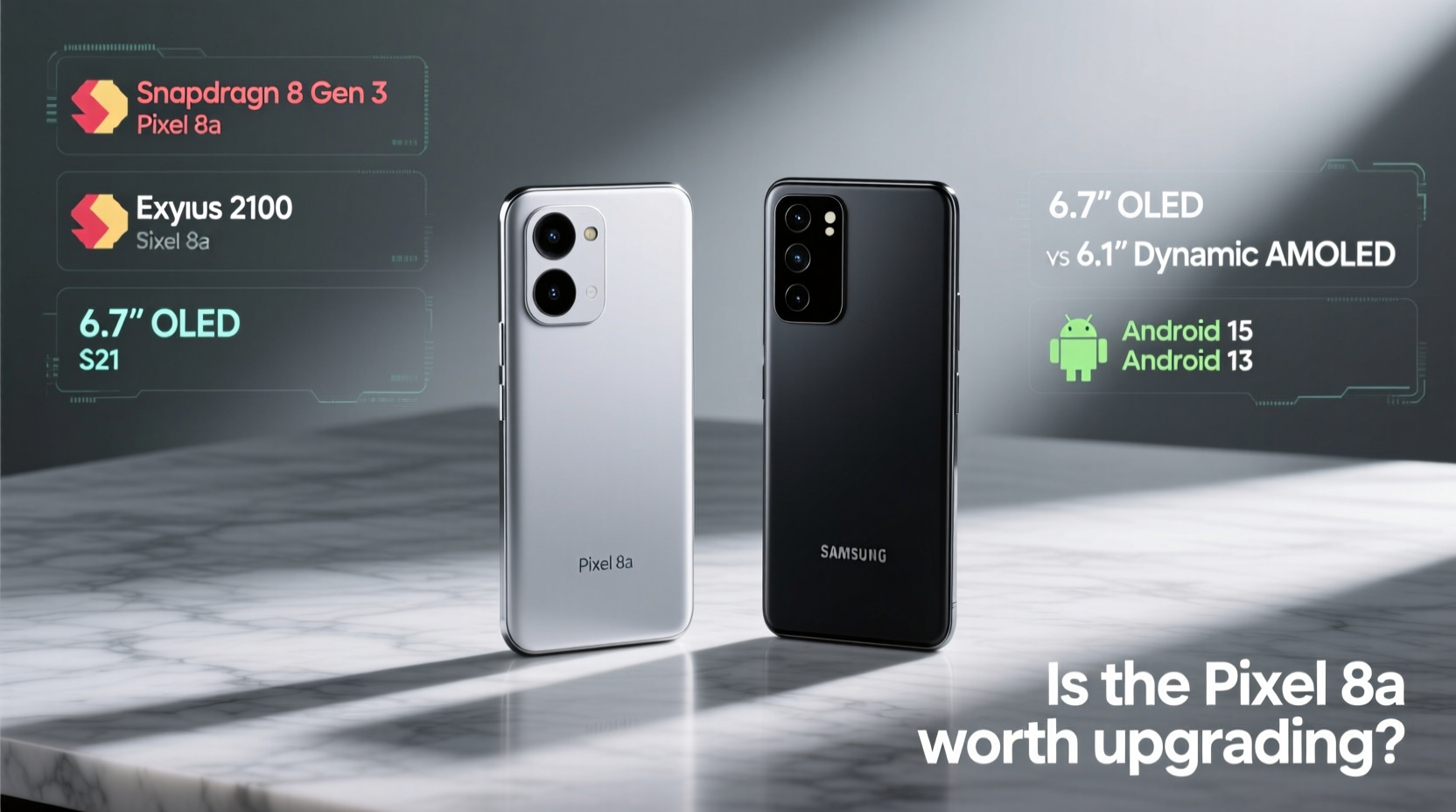
The Galaxy S21 launched in 2021 as Samsung’s premium flagship, featuring a sleek glass-and-metal build with a distinctive contoured camera housing. It’s compact, measuring 151.7 x 71.2 x 7.9 mm, and weighs just 169g, making it comfortable for one-handed use. Despite its elegance, the glass back is prone to fingerprints and requires careful handling without a case.
In contrast, the Pixel 8a adopts a more utilitarian yet refined approach. It uses a recycled aluminum frame and Gorilla Glass 3 on the front, but opts for a durable matte polycarbonate back. At 155.5 x 73.9 x 8.9 mm and 186g, it’s slightly larger and heavier than the S21, but feels more rugged. Its IP67 rating also gives it superior dust and water resistance over the S21’s IP68—though both are well-protected against spills and splashes.
Display: Brightness vs. Smoothness
The S21 boasts a 6.2-inch Dynamic AMOLED 2X display with a 120Hz refresh rate and HDR10+ support. Even by today’s standards, its screen delivers vibrant colors, deep blacks, and excellent viewing angles. Peak brightness reaches around 1300 nits, making it highly usable in direct sunlight.
The Pixel 8a counters with a 6.1-inch OLED display, also with HDR support and a peak brightness of 1700 nits—the highest ever on an “a” series Pixel. However, it sticks to a 60Hz refresh rate, which results in noticeably less fluid scrolling and animations compared to the S21’s buttery-smooth 120Hz panel. While Google compensates with responsive touch tuning, the lack of high refresh rate is a tangible downgrade for users accustomed to smoother screens.
“High refresh rates aren’t just about specs—they change how a phone feels in daily use. Once you go 120Hz, going back can feel sluggish.” — David Kim, Mobile UX Analyst at TechPulse Insights
Performance and Real-World Speed
Under the hood, the S21 runs on either the Exynos 2100 or Snapdragon 888 (depending on region), both of which were top-tier chips in 2021. In practice, this means strong multitasking, fast app launches, and solid gaming performance—even in demanding titles like Genshin Impact. However, the Snapdragon 888 has a known thermal throttling issue, meaning sustained workloads can cause the phone to heat up and slow down.
The Pixel 8a is powered by Google’s Tensor G3, built specifically to handle AI and machine learning tasks. While not as powerful in raw CPU benchmarks as the Snapdragon 888, the Tensor G3 excels in efficiency and software integration. Everyday tasks like web browsing, messaging, and media playback feel snappy and responsive. Plus, Google optimizes its UI and apps to run smoothly even on lower-spec hardware.
Where the Pixel pulls ahead is longevity. The Tensor G3 supports seven years of OS and security updates—a first for Android phones. The S21, originally promised four years, now only receives security patches until 2025. For users planning to keep their phone beyond three years, this is a decisive advantage.
Camera Comparison: Computational Photography vs. Versatility
The camera is where the Pixel 8a shines brightest. Both phones feature dual rear setups, but Google’s computational photography consistently outperforms hardware-limited rivals. The Pixel 8a includes a 64MP main sensor and a 13MP ultrawide, backed by advanced HDR+, Night Sight, Magic Eraser, and Best Take. These tools allow for stunning low-light shots, accurate skin tones, and effortless photo editing directly in the gallery.
The S21 also has a 64MP main and 12MP ultrawide, but relies more on traditional optics. Its photos are sharp in daylight but often oversharpened or overly saturated. Low-light performance lags behind the Pixel, and while it offers 30x Space Zoom, the results are mostly unusable beyond 3x. Video recording is a stronger suit for Samsung, with 8K@24fps and better stabilization, though most users won’t notice the difference in everyday clips.
For selfies, the Pixel 8a’s 13MP front camera produces more natural-looking portraits with better dynamic range. The S21’s 10MP shooter tends to overexpose faces in bright conditions.
Battery Life and Charging
The Pixel 8a packs a 4,410mAh battery, slightly larger than the S21’s 4,000mAh unit. Combined with the efficiency of the Tensor G3 and aggressive background app management, this translates to reliably full-day usage, even with mixed screen-on time. Google also includes Adaptive Charging, which learns your routine to slow charging overnight and preserve battery health.
The S21, while still capable, shows signs of aging. After two to three years of use, many units experience reduced battery capacity. It supports faster charging (25W wired, 15W wireless) compared to the Pixel 8a’s 18W wired and no wireless charging. However, the absence of wireless charging on the 8a may disappoint some users coming from flagship experiences.
| Feature | Pixel 8a | Samsung S21 |
|---|---|---|
| Battery Capacity | 4,410 mAh | 4,000 mAh |
| Charging Speed | 18W wired | 25W wired, 15W wireless |
| Wireless Charging | No | Yes |
| Estimated Daily Use | 1.2 days | 1 day (older units may vary) |
Software Experience and Longevity
Here, the Pixel 8a gains a significant edge. It ships with Android 14 and guarantees updates through 2031—seven years of support. This includes monthly security patches, quarterly OS upgrades, and timely feature drops like Call Screen, Now Playing, and Live Translate.
The S21 launched with Android 11 and will receive its final major update with Android 14. Security updates continue until 2025, but after that, the phone will be left vulnerable to emerging threats. Given that many users keep phones for four years or more, this limited lifespan could become a liability.
Additionally, Pixel-exclusive features such as Hold for Me, Assistant Voice Typing, and seamless Google integration enhance productivity and convenience. Samsung’s One UI offers more customization, but some find it bloated compared to the clean, intuitive Pixel interface.
Mini Case Study: Upgrading from S21 to Pixel 8a
Consider Maria, a freelance photographer who used her S21 daily for three years. While the phone handled editing apps and social media well initially, she noticed increasing lag, shorter battery life, and inconsistent photo quality in low light. After switching to the Pixel 8a, she found the camera vastly improved her workflow—especially Magic Eraser for removing distractions from client photos. Though she missed the 120Hz screen at first, she adapted within a week and appreciated the longer update support for her business-critical communications.
For Maria, the upgrade wasn’t about raw power—it was about reliability, image quality, and peace of mind knowing her phone would stay secure and functional for years to come.
Frequently Asked Questions
Is the Pixel 8a faster than the S21?
Not in raw processing power. The S21’s Snapdragon 888 outperforms the Tensor G3 in benchmarks. However, the Pixel 8a feels smooth in daily use due to software optimization, and its AI capabilities offer unique advantages in photo editing and voice features.
Should I upgrade if my S21 still works fine?
If your S21 performs well and you don’t need better cameras or long-term updates, the upgrade may not be urgent. But if you value photo quality, software longevity, or newer AI tools, the Pixel 8a offers meaningful improvements despite its modest specs.
Does the Pixel 8a support 5G?
Yes, the Pixel 8a supports both sub-6GHz and mmWave 5G networks, offering future-proof connectivity. The S21 also has 5G, so there’s no major advantage here unless you’re in an area with expanding mmWave coverage.
Conclusion: Is the Upgrade Worth It?
The answer depends on your priorities. If you value a smoother display, faster charging, and wireless charging, the S21—or a newer Samsung mid-ranger—might serve you better. But if you want superior photo quality, cleaner software, and the assurance of seven years of updates, the Pixel 8a is a compelling upgrade—even over a former flagship.
It’s not about having the fastest chip or the shiniest screen. It’s about getting a phone that works intelligently, lasts longer, and adapts to your life. For many S21 owners, especially those frustrated with aging batteries or outdated software, the Pixel 8a represents a thoughtful step forward—not a leap, but a wise evolution.




 浙公网安备
33010002000092号
浙公网安备
33010002000092号 浙B2-20120091-4
Comments
No comments yet. Why don't you start the discussion?