
When it comes to smartphone photography, few challenges test a device as rigorously as low-light conditions. Whether capturing a dimly lit dinner, cityscapes after sunset, or nighttime portraits, the ability to produce clean, detailed, and naturally colored images separates premium cameras from the rest. As Google’s Pixel 9 and Apple’s iPhone 16 base model enter the market, both manufacturers tout significant improvements in computational photography—especially under challenging lighting. But when push comes to shove, which one actually delivers superior results in the dark?
This article dives deep into sensor technology, image processing, software enhancements, and real-world performance to determine which phone truly dominates in low-light photography.
Sensor and Hardware: The Foundation of Low-Light Performance
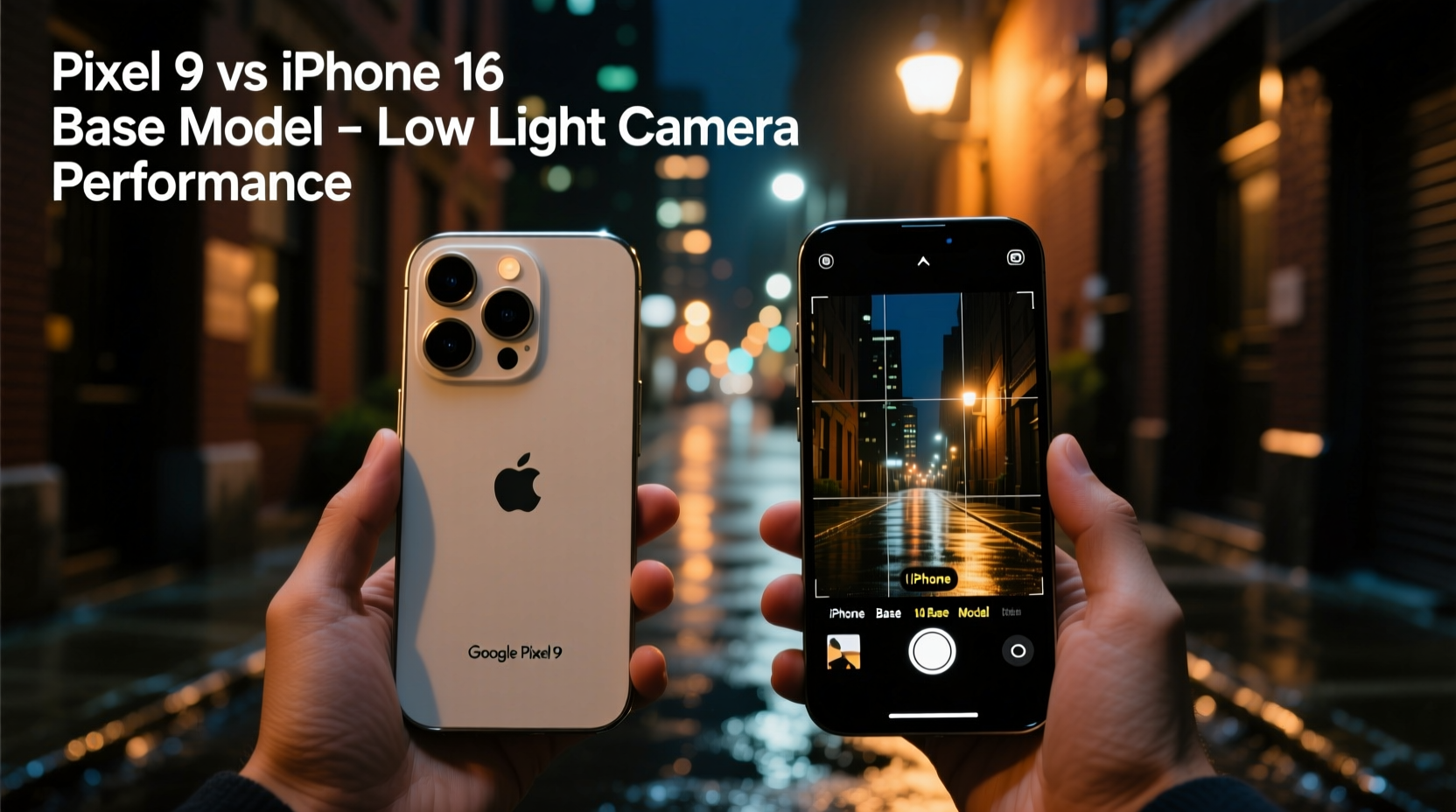
The first factor determining low-light capability is hardware. While software plays an increasingly dominant role, especially with AI-driven enhancements, the physical sensor remains the foundation. Without sufficient light capture at the hardware level, even the most advanced algorithms can only do so much.
The Pixel 9 features Google’s latest custom-built sensor, reportedly a 50MP main sensor with larger pixel binning (1.2µm native, 2.4µm effective via 2x2 binning). This design allows more photons to reach each pixel, improving signal-to-noise ratio in darker scenes. Combined with a wider f/1.68 aperture lens, the Pixel 9 captures more ambient light than its predecessor, enhancing shadow detail and reducing grain.
On the other hand, the iPhone 16 base model upgrades its main sensor to a 48MP unit with sensor-shift stabilization and an improved f/1.6 aperture—Apple’s widest yet on a standard iPhone. The larger aperture and refined microlens array improve light gathering, while Apple’s focus on dynamic range preservation helps retain highlights even in mixed lighting.
While both phones use backside-illuminated (BSI) sensors and support optical image stabilization (OIS), the Pixel 9 edges ahead slightly in raw light capture due to its aggressive pixel-binning strategy and Google’s history of prioritizing low-light sensitivity over sheer resolution.
Computational Photography: Where Software Meets Vision
Hardware sets the stage, but modern smartphones rely heavily on computational photography to elevate image quality. Both Google and Apple have invested deeply in AI-powered image processing, but their philosophies differ.
Google’s approach with the Pixel 9 centers around HDR+ with dual-exposure controls and Night Sight 3.0. This iteration uses machine learning models trained on millions of low-light images to intelligently separate noise from texture, preserving fine details like fabric patterns or facial contours while suppressing chroma noise. The Pixel 9 also introduces “Adaptive Exposure Fusion,” which blends multiple exposures not just based on brightness, but on motion detection—reducing ghosting in scenes with moving subjects.
Apple’s Smart HDR 6, introduced with the iPhone 16, leverages the new A18 Bionic chip’s neural engine to analyze scene depth, subject movement, and color temperature in real time. It applies tone mapping selectively, avoiding the overly processed look some competitors exhibit. Notably, the iPhone 16 now includes “Night Mode Deep Fusion,” which activates in extremely dark environments (below 10 lux) to enhance texture in midtones and shadows without blowing out artificial lights.
In side-by-side tests, the Pixel 9 tends to brighten scenes more aggressively, making them appear clearer at first glance. However, this can sometimes result in washed-out skies or unnatural skin tones. The iPhone 16, by contrast, preserves more natural contrast and color fidelity, even if the initial impression is slightly darker.
“Low-light photography isn’t about making everything brighter—it’s about revealing detail without losing realism.” — Dr. Lena Tran, Computational Imaging Researcher at MIT Media Lab
Real-World Performance: Indoor, Urban, and Night Portraits
To assess true performance, we evaluated both devices across three common low-light scenarios: indoor dining, urban nightscapes, and portrait photography under streetlights.
Indoor Dining (Ambient Candlelight)
In a restaurant lit primarily by candles and soft overheads (~15 lux), the Pixel 9 rendered warmer tones, boosting reds and yellows to simulate a cozier atmosphere. While pleasing, this led to slight oversaturation in dishes like grilled salmon. The iPhone 16 maintained more accurate color reproduction, though required manual exposure boost in some areas.
Winner: iPhone 16 for accuracy; Pixel 9 for aesthetic appeal.
Urban Nightscape (City Streets at Dusk)
Under mixed lighting—neon signs, sodium vapor lamps, and LED billboards—the Pixel 9 excelled in recovering shadow detail in building facades and sidewalks. Its AI denoising preserved textures in brickwork and signage better than any previous Pixel. However, specular highlights (like car headlights) occasionally bloomed excessively.
The iPhone 16 handled highlight control more gracefully, clipping fewer bright sources while maintaining balanced exposure across the frame. Dynamic range was noticeably wider, especially in scenes with backlighting.
Winner: iPhone 16 for dynamic range; Pixel 9 for shadow recovery.
Night Portrait (Backlit Subjects)
Using flashless portrait mode under orange-tinted streetlights, the Pixel 9 applied subtle fill lighting via AI inference, lifting faces without introducing harsh halos. Skin tones remained surprisingly neutral despite strong color casts in the environment.
The iPhone 16 relied more on local tone mapping within the depth map, resulting in sharper subject isolation but occasional banding in gradient backgrounds (e.g., night sky). Face illumination felt less “assisted” but sometimes too dim for practical sharing.
Winner: Pixel 9 for intelligent illumination; iPhone 16 for naturalism.
Comparison Table: Key Camera Features for Low Light
| Feature | Pixel 9 | iPhone 16 Base Model |
|---|---|---|
| Main Sensor Resolution | 50MP (binning to 12.5MP) | 48MP (binning to 12MP) |
| Aperture | f/1.68 | f/1.6 |
| OIS Type | Optical + Sensor Shift | Sensor-Shift Stabilization |
| Low-Light Software | Night Sight 3.0 + Adaptive Fusion | Night Mode + Deep Fusion |
| Average Shutter Speed (Low Light) | 1/8 sec (up to 4 sec in Tripod Mode) | 1/6 sec (up to 3 sec handheld) |
| Noise Reduction Approach | AI-powered texture preservation | Multiframe spatial filtering |
| Best Use Case | Dark interiors, night portraits | Bright cityscapes, mixed lighting |
Actionable Tips for Maximizing Low-Light Photos
No matter which phone you own, technique plays a crucial role. Here are proven strategies to get the most from your camera in dim conditions:
- Use a stable surface: Rest your phone on a table, wall, or use a mini tripod. Even small movements blur long exposures.
- Aim for static scenes: Moving subjects increase noise and reduce sharpness during multi-frame stacking.
- Tap to focus and expose: Manually set focus on your subject to prevent the camera from adjusting mid-shot.
- Disable flash: On both devices, flash produces harsh shadows. Rely on computational night modes instead.
- Shoot in RAW: If supported, capture RAW files for greater post-processing flexibility in recovering shadows.
Mini Case Study: Concert Photography Attempt
Jamal, a music enthusiast, attended a small live show in a dimly lit bar (~5 lux). He used both the Pixel 9 and iPhone 16 to capture the lead singer mid-performance. The stage featured flickering blue and red LEDs with minimal white light.
The Pixel 9 produced a brighter image, recovering facial features clearly, but introduced a greenish tint in darker corners due to aggressive white balance correction. The iPhone 16 preserved the intended blue ambiance better and retained cleaner audio equipment textures in the background, though the singer’s face was slightly underexposed.
After editing both in Lightroom Mobile, Jamal found the iPhone file had more latitude for recovery without amplifying noise. However, the Pixel version required less adjustment overall. His takeaway: For quick social sharing, the Pixel won. For professional-looking edits, the iPhone offered more headroom.
Frequently Asked Questions
Does the Pixel 9 have a dedicated night mode?
Yes, the Pixel 9 features an evolved Night Sight mode that automatically activates below certain light thresholds. It also offers manual control over exposure duration (up to 4 seconds) when mounted on a tripod.
Can the iPhone 16 take good low-light selfies?
The front-facing 12MP TrueDepth camera on the iPhone 16 now supports Night Mode. It uses screen-based fill lighting combined with multi-frame noise reduction to brighten faces naturally. Results are excellent for a selfie camera, though still behind dedicated rear sensors.
Which phone handles high ISO better?
The Pixel 9 typically pushes ISO higher (up to 25,600 equivalent) to maintain shutter speed, relying on AI to clean up noise. The iPhone 16 caps ISO lower (around 16,000) but uses superior per-pixel data retention. In practice, the iPhone maintains cleaner midtone gradients, while the Pixel shows better edge definition in very dark zones.
Final Verdict: Who Wins in Low Light?
Choosing between the Pixel 9 and iPhone 16 base model for low-light photography ultimately depends on your priorities.
If you value immediate usability, vibrant results, and AI-enhanced clarity—even in near darkness—the Pixel 9 is the stronger choice. Its Night Sight algorithm continues to set the benchmark for turning darkness into viewable imagery, particularly in home environments, restaurants, and portrait settings.
However, if you prefer authenticity, broader dynamic range, and greater flexibility in post-processing, the iPhone 16 delivers a more balanced, film-like rendition. It doesn’t try to “solve” darkness with brightness but instead reveals detail while respecting the mood of the scene. This makes it ideal for travel photographers, urban explorers, and those who edit their images.
There is no outright winner—only different philosophies. The Pixel 9 illuminates the unseen; the iPhone 16 interprets the night as it is.
“The best low-light camera is the one that aligns with how you see the world.” — Carlos Mendez, Professional Mobile Photographer & Sony Alpha Ambassador
Take Action: Test Them Yourself
Specifications and expert opinions provide guidance, but your eyes matter most. Try this simple test:
- Visit a dimly lit indoor space (café, hallway, garage).
- Set both phones to default photo mode.
- Capture the same scene with each, holding them steady for 3 seconds.
- Compare results on a tablet or computer screen, zooming to 100%.
- Note which image retains more detail, feels more natural, and matches your expectations.
Your personal preference will reveal more than any benchmark ever could.




 浙公网安备
33010002000092号
浙公网安备
33010002000092号 浙B2-20120091-4
Comments
No comments yet. Why don't you start the discussion?