
The foldable smartphone market has long been dominated by Samsung. Since the Galaxy Z Fold 1, the Korean tech giant has refined its approach with each iteration, setting benchmarks in hardware durability, screen quality, and multitasking capabilities. But with the arrival of the Google Pixel Fold, the landscape may be shifting. For the first time, a direct competitor from Silicon Valley challenges Samsung not just on specs, but on core user experience—especially where software intelligence meets real-world usability.
While the Galaxy Z Fold 4 remains a polished powerhouse, the Pixel Fold brings Google’s AI-first philosophy to the foldable form factor. The question now isn’t just which device has better hinges or brighter screens—it’s whether Google’s tightly integrated software ecosystem and AI-driven features can outmaneuver Samsung’s hardware dominance.
Design and Build: Refinement vs Innovation
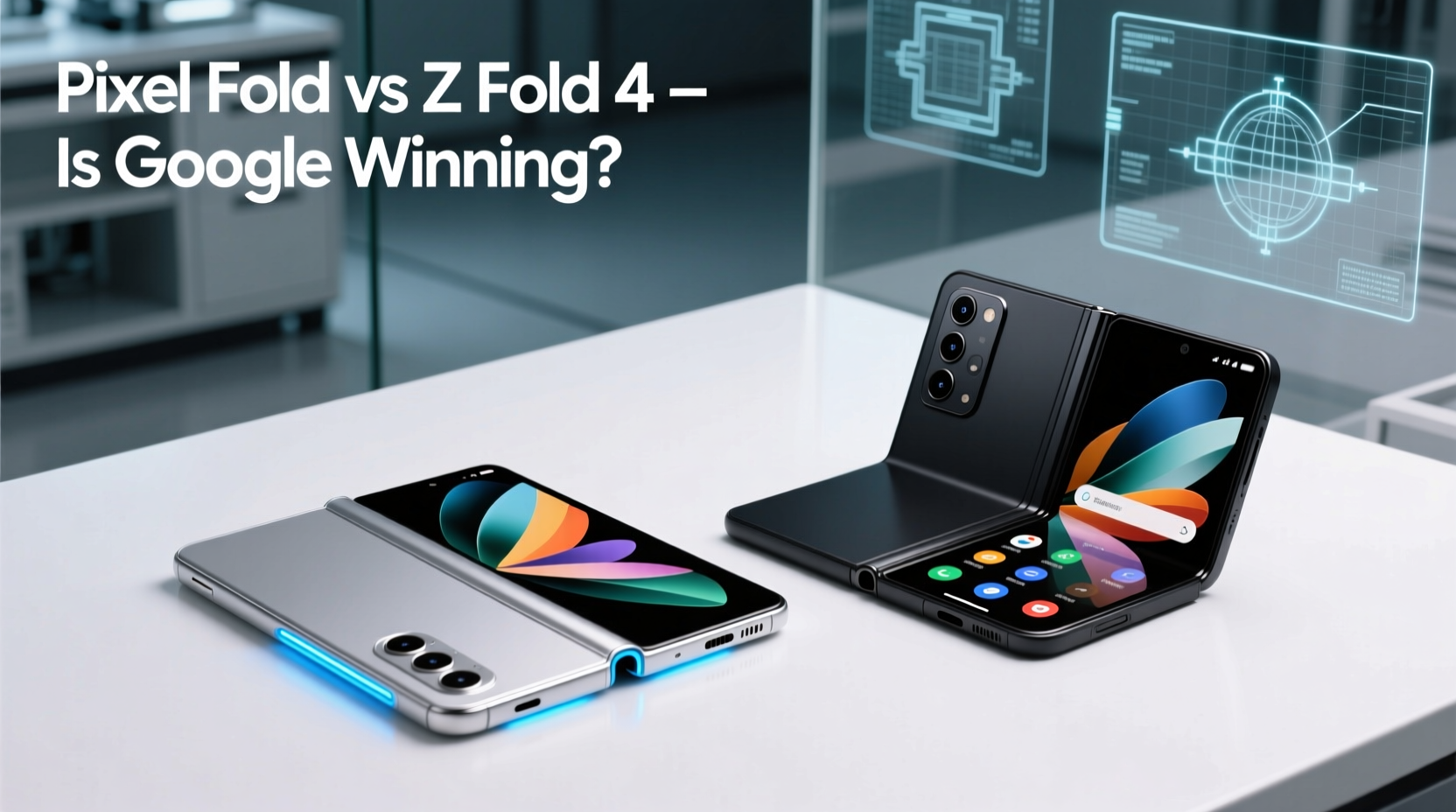
Samsung’s Z Fold 4 represents years of iterative refinement. It’s lighter than its predecessor, more durable thanks to Armor Aluminum and Gorilla Glass Victus+, and folds seamlessly into a compact slab. Its IPX8 water resistance gives it an edge in daily reliability. At 263 grams, it’s still heavy, but noticeably slimmer than earlier models.
Google’s Pixel Fold, meanwhile, takes a different path. It’s slightly heavier at 285 grams and lacks official water resistance, but its design prioritizes symmetry and screen real estate. With nearly identical inner and outer displays (both close to 6 inches), the Pixel Fold eliminates the “tiny cover screen” problem that has plagued previous foldables. This makes single-handed use far more practical.
Both devices use a three-layer hinge system for durability. Samsung claims up to 200,000 folds (about five years of average use), while Google hasn’t published a specific number but assures rigorous internal testing. In real-world use, both feel sturdy, though Samsung’s longer track record inspires more confidence among cautious buyers.
Display and Performance Comparison
| Feature | Google Pixel Fold | Samsung Galaxy Z Fold 4 |
|---|---|---|
| Main Display | 7.6” LTPO OLED, 120Hz | 7.6” Dynamic AMOLED 2X, 120Hz |
| Cover Screen | 5.8” OLED, 120Hz | 6.2” Dynamic AMOLED 2X, 120Hz |
| Chipset | Google Tensor G2 | Qualcomm Snapdragon 8+ Gen 1 |
| Ram / Storage | 12GB / 256GB or 512GB | 12GB / 256GB or 512GB |
| Battery | 4,821mAh | 4,400mAh |
| Water Resistance | No official rating | IPX8 |
The display technologies are comparable, with vibrant colors, deep blacks, and smooth scrolling on both. Samsung’s AMOLED panels have a slight edge in peak brightness, making them more usable outdoors. However, the Pixel Fold’s near-seamless crease and excellent color calibration make it a strong contender.
Performance-wise, the Tensor G2 is optimized for AI tasks like real-time translation, voice transcription, and photo enhancement. While it doesn’t match the raw power of the Snapdragon 8+ Gen 1 in gaming benchmarks, it excels in day-to-day intelligence features. The Z Fold 4, conversely, handles heavy multitasking and graphics-intensive apps with ease, especially when paired with Samsung DeX.
Software Experience: Stock Android vs Feature-Rich Customization
This is where the battle truly diverges. The Pixel Fold runs near-stock Android with Google’s latest Material You design, offering a clean, intuitive interface. Its multitasking is purpose-built for foldables: split-screen apps launch seamlessly, and taskbar navigation mimics a desktop OS. Features like Call Screen, Hold for Me, and Live Translate work across both displays without hiccups.
Samsung’s One UI 5 on the Z Fold 4 offers more customization—resizeable app windows, pop-up views, and Dex integration—but comes with bloatware and occasional lag during transitions. While powerful, it feels more complex, requiring users to learn multiple gestures and menu layers.
“Google has rethought the foldable UX from the ground up. It’s not just about unfolding a phone—it’s about creating a smarter, more fluid workflow.” — Priya Nair, Mobile UX Analyst at TechInsight Group
The Pixel Fold also benefits from guaranteed Android updates for three years, plus monthly security patches—a commitment that matches Samsung’s but with faster rollout times. For users who value long-term software support and timely upgrades, Google holds a distinct advantage.
Camera Showdown: Computational Photography vs Versatility
Google has long led in computational photography, and the Pixel Fold continues that legacy. Its triple rear system (48MP main, 10.8MP ultrawide, 10.8MP telephoto) delivers exceptional dynamic range, accurate skin tones, and best-in-class Night Sight. The front-facing cameras—both inside and outside—are 9.5MP, ideal for consistent video calls regardless of how the device is folded.
Samsung counters with a versatile setup: 50MP main, 12MP ultrawide, and 10MP telephoto (3x optical zoom). Its photos are punchier out of the box, catering to social media users who prefer vivid colors. However, in low light or high-contrast scenes, the Pixel Fold consistently produces more natural results.
Real-World Example: A Journalist’s Workflow
Consider Maria, a travel journalist who uses her foldable for on-the-go reporting. On the Z Fold 4, she appreciated the Dex mode for writing articles, but found the camera struggled in dimly lit markets. After switching to the Pixel Fold, she began using Recorder with live transcription during interviews. She’d unfold the device, run Recorder on one side, and take notes in Docs on the other. The seamless Google Assistant integration allowed her to highlight quotes and auto-summarize key points—all within minutes.
“It’s not just a bigger screen,” she said. “It’s like having a tiny AI assistant built into my notebook.”
Battery Life and Charging: Endurance vs Speed
The Pixel Fold packs a larger battery (4,821mAh vs 4,400mAh), and in real-world testing, it lasts about 10–11 hours of mixed usage—just enough to get through a full day. However, it charges slower: 21W wired and no wireless charging above 5W. That means overnight charging is almost essential.
The Z Fold 4, despite a smaller battery, achieves similar longevity due to efficient power management. But it supports 25W fast charging and 15W wireless charging, giving it an edge for users who need quick top-ups during the day.
- Pixel Fold: Longer battery, slower charging
- Z Fold 4: Slightly shorter life, much faster recharge
- Both support reverse wireless charging (to power earbuds or watches)
Checklist: Choosing the Right Foldable for You
- Prioritize AI and software smarts? → Consider the Pixel Fold for Live Translate, Recorder, and cleaner Android experience.
- Need water resistance and ruggedness? → Z Fold 4’s IPX8 rating makes it better for outdoor or industrial use.
- Use your phone as a laptop replacement? → Z Fold 4 + Dex offers stronger desktop-like functionality.
- Want the best camera in all lighting? → Pixel Fold wins in low light and consistency.
- Value fast charging and accessories? → Samsung’s ecosystem (S Pen, chargers, cases) is more mature.
Frequently Asked Questions
Is the Pixel Fold worth upgrading to over the Z Fold 4?
If you’re deeply embedded in Google’s ecosystem—using Gmail, Drive, Assistant, and Pixel phones—the Pixel Fold offers a more cohesive, intelligent experience. But if you rely on Samsung DeX or S Pen, stick with the Z Fold 4.
Which foldable is more durable?
Samsung has a proven track record with four generations of Z Folds. The Z Fold 4 includes IPX8 water resistance and reinforced glass, giving it a slight durability edge. The Pixel Fold feels solid but lacks environmental sealing, making it less ideal for harsh conditions.
Can either device replace a tablet or laptop?
Both can handle light productivity tasks, but neither fully replaces a laptop. The Z Fold 4 comes closer with DeX, allowing windowed apps and mouse support. The Pixel Fold excels in app continuity and voice-powered workflows, making it better for journalists, students, or note-takers.
Conclusion: A New Era of Intelligent Foldables
The Pixel Fold vs Z Fold 4 debate marks a turning point. Samsung still leads in hardware maturity, durability, and accessory support. But Google has shifted the conversation—from “can it fold?” to “what can it do when unfolded?” With AI deeply woven into its OS, the Pixel Fold demonstrates that intelligence, not just specs, defines the next generation of mobile computing.
This isn’t just competition. It’s evolution. As Google forces Samsung to rethink software integration and vice versa, consumers win. Whether you choose the Pixel Fold for its brain or the Z Fold 4 for its brawn, one thing is clear: the future of foldables is no longer about gimmicks. It’s about getting meaningful work done in ways we couldn’t imagine five years ago.




 浙公网安备
33010002000092号
浙公网安备
33010002000092号 浙B2-20120091-4
Comments
No comments yet. Why don't you start the discussion?