
Choosing the right smartwatch as an Android user means balancing seamless integration, reliable performance, and long-term usability. Two leading contenders—Google’s Pixel Watch 2 and Samsung’s Galaxy Watch 6—offer distinct advantages tailored to different lifestyles. While both run Wear OS and support full Android compatibility, their approach to battery life, health tracking, design, and software experience sets them apart. For users deciding between these devices, understanding how each performs in real-world usage is critical.
This comparison dives deep into key areas that matter most: battery longevity, fitness and health monitoring, Google ecosystem integration, display quality, durability, and value. Whether you're a fitness enthusiast, a productivity-focused professional, or someone who values all-day convenience, this guide delivers actionable insights to help you make an informed decision.
Battery Life: Real-World Endurance Compared
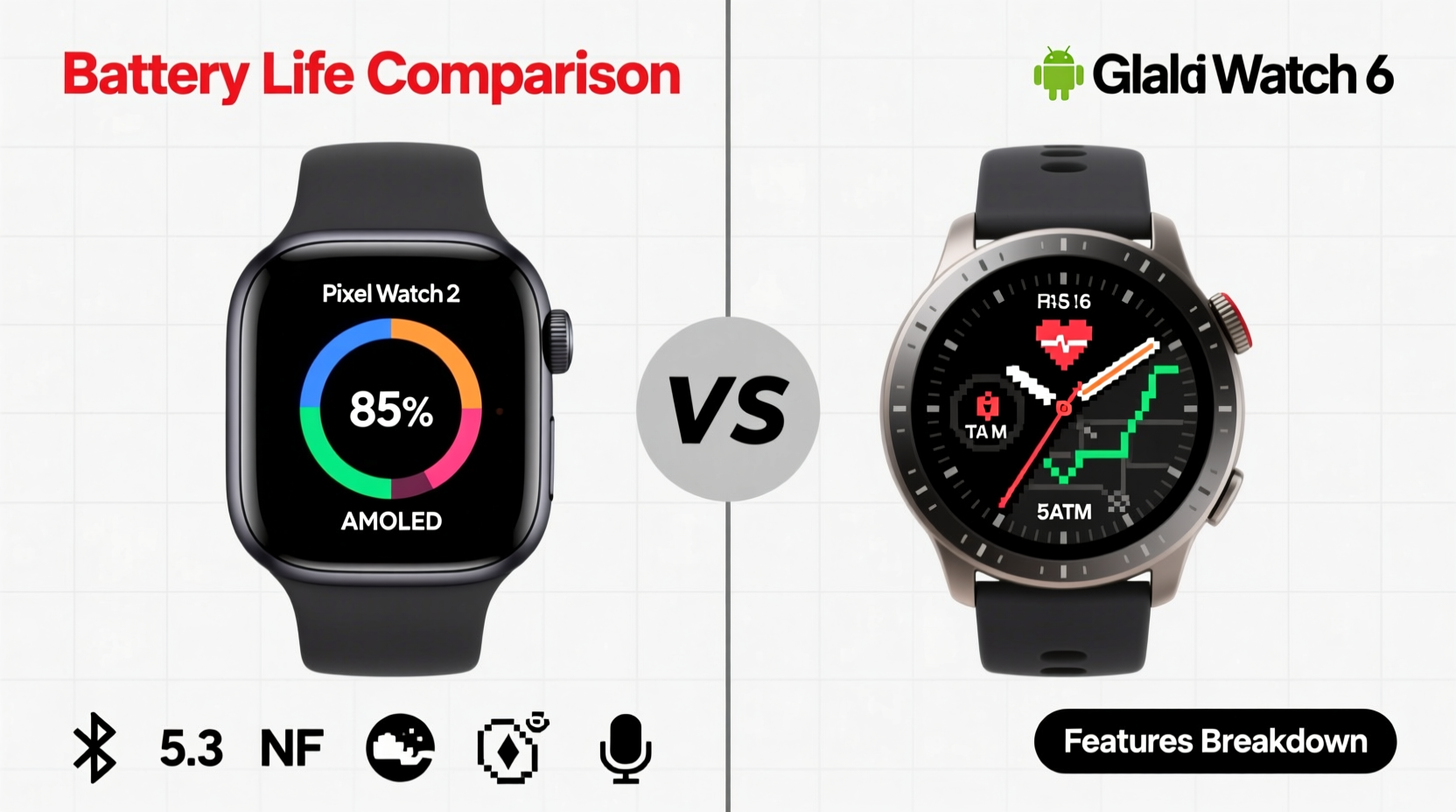
Battery life remains one of the most debated aspects of modern smartwatches. Both the Pixel Watch 2 and Galaxy Watch 6 promise “up to” 24–48 hours, but actual performance varies significantly based on usage patterns.
The **Pixel Watch 2** improves over its predecessor with a 305 mAh battery and more efficient components, including the newer Exynos W930 chip co-developed by Google and Samsung. In moderate use—notifications, occasional heart rate checks, sleep tracking, and one 30-minute workout—the device typically lasts about 28–32 hours. Heavy GPS usage during outdoor runs can reduce that to under 20 hours. Notably, it supports fast charging, reaching 80% in around 45 minutes.
In contrast, the **Galaxy Watch 6** (44mm model) packs a larger 425 mAh battery, giving it a clear edge. Under similar conditions, it consistently delivers 36–44 hours. With power-saving mode enabled and fewer background apps, some users report stretching it to nearly two days. The Watch 6 Classic variant offers slightly longer life due to optimized dial mechanics and reduced screen-on time.
| Feature | Pixel Watch 2 | Galaxy Watch 6 (44mm) |
|---|---|---|
| Battery Capacity | 305 mAh | 425 mAh |
| Average Battery Life | 28–32 hours | 36–44 hours |
| Fast Charging Support | Yes (0–80% in ~45 min) | Yes (0–80% in ~60 min) |
| Charging Method | Magnetic puck (proprietary) | Magnetic puck (Samsung standard) |
| Standby Efficiency | Good | Excellent |
Fitness and Health Tracking: Accuracy and Features
Both watches offer comprehensive health monitoring, but their implementation differs in depth and reliability.
The **Pixel Watch 2** introduces enhanced sensors developed with Fitbit, including dual-band heart rate monitoring, skin temperature sensing, EDA (electrodermal activity) for stress tracking, and improved SpO2 accuracy. Its standout feature is continuous skin temperature tracking overnight, which aids in detecting physiological shifts like illness onset or menstrual cycle changes. It also includes built-in GPS and automatic workout detection for running, cycling, swimming, and elliptical training.
Samsung’s **Galaxy Watch 6** builds on years of refinement with optical heart rate, ECG, blood pressure estimation (in select regions), and advanced sleep staging powered by AI. Its BioActive Sensor combines three technologies into one module for consistent readings. While it lacks skin temperature tracking, its body composition analysis using BIA (Bioelectrical Impedance Analysis) provides metrics like skeletal muscle mass and body fat percentage—useful for serious fitness enthusiasts.
“Wearable health data is only valuable if it's accurate and contextual. Samsung’s long-term investment in sensor fusion gives it an edge in consistency.” — Dr. Lena Torres, Digital Health Researcher at MIT Media Lab
For runners and swimmers, both watches deliver reliable GPS and water resistance (5ATM). However, the Galaxy Watch 6’s larger size allows for better antenna placement, resulting in faster satellite lock and improved route accuracy in dense urban areas.
Software Experience and Android Integration
As Android-centric devices, both watches benefit from deep platform integration—but in different ways.
The **Pixel Watch 2** offers the purest Wear OS experience, closely aligned with Google’s vision. It receives updates directly from Google, often weeks before other manufacturers. This ensures timely security patches and new features like voice message replies, Google Wallet enhancements, and deeper Assistant functionality. Notifications sync instantly across Pixel phones, and Call Screen works seamlessly when answering calls from the wrist.
On the other hand, the **Galaxy Watch 6** runs Samsung’s One UI Watch atop Wear OS. While it adds useful customization options—rotating bezel navigation (Classic model), multi-window support, and richer app shortcuts—it may feel bloated to minimalists. That said, Samsung excels in cross-device synergy for Galaxy phone owners: seamless Bluetooth audio switching, SmartThings control, and private share via wrist gestures.
For non-Galaxy Android users, the Pixel Watch 2 generally provides smoother pairing and fewer compatibility hiccups. Apps like YouTube Music, Google Maps, and Messages behave more predictably. Meanwhile, Galaxy-specific features such as Samsung Health integration or DeX support are less relevant outside the Samsung ecosystem.
Design, Durability, and Daily Usability
Form factor plays a major role in comfort and practicality.
The **Pixel Watch 2** retains a compact, domed design with a stainless steel case and recycled aluminum trim. At 41mm, it fits smaller wrists comfortably and maintains a premium look. The flat-lens Gorilla Glass 5 offers decent scratch resistance, though the curved edges remain vulnerable. It uses proprietary quick-release bands, limiting third-party accessory choices unless adapters are used.
The **Galaxy Watch 6** comes in 40mm and 44mm sizes, with the latter being more popular for its balance of screen space and wearability. The aluminum build feels lightweight, while the Classic version features a rotating bezel made of ceramic-metal composite, enhancing tactile feedback. Its sapphire crystal glass provides superior scratch protection, making it ideal for active users or those working in rugged environments.
In terms of daily usability, the Galaxy Watch 6’s larger display makes reading messages, controlling music, and navigating menus easier. The rotating bezel (on Classic models) reduces reliance on touch input, which is helpful during workouts or in cold weather with gloves. The Pixel Watch 2 relies entirely on touchscreen and crown scrolling, which can be less precise under wet conditions.
Real-World User Scenario: Commuter and Weekend Athlete
Consider Alex, a 32-year-old urban commuter and weekend trail runner who uses a Google Pixel 8 Pro. During weekdays, Alex relies on his smartwatch for transit alerts, calendar reminders, and stress tracking during back-to-back meetings. On weekends, he logs 10K runs with GPS tracking and monitors recovery metrics.
With the **Pixel Watch 2**, Alex enjoys instant notification syncing, smooth Google Maps turn-by-turn directions on-wrist, and accurate post-run summaries synced directly to Fitbit. However, he finds himself charging the watch every night because prolonged GPS use drains it quickly. He appreciates the discreet design under dress shirts but wishes for a longer battery window.
Switching to the **Galaxy Watch 6**, Alex notices faster GPS lock times and more detailed post-workout analytics, including VO₂ max estimates and stride length. The extra battery life lets him skip a mid-week charge, even after a long Saturday hike. Though he doesn’t use Samsung Pay, the larger screen improves readability on crowded subways. His only gripe? Some Google Assistant responses feel slower than on the Pixel Watch.
This scenario illustrates that hardware preferences depend heavily on routine demands. For integrated Google services and minimalist design, the Pixel Watch 2 wins. For endurance athletes needing robust tracking and extended uptime, the Galaxy Watch 6 pulls ahead.
Actionable Checklist Before Buying
Use this checklist to determine which watch aligns best with your needs:
- ✅ Do you own a Pixel phone? → Prioritize Pixel Watch 2 for tighter integration.
- ✅ Do you need >36-hour battery life? → Choose Galaxy Watch 6.
- ✅ Are you a serious athlete tracking performance metrics? → Galaxy Watch 6 offers deeper insights.
- ✅ Do you value skin temperature or EDA stress tracking? → Pixel Watch 2 has unique biometrics.
- ✅ Do you prefer physical controls over touch-only navigation? → Opt for Galaxy Watch 6 Classic.
- ✅ Is fast software updating important? → Pixel Watch 2 gets updates first.
- ✅ Do you want broader third-party band compatibility? → Galaxy Watch uses standard 20mm lugs.
Frequently Asked Questions
Can I use the Galaxy Watch 6 with a non-Samsung Android phone?
Yes. The Galaxy Watch 6 works with any Android phone running Android 10 or higher. However, some features like Samsung Health challenges, BP monitoring, and Seamless Audio Switching require a Galaxy phone for full functionality.
Does the Pixel Watch 2 support third-party watch faces?
Yes. While Google curates its Watch Face Library, developers can publish custom faces through the Play Store. You can install popular options like Facer or Zeno, though sideloading is limited compared to older platforms.
Which watch has better water resistance for swimming?
Both watches are rated 5ATM (up to 50 meters) and support swim tracking. The Galaxy Watch 6 edges ahead due to its superior GPS accuracy in open water and dedicated Swim Analytics in Samsung Health. The Pixel Watch 2 performs well but may record slightly erratic routes in choppy conditions.
Final Verdict and Recommendation
The choice between the Pixel Watch 2 and Galaxy Watch 6 ultimately hinges on your priorities. If you’re deeply invested in the Google ecosystem, appreciate clean design, and don’t mind nightly charging, the Pixel Watch 2 delivers a polished, future-proof experience with standout health innovations.
However, if battery life, display clarity, and comprehensive fitness analytics are non-negotiable, the Galaxy Watch 6—especially the Classic model—is the smarter pick. Its blend of hardware durability, extended endurance, and mature software suite makes it the most versatile Wear OS watch available today.
For most Android users seeking a balance of performance and longevity, the Galaxy Watch 6 represents the safer, more capable investment. But for those who live inside Google’s world and value wellness innovation over raw stamina, the Pixel Watch 2 remains a compelling alternative.




 浙公网安备
33010002000092号
浙公网安备
33010002000092号 浙B2-20120091-4
Comments
No comments yet. Why don't you start the discussion?