
For over two decades, Pokémon and Yu-Gi-Oh! have stood as titans in the world of collectible trading card games (TCGs). Both emerged from beloved anime franchises and evolved into global phenomena with competitive circuits, organized play, and passionate fanbases. Yet, despite their shared roots in pop culture and strategy gaming, they differ significantly in complexity, accessibility, and how quickly new players can grasp their core mechanics. The central question remains: which game presents a steeper learning curve?
The answer isn’t simply about rulebook length or card count. It’s about how intuitive the systems are, how much prior knowledge is assumed, and how easily beginners can transition from understanding basic gameplay to executing strategic decisions. By examining structure, turn flow, card interactions, and community resources, we can determine where each game stands in terms of initial difficulty and long-term mastery.
Game Structure and Core Objectives
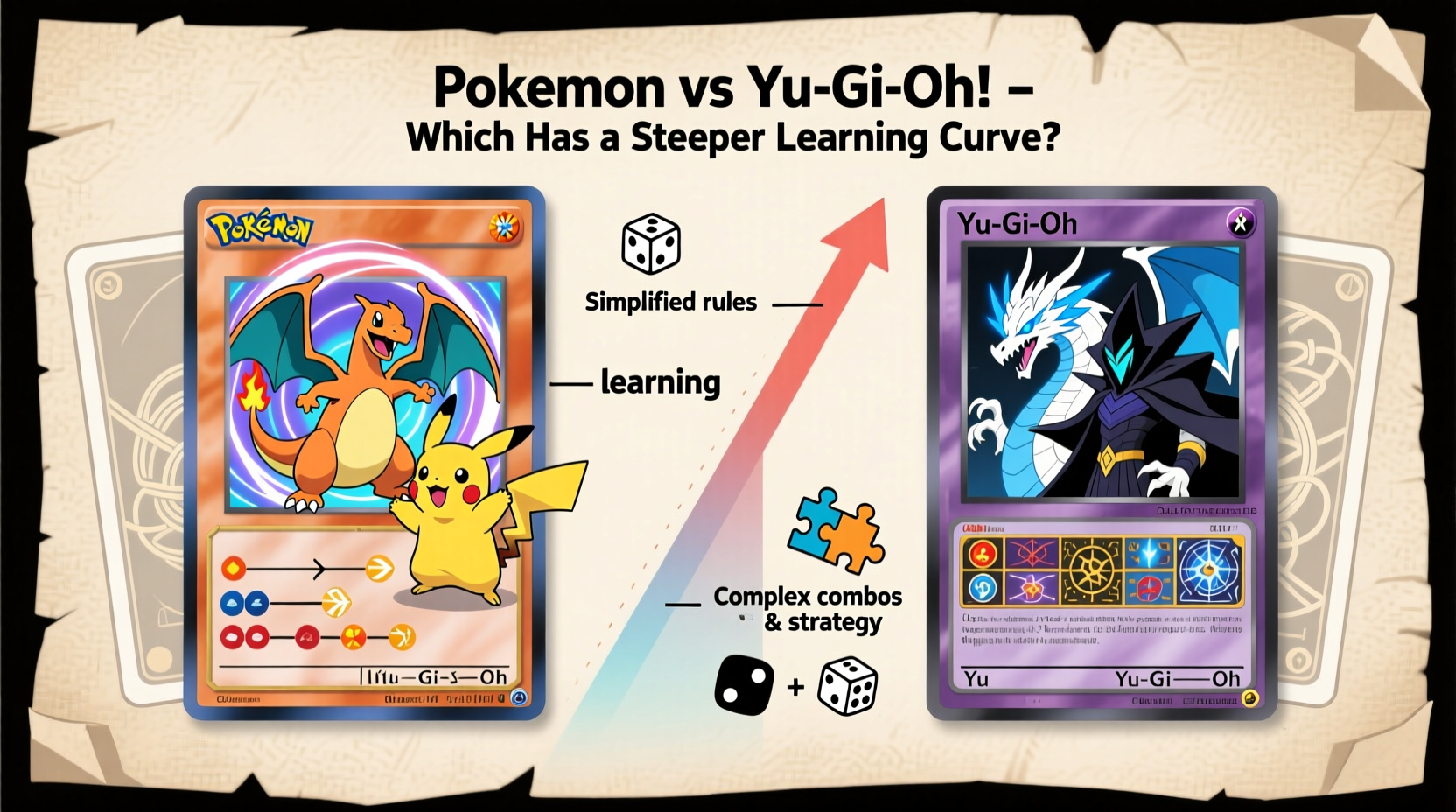
At first glance, both games share surface-level similarities: players use decks of cards representing characters or creatures, aim to reduce an opponent’s life points, and rely on resource management. However, their foundational designs diverge sharply.
Pokémon TCG is built around a streamlined, accessible framework. Each player begins by placing one Active Pokémon in play and up to five Benched Pokémon. The goal is to knock out six Prize cards by defeating opposing Pokémon. Energy cards power attacks, and turns follow a predictable sequence: draw a card, play Pokémon, attach energy, attack, and end turn. Special conditions like Burned or Paralyzed are clearly marked on cards, reducing the need for memorization.
In contrast, Yu-Gi-Oh! operates under a far more intricate system. Turns are divided into six distinct phases—Draw, Standby, Main 1, Battle, Main 2, and End—each allowing specific actions. Players manage multiple zones: Monster, Spell & Trap, Field, Graveyard, and Extra Deck. Summoning monsters involves various methods—Normal, Tribute, Fusion, Synchro, Xyz, Pendulum, Link—and each has unique requirements and timing windows. Card effects often trigger in response to others, creating complex chains that resolve in reverse order, a concept absent in Pokémon.
Complexity Comparison: Mechanics and Interactions
The real divergence lies in how card effects interact and when they can be activated. This is where the learning curve becomes most apparent.
In Pokémon, effects are generally static or conditional. For example, “At the end of your turn, heal 30 damage from this Pokémon” requires no timing judgment. Most abilities activate automatically or during your own turn. There’s minimal interaction with your opponent’s moves outside of direct combat. Interrupts and responses are rare, making the flow of play linear and predictable.
Yu-Gi-Oh!, however, thrives on dynamic interaction. Cards like Trap Hole or Call of the Haunted can be activated in response to specific events, such as a monster being summoned. These activations form \"chains,\" where players respond to each other’s moves in a stack-based system. Understanding chain order, priority, and timing windows—like whether a monster can be targeted before it hits the field—is essential for competitive play and often confusing for newcomers.
This reactive layer introduces a high cognitive load. A beginner might not realize that setting a Trap card doesn’t guarantee its activation if the opponent plays around it. Or that activating a Spell during Main Phase 1 limits options later. These nuances aren't just advanced tactics—they're fundamental to surviving even casual duels.
“Yu-Gi-Oh!’s depth comes from its timing system. But that same depth is what makes it intimidating. You’re not just playing your turn—you’re anticipating your opponent’s counters before they happen.” — James Lim, Level 5 Judge and Tournament Organizer
Learning Curve Breakdown: A Comparative Table
| Aspect | Pokémon TCG | Yu-Gi-Oh! |
|---|---|---|
| Turn Structure | Simple: Draw, Play, Attach, Attack, End | Complex: Six-phase system with strict order |
| Summoning Methods | One method: Play from hand (with evolution) | Multiple: Normal, Tribute, Fusion, Synchro, Xyz, Pendulum, Link |
| Card Interactions | Limited; mostly passive or automatic | High; real-time responses, chaining effects |
| Resource Management | Energy attachment per turn | Tribute sacrifices, spell speed, field control |
| Beginner-Friendly Onboarding | Strong: Clear icons, guided play apps | Moderate: Relies on external guides, community help |
| Time to First Win (Avg. New Player) | 1–2 sessions | 3–6 sessions |
| Rule Exceptions & Edge Cases | Few; most covered in starter rules | Many; require frequent reference to official guides |
A Real Example: Two Beginners’ First Week
Consider two friends, Mia and Leo, both picking up a TCG for the first time. Mia chooses Pokémon, Leo picks Yu-Gi-Oh!. They each spend three hours across four days learning their respective games.
Mia starts with a pre-built Charizard deck. The instruction booklet walks her through setup, turns, and winning conditions. By her second session, she’s confidently attaching Fire Energy, using basic attacks, and evolving her Pokémon. She wins her first match against a friend within 45 minutes of starting. The visuals on the cards—damage counters, energy types, ability text—are intuitive and color-coded.
Leo, meanwhile, struggles. His starter deck includes a Fusion Monster, but he can’t summon it because he doesn’t understand Tributes or Extra Deck rules. During his first duel, his opponent activates Monster Reborn, bringing back a powerful creature. Leo had no idea he could respond with a Trap card. He loses quickly, frustrated. It takes him two full sessions just to grasp the turn phases. By day four, he’s still mixing up when he can activate Spells versus Traps.
This scenario reflects a common experience. While both games reward study and practice, Pokémon allows faster early success, reinforcing motivation. Yu-Gi-Oh!’s early barrier to entry often leads to higher dropout rates among casual learners.
Step-by-Step: How to Approach Learning Each Game
Regardless of which game you choose, structured onboarding improves retention and reduces frustration. Here’s a practical timeline for mastering the basics.
- Day 1: Learn the Objective – Understand how to win (knock out Prizes in Pokémon, reduce LP to zero in Yu-Gi-Oh!). Study deck composition: Pokémon needs Basics, Energy, Trainers; Yu-Gi-Oh! needs Monsters, Spells, Traps.
- Day 2: Run a Practice Turn – Use a solo setup or app (like Pokémon Live or Yu-Gi-Oh! Duel Links) to go through a full turn. Focus on sequence, not strategy.
- Day 3: Introduce One Complex Mechanic – For Pokémon: Evolutions. For Yu-Gi-Oh!: Normal Summon and setting cards.
- Day 4: Play a Controlled Match – Duel someone with the same starter deck. Limit card pool to avoid confusion.
- Day 5: Add One Interactive Element – In Pokémon: Try a Supporter card. In Yu-Gi-Oh!: Activate a Counter Trap in response to a summon.
- Day 6–7: Review and Repeat – Replay matches, identify mistakes, consult official rule summaries.
This method works for both games, but expect to move slower with Yu-Gi-Oh! due to layered mechanics. Skipping steps—like trying to build a custom deck too soon—often leads to confusion.
Checklist: Essential Knowledge Before Going Competitive
- ✅ Understand all phases of your turn (especially critical in Yu-Gi-Oh!)
- ✅ Know the difference between Continuous, Trigger, and Activated effects
- ✅ Be able to identify valid targets and summoning conditions
- ✅ Recognize when you can interrupt your opponent (Spell Speed in Yu-Gi-Oh!, Quick Abilities in Pokémon)
- ✅ Memorize key terminology: “banish,” “attach,” “evolve,” “pendulum scale,” “link marker”
- ✅ Practice deck construction within format rules (Standard, Advanced, etc.)
- ✅ Watch at least three live tournament matches to observe pacing and decision-making
Frequently Asked Questions
Is Pokémon TCG easier for kids than Yu-Gi-Oh!?
Yes, overwhelmingly so. Pokémon uses simpler language, visual cues, and fewer procedural steps. Its younger target demographic is reflected in design choices—larger text, clear icons, and gradual complexity through evolutions. Many children as young as 6 can play basic matches after a single explanation. Yu-Gi-Oh!’s abstract concepts and dense text make it better suited for ages 10 and up.
Can you become competitive faster in Pokémon?
Generally, yes. Because the core mechanics stabilize earlier, players can focus on strategy, deck tuning, and meta awareness within weeks. In Yu-Gi-Oh!, months may pass before a player fully grasps timing and chain resolution—prerequisites for effective competition. That said, mastery in either game takes years.
Does Yu-Gi-Oh!’s complexity make it more rewarding?
For many players, yes. The satisfaction of successfully navigating a multi-card chain or predicting an opponent’s move is unique to high-interaction games like Yu-Gi-Oh!. The sense of control and tactical depth appeals to those who enjoy chess-like foresight. However, this depth isn’t inherently “better”—it’s a matter of preference. Some players value accessibility over intricacy.
Final Verdict: Which Has the Steeper Curve?
After evaluating structure, mechanics, and real-world learning patterns, **Yu-Gi-Oh! has a significantly steeper learning curve than Pokémon TCG**. This isn’t a flaw—it’s a design choice that enables deeper strategic layers and dynamic duels. But it comes at the cost of accessibility.
Pokémon excels at onboarding. Its rules are transparent, its progression logical, and its failures rarely stem from misunderstanding hidden systems. You can lose because your opponent had a stronger deck, not because you missed a timing window.
Yu-Gi-Oh!, while more complex, offers unparalleled interactivity. Every phase invites counterplay. Every card could change the board state. But that richness demands investment. New players must grapple with abstract concepts like Spell Speed 2, Ignition Effects, and Chain Building—none of which exist in Pokémon.
If ease of entry and quick gratification are priorities, Pokémon is the clear winner. If you thrive on mastering intricate systems and love the thrill of real-time decision trees, Yu-Gi-Oh! will eventually reward your patience.
Take the Next Step
Whichever game calls to you, start small. Use starter decks. Play digitally before investing in physical cards. Join beginner communities on Reddit or Discord. Don’t rush to build a meta deck—master the fundamentals first.




 浙公网安备
33010002000092号
浙公网安备
33010002000092号 浙B2-20120091-4
Comments
No comments yet. Why don't you start the discussion?