
Glare from sunlight reflecting off water, snow, glass, or pavement doesn’t just annoy—it can impair vision, cause eye strain, and even lead to accidents while driving or during outdoor activities. Choosing the right lens technology is essential for visual comfort and safety. Two of the most popular options—polarized lenses and mirrored coatings—are often misunderstood. While both claim to combat glare, they do so in fundamentally different ways. Understanding how each works, where they excel, and how they compare can help you make an informed decision based on your lifestyle and environment.
How Glare Forms and Why It Matters
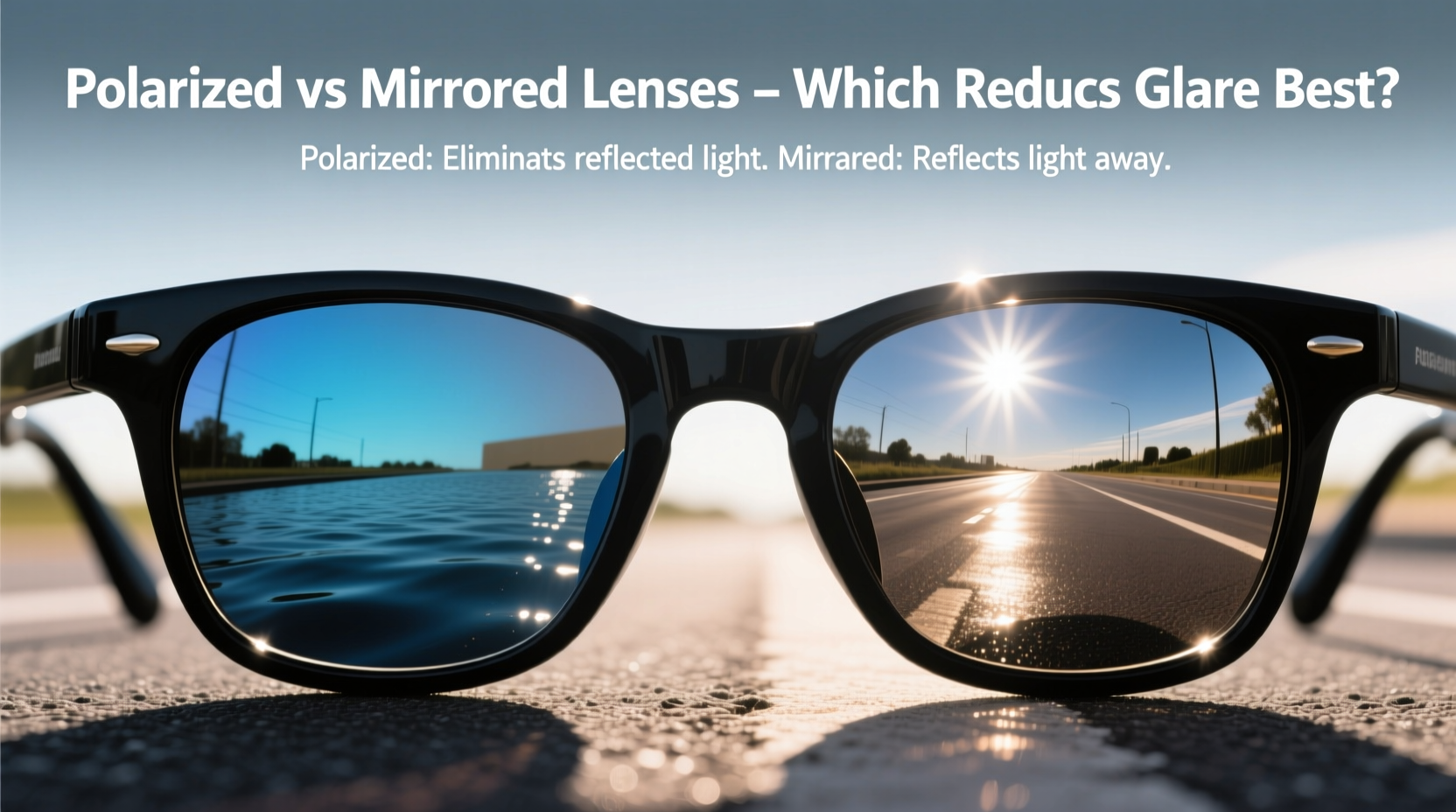
Glare occurs when sunlight reflects off flat, smooth surfaces such as water, roads, car hoods, or snow. These horizontal reflections create intense, concentrated light that overwhelms the eyes. This type of reflected light is often horizontally polarized, meaning the light waves oscillate in a single plane parallel to the surface. The human eye isn't designed to handle this kind of focused brightness, leading to squinting, fatigue, and reduced depth perception.
Effective glare reduction isn't just about dimming light—it's about filtering specific types of reflected light. That’s where specialized lens technologies come into play. Polarized lenses and mirrored coatings serve distinct purposes, though they are sometimes combined for enhanced performance.
Polarized Lenses: Targeted Glare Elimination
Polarized lenses contain a special chemical filter applied in a vertical alignment across the lens. This filter blocks horizontally oriented light waves—the primary component of surface glare—while allowing vertically oriented light to pass through. Think of it like a venetian blind: horizontal slats block side-to-side light but let vertical rays through.
This selective filtering dramatically reduces blinding reflections, especially in high-glare environments like lakes, oceans, snowy mountains, or wet asphalt. The result is sharper contrast, improved color clarity, and more natural vision under bright conditions.
However, polarization does not inherently reduce overall brightness. Instead, it targets the directionality of light. This means that while glare is significantly cut, the base tint of the lens determines how much total light reaches the eye.
Advantages of Polarized Lenses
- Eliminates up to 99% of horizontal glare from reflective surfaces
- Enhances visual clarity and contrast
- Reduces eye strain during prolonged sun exposure
- Improves depth perception, especially on water or snow
Limits of Polarization
- May interfere with visibility of LCD screens (e.g., smartphones, GPS devices, car dashboards)
- Does not increase UV protection—must be paired with UV-blocking materials
- Ineffective against non-horizontal glare or diffuse sky brightness
“Polarized lenses are among the most effective tools for reducing disabling glare in dynamic outdoor environments.” — Dr. Alan Weiss, Optometrist and Vision Science Researcher
Mirrored Lenses: Reflective Coatings for Bright Light
Mirrored lenses feature a thin, reflective metallic coating—often silver, gold, blue, or green—applied to the outer surface of the lens. This coating acts like a one-way mirror, reflecting a portion of incoming light before it enters the lens. Typically, mirror coatings can reflect 10–60% of ambient light, depending on the material and application.
Unlike polarization, mirroring does not discriminate based on the orientation of light waves. Instead, it reduces the overall intensity of light entering the eye by bouncing some of it away. This makes mirrored lenses ideal for extremely bright conditions, such as high-altitude skiing, desert trekking, or open-water sailing, where sheer volume of light—not just reflection—is the main concern.
The mirrored finish also provides a stylistic advantage, concealing the wearer’s eyes, which many find appealing for privacy or fashion.
Benefits of Mirrored Lenses
- Reduces total light transmission without darkening the lens excessively
- Helps prevent overheating of the lens and eyes in intense sunlight
- Offers aesthetic appeal and eye concealment
- Can be applied over polarized lenses for dual functionality
Drawbacks of Mirror Coatings
- Coating can scratch or peel over time, especially with improper cleaning
- Does not specifically target glare—only reduces general brightness
- Less effective than polarization at eliminating blinding reflections
Direct Comparison: Polarized vs Mirrored Lenses
| Feature | Polarized Lenses | Mirrored Lenses |
|---|---|---|
| Primary Function | Blocks horizontally polarized glare | Reflects overall incoming light |
| Glare Reduction | Excellent (targeted) | Moderate (general dimming) |
| Brightness Control | Depends on lens tint | High (due to reflection) |
| UV Protection | Only if added separately | Only if added separately |
| Durability | High (internal filter) | Moderate (coating may degrade) |
| Ideal For | Driving, fishing, beach, everyday wear | Mountains, deserts, high-altitude sports |
| LCD Screen Visibility | Potentially reduced | Generally unaffected |
Combining Both Technologies for Maximum Performance
Many premium sunglasses now integrate both polarization and mirror coatings. These hybrid lenses offer the best of both worlds: the glare-cutting precision of polarization and the extra light reduction of a reflective surface. For example, a pair of glacier glasses might have a polarized gray-green base with a silver mirror coating, delivering optimal clarity and comfort in extreme alpine conditions.
Such combinations are especially useful in environments where both intense ambient light and strong surface reflections coexist—like coastal drives, ski slopes, or open boats on sunny days.
Real-World Example: Fishing on a Sunny Lake
Consider Mark, an avid fly fisherman who spends weekends on a large freshwater lake. On a recent trip, he wore standard tinted sunglasses without polarization. Despite the dark lenses, he struggled to see beneath the water’s surface due to blinding reflections. Fish were nearly invisible, and his eyes ached by midday.
The following weekend, he switched to polarized amber-tinted sunglasses with a subtle blue mirror coating. Instantly, the surface glare vanished. He could clearly see trout near submerged rocks and made better casts as a result. The mirror layer helped keep the lenses cooler and further reduced brightness on the brightest parts of the day. His experience wasn’t just more comfortable—it was more productive.
This scenario illustrates that while mirror coatings help manage brightness, it was the polarization that solved the core problem: glare obscuring vision.
Step-by-Step Guide: Choosing the Right Lens for Your Needs
- Assess Your Primary Environment: Are you mostly on water, snow, roads, or urban settings? Water and snow generate high glare—favor polarization.
- Evaluate Light Intensity: High-altitude or desert regions demand extra light reduction—mirrored lenses add value here.
- Check for Combined Features: If you face both glare and extreme brightness, seek sunglasses that combine polarization and mirror coating.
- Test Screen Visibility: If you rely on GPS, phones, or digital dashboards, try on polarized glasses first to ensure readability.
- Consider Durability and Maintenance: Mirror coatings require gentle cleaning with microfiber cloths. Avoid abrasive materials.
- Verify UV Protection: Regardless of polarization or mirroring, ensure lenses block 100% of UVA and UVB rays.
Common Misconceptions Debunked
Misconception 1: “Mirrored lenses are automatically better for glare.” False. Mirrors reduce overall brightness but don’t selectively block glare like polarization does.
Misconception 2: “Darker lenses mean better protection.” Not true. Lens darkness affects comfort, not UV protection or glare control. A light-colored polarized lens can outperform a dark non-polarized one.
Misconception 3: “All premium sunglasses are polarized.” No. Many high-end fashion brands use mirror coatings for style but omit polarization unless specified.
FAQ: Polarized vs Mirrored Lenses
Do mirrored lenses provide UV protection?
No, mirror coatings themselves do not block UV radiation. UV protection must be built into the lens material. Always verify that your sunglasses offer 100% UVA/UVB protection, regardless of coating or polarization.
Can I get polarized lenses with a mirror coating?
Yes, many manufacturers offer dual-technology lenses. These combine the glare-reducing power of polarization with the light-reflecting benefit of a mirror finish, ideal for extreme conditions.
Why do my polarized glasses make my phone screen look strange?
Polarized lenses and LCD screens both use polarization filters. When their axes conflict, it creates a dark or rainbow-like effect. Tilting your head or removing the glasses temporarily resolves this. Some users prefer non-polarized sunglasses for frequent device use.
Expert Recommendations by Use Case
- Driving: Polarized lenses (preferably with neutral gray tint) to eliminate road and windshield glare.
- Fishing/Boating: Polarized lenses with amber or copper tint to enhance contrast on water; mirror coating optional for bright days.
- Skiing/Snowboarding: Combination of polarization and mirror coating to handle snow glare and high-altitude brightness.
- Everyday Urban Wear: Polarized lenses improve comfort on sidewalks and near glass buildings. Mirrored styles add flair but aren’t necessary.
- Cycling: Consider semi-rimless designs with polarized lenses and mirror coating for aerodynamic efficiency and glare control.
Final Verdict: Which Reduces Glare Best?
When it comes to reducing glare specifically, **polarized lenses are superior**. They are engineered to target the root cause of blinding reflections by filtering out horizontally polarized light. No other technology matches their precision in eliminating surface glare.
Mirrored lenses, while effective at reducing overall brightness and adding a layer of comfort in intense sun, do not differentiate between harmful glare and useful light. They act more like a sunshade than a corrective filter.
That said, the ideal solution for many outdoor enthusiasts is not choosing one over the other—but combining both. A polarized lens with a mirror coating delivers comprehensive protection: targeted glare elimination plus enhanced light management.
Conclusion: Make an Informed Choice for Safer, Clearer Vision
Understanding the difference between polarized and mirrored lenses empowers you to choose eyewear that aligns with your daily needs and environments. If glare is your main concern—whether from water, snow, or pavement—prioritize polarization. If you’re facing extreme brightness at high altitudes or in open terrain, consider mirrored finishes for added comfort. And when possible, opt for sunglasses that integrate both technologies for maximum performance.
Don’t let marketing terms or sleek appearances guide your purchase. Check the label, test the lenses in real conditions, and prioritize optical function over fashion alone. Your eyes—and your safety—depend on it.




 浙公网安备
33010002000092号
浙公网安备
33010002000092号 浙B2-20120091-4
Comments
No comments yet. Why don't you start the discussion?