
For many people struggling with attention regulation, time blindness, and task initiation—common hallmarks of ADHD—the Pomodoro Technique has emerged as a popular tool. Originally designed to improve focus through structured work intervals, its promise of 25-minute focused sprints followed by 5-minute breaks sounds appealing. But does it truly work for ADHD brains, which often operate on different neurological rhythms?
The short answer: yes—but not in its rigid, textbook form. When adapted thoughtfully, the Pomodoro Technique can be a powerful ally for managing executive dysfunction. However, applying it without modification can lead to frustration, burnout, or abandonment. Understanding how ADHD affects attention, motivation, and time perception is key to reshaping this method into something sustainable and effective.
How ADHD Affects Focus and Time Management
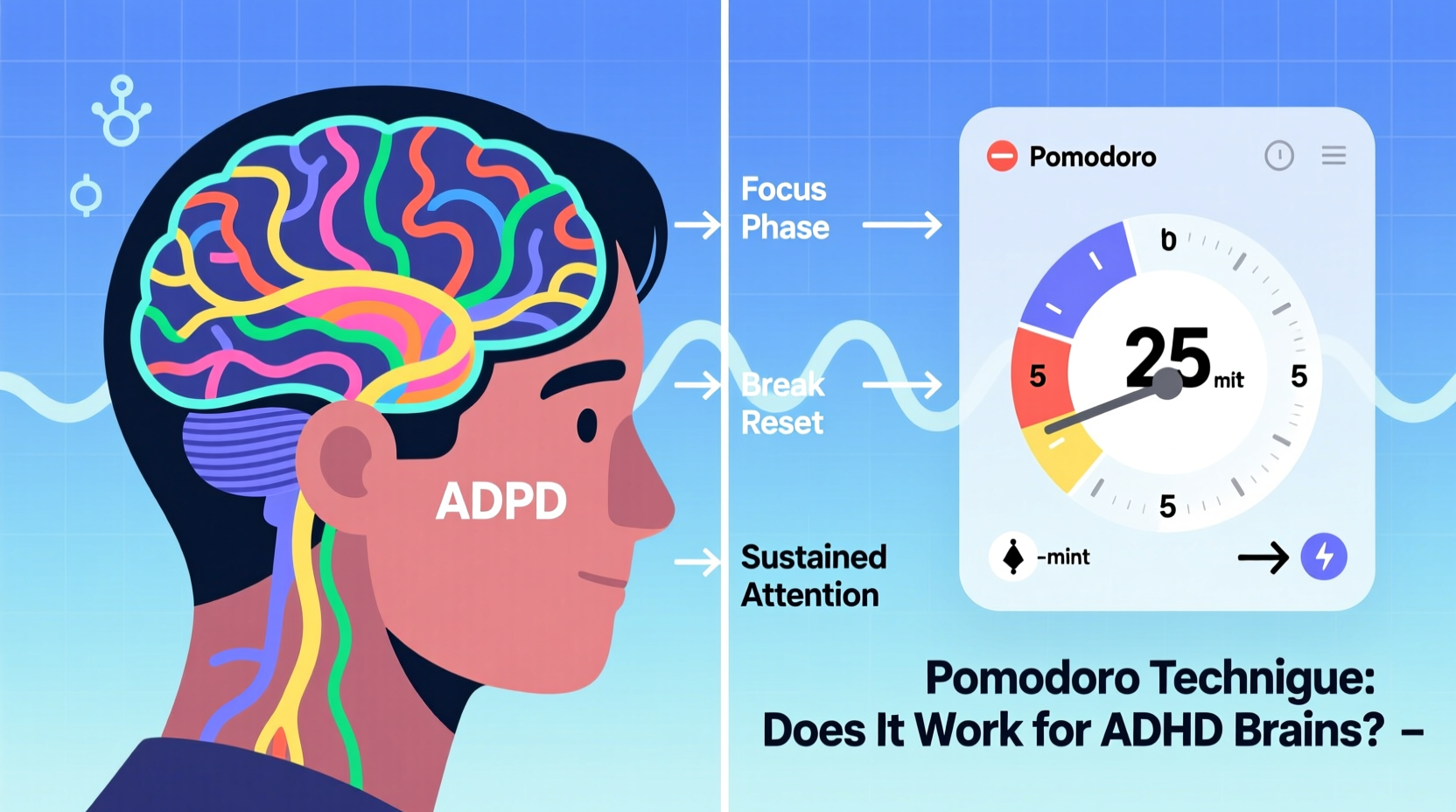
ADHD isn’t simply about being “distracted” or “lazy.” It’s a neurodevelopmental condition that impacts executive functions—mental skills like planning, working memory, emotional regulation, and task initiation. For individuals with ADHD, the brain’s dopamine system operates differently, making it harder to sustain attention on tasks that don’t provide immediate rewards.
Time blindness—a common symptom—means many with ADHD struggle to estimate how long tasks take or how much time has passed. This makes traditional time-based productivity systems feel alienating. A 25-minute timer may seem arbitrary or even oppressive when your internal clock runs on bursts of hyperfocus or paralysis.
“People with ADHD don’t lack attention—they have an abundance of it, but poor filtering. The challenge isn’t focusing; it’s directing that focus intentionally.” — Dr. Ari Tuckman, clinical psychologist and ADHD expert
This insight reframes the problem: it’s not about forcing longer attention spans, but creating conditions where focus can emerge naturally. That’s where modified time-blocking strategies like an adapted Pomodoro Technique come in.
Why the Standard Pomodoro Technique Falls Short for ADHD
The classic Pomodoro method follows a strict cycle:
- Work for 25 minutes (one “Pomodoro”)
- Take a 5-minute break
- After four cycles, take a 15–30 minute extended break
While this structure helps many neurotypical users, it can backfire for ADHD individuals for several reasons:
- Rigid timing ignores natural energy fluctuations. A fixed 25-minute block may end just as momentum builds—or begin when mental fatigue is high.
- Task initiation remains a barrier. Starting the first Pomodoro often feels impossible due to inertia, despite knowing it’s only 25 minutes.
- Breaks can become escape hatches. A 5-minute break might turn into 45 minutes of scrolling if transitions aren’t managed intentionally.
- Dopamine mismatch. The delayed reward of finishing four Pomodoros doesn’t align with the ADHD brain’s need for more frequent reinforcement.
Adapting the Pomodoro Technique for ADHD: A Flexible Framework
The core idea behind Pomodoro—breaking work into manageable chunks with intentional breaks—is sound. The solution lies in flexibility. Here’s how to tailor it for ADHD-friendly use:
1. Adjust the Timer Length
Instead of defaulting to 25 minutes, experiment with intervals that match your natural attention rhythm. Some find success with shorter bursts (10–15 minutes), while others in hyperfocus mode prefer longer blocks (45–50 minutes).
| Attention State | Suggested Work Interval | Break Duration |
|---|---|---|
| Low energy, high distraction | 10–15 min | 5–10 min |
| Moderate focus | 20–25 min | 5 min |
| Hyperfocus onset | 45–50 min | 15–20 min |
| Post-task recovery | None (rest) | 20–30 min |
The goal is responsiveness, not rigidity. Use timers as tools—not tyrants.
2. Pre-Commit to Break Activities
Unstructured breaks are risky. Without a plan, they can derail entire workflows. Instead, define what you’ll do during each break: stretch, walk around the block, drink water, or doodle. Avoid screens if possible—especially social media, which triggers dopamine spikes that make returning to work harder.
3. Pair Pomodoros with External Accountability
Body-doubling—working alongside someone else, even virtually—can dramatically increase follow-through. Use video calls with a friend, join focus rooms on platforms like Focusmate, or tell someone your next Pomodoro goal before starting.
4. Reward Immediately and Tangibly
Since delayed gratification is challenging, build in micro-rewards. After one completed interval, allow yourself a piece of chocolate, a song, or five minutes with a fidget toy. These small reinforcements help condition the brain to associate task completion with pleasure.
5. Track Completion, Not Just Time
Focus on what got done, not just how many Pomodoros passed. Did you draft an email? Organize a folder? Make one phone call? Celebrate those outcomes. Over time, this shifts the mindset from “I survived 25 minutes” to “I made progress.”
Mini Case Study: Sarah’s Shift from Failure to Flow
Sarah, a 32-year-old graphic designer with diagnosed ADHD, tried the Pomodoro Technique twice before giving up. The first time, she set a 25-minute timer for client revisions but got overwhelmed after five minutes and shut her laptop. The second attempt ended with her losing track of time during a break and not returning for hours.
On her third try, she adapted the method:
- She shortened her first session to 12 minutes, telling herself she could stop after that.
- She placed her phone across the room during work intervals to reduce temptation.
- Her break activity was predefined: stand up, pour water, look out the window.
- After each interval, she placed a colored marble in a jar—creating a visible progress tracker.
Within a week, Sarah found she was completing three to four adapted Pomodoros daily. More importantly, she felt less guilt and shame around productivity. “It’s not about doing more,” she said. “It’s about doing *something* consistently, without crashing.”
Expert-Backed Strategies for Sustainable Implementation
Dr. Melissa Shepard, a psychiatrist specializing in adult ADHD, emphasizes environmental design over willpower: “Tools like Pomodoro only work when paired with accommodations. Reduce friction, increase cues, and lower the bar for starting.”
Here’s a step-by-step guide to building an ADHD-adapted Pomodoro practice:
- Assess your current attention patterns. For two days, note when you’re most alert, distracted, or fatigued. Look for trends.
- Choose a flexible interval. Start with 10 or 15 minutes. Use a physical timer (like a Time Timer) for visual feedback.
- Pick one low-stakes task. Email inbox? Laundry? Something simple to test the method.
- Define your break ritual. Write down exactly what you’ll do: “Walk to kitchen, drink water, return.”
- Add a tiny reward. One piece of gum, a sticker, a quick dance—something pleasurable and immediate.
- Reflect nightly. Ask: Did I start more easily today? Did I feel less overwhelmed? Adjust based on results, not ideals.
Over time, refine your intervals and routines. The goal isn’t perfection—it’s consistency with self-compassion.
Checklist: ADHD-Friendly Pomodoro Setup
Before launching your adapted Pomodoro system, run through this checklist:
- ✅ Choose a customizable timer app (e.g., Focus To-Do, Be Focused, or a physical timer)
- ✅ Identify 1–2 go-to break activities that don’t involve screens
- ✅ Prepare your workspace: clear clutter, silence notifications, gather needed materials
- ✅ Select a starter task—small, defined, and low-pressure
- ✅ Set up a progress tracker (marbles in a jar, checkboxes, stickers)
- ✅ Share your intention with someone (“I’m doing one 15-minute sprint at 10 AM”)
- ✅ Plan a small reward for completion (a treat, a walk, a favorite song)
This preparation reduces decision fatigue and increases the odds of follow-through.
Frequently Asked Questions
Can the Pomodoro Technique worsen anxiety for people with ADHD?
Yes, if applied too rigidly. A ticking timer can trigger performance pressure, especially when combined with self-criticism. The key is to reframe the timer as a supportive tool—not a judge. If anxiety arises, shorten the interval, remove the visual countdown, or switch to untimed “just start” attempts.
What if I lose track of time during a Pomodoro?
This is common with time blindness. Try using a Time Timer (with a fading red disk) for better visual time awareness. Alternatively, pair Pomodoros with body doubling so someone else can gently signal transitions. Accept that some sessions will run long or short—that’s normal.
How do I handle interruptions during a work interval?
Interruptions are inevitable. Instead of abandoning the Pomodoro, pause the timer, address the interruption, then resume. Or—if the interruption derails you completely—mark it as “abandoned” without judgment and try again later. The habit of restarting is more important than any single session.
Conclusion: Rethinking Productivity for ADHD Brains
The Pomodoro Technique isn’t a magic fix for ADHD-related productivity challenges—but it doesn’t need to be. In its original form, it may fail. But when reimagined as a flexible, compassionate framework for structuring effort, it becomes something far more valuable: a scaffold for building sustainable focus.
The real power lies not in the timer, but in the principles behind it: breaking overwhelm into steps, honoring the need for rest, and creating external structure to support internal regulation. For ADHD brains, success isn’t about mimicking neurotypical productivity. It’s about designing systems that work with your brain, not against it.




 浙公网安备
33010002000092号
浙公网安备
33010002000092号 浙B2-20120091-4
Comments
No comments yet. Why don't you start the discussion?