
Creative work—whether writing a novel, designing a brand identity, or composing music—demands more than just time. It requires mental space, sustained focus, and the right rhythm to enter a state of flow. Two of the most widely discussed productivity methods today are the Pomodoro Technique and Deep Work. Both aim to improve concentration and output, but they operate on fundamentally different principles. For creatives navigating distractions and deadlines, choosing between them isn’t about picking the “best” method overall—it’s about understanding which one aligns with the nature of the task at hand.
The Pomodoro Technique breaks work into short, timed intervals—typically 25 minutes of focused effort followed by a 5-minute break. In contrast, Deep Work, popularized by Cal Newport, advocates for long, uninterrupted stretches of high-concentration work, free from distractions. While both can enhance productivity, their effectiveness in creative contexts varies significantly depending on the phase of creation, individual cognitive style, and environmental constraints.
Understanding the Core Principles
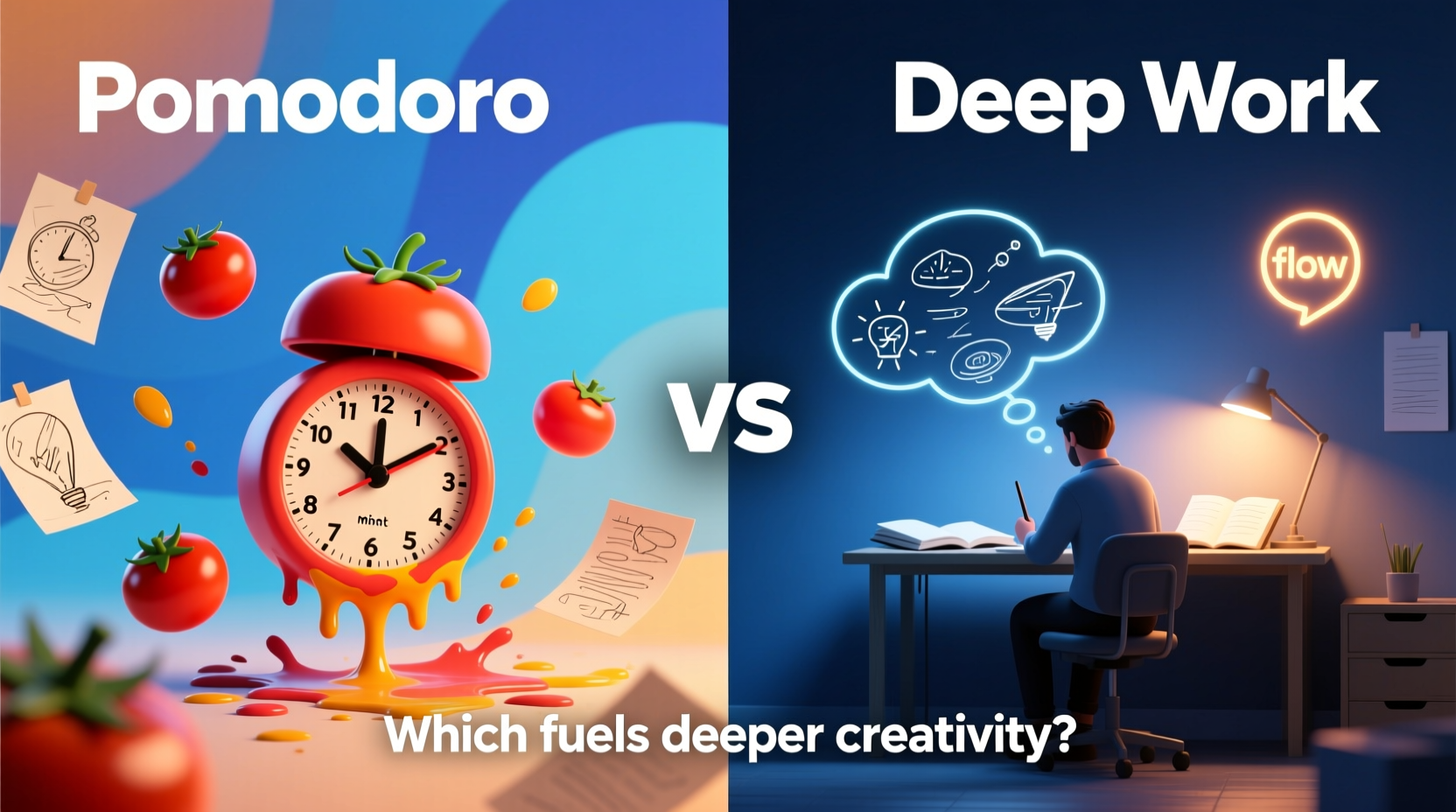
The Pomodoro Technique was developed by Francesco Cirillo in the late 1980s as a way to combat procrastination and maintain energy throughout the day. The method relies on structured intervals to create a rhythm that prevents burnout. Each 25-minute session (a “Pomodoro”) is meant to be fully dedicated to a single task, followed by a short recovery period. After four cycles, a longer break of 15–30 minutes resets the mind.
Deep Work, as defined by computer science professor and author Cal Newport, is “professional activities performed in a state of distraction-free concentration that push your cognitive capabilities to their limit.” This kind of work creates new value, improves skills rapidly, and is hard to replicate. Newport argues that in an age of constant digital interruption, cultivating the ability to engage in deep work is becoming a rare and valuable skill.
At first glance, these approaches seem contradictory: one favors fragmentation, the other immersion. But rather than viewing them as rivals, it’s more useful to see them as tools suited to different stages of the creative process.
When Pomodoro Excels in Creative Work
The Pomodoro Technique shines during early-stage creative tasks—brainstorming, outlining, sketching, or editing drafts—where momentum matters more than depth. Many creatives struggle to start because the blank page feels overwhelming. Pomodoro lowers the psychological barrier by reframing work as “just 25 minutes.” This time-boxing effect reduces anxiety and encourages action.
Additionally, the built-in breaks serve as cognitive reset points. For people working in open offices, shared homes, or noisy environments, frequent pauses help manage external interruptions without derailing progress. The ticking timer also introduces gentle urgency, which can boost focus during low-motivation periods.
Another strength of Pomodoro lies in task variety. Creative professionals often juggle multiple projects—writing copy, responding to client feedback, refining visuals. The technique allows for structured switching without falling into multitasking traps. By assigning different Pomodoros to different tasks, you maintain clarity and avoid decision fatigue.
Case Study: A Freelance Writer’s Workflow
Maya, a freelance content writer, used to spend hours staring at her screen, trying to draft blog posts in one sitting. She’d often stop after 20 minutes, distracted by emails or social media. After adopting Pomodoro, she committed to three sessions per article: one for research, one for outlining, and one for drafting. Within two weeks, her output doubled. The enforced breaks gave her time to walk, refill water, or stretch—simple actions that reduced mental fatigue. More importantly, knowing she only had to focus for 25 minutes made starting less daunting.
The Power of Deep Work in High-Stakes Creativity
While Pomodoro supports initiation and maintenance, Deep Work is essential for breakthrough moments. When a novelist is weaving complex plot threads, a composer is arranging a symphony, or a designer is crafting a cohesive visual system, shallow focus won’t suffice. These tasks require what psychologist Mihaly Csikszentmihalyi calls “flow”—a state where self-consciousness fades and time seems to disappear.
Deep Work creates the conditions for flow by eliminating distractions and extending focus beyond the typical attention span. Newport emphasizes that this mode of working must be scheduled deliberately. It often requires turning off notifications, setting up a quiet workspace, and informing others of unavailability. The payoff is substantial: in 90 minutes of uninterrupted focus, a creative can accomplish what might otherwise take days of fragmented effort.
“Deep work is like a superpower in our competitive economy.” — Cal Newport, *Deep Work*
For creatives aiming to produce original, high-quality work, Deep Work isn’t optional—it’s foundational. Consider the difference between editing a paragraph (Pomodoro-friendly) versus structuring an entire narrative arc (deep work territory). The latter demands mental continuity that short bursts cannot provide.
Step-by-Step Guide to Scheduling Deep Work
- Identify your peak focus window – Most people have 2–4 hours daily when mental clarity is highest (e.g., early morning).
- Block the time – Reserve this window in your calendar as non-negotiable.
- Define a specific outcome – Instead of “work on novel,” aim for “write the confrontation scene between Alex and Jordan.”
- Eliminate distractions – Turn off Wi-Fi, silence phone, close unrelated tabs.
- Warm up mentally – Spend 5 minutes reviewing notes or rereading the last section to re-enter the context.
- Work until completion or time ends – Avoid checking email or messages until the block is over.
- Review and reflect – Note what worked, what interrupted you, and how to improve next time.
Comparative Analysis: Pomodoro vs Deep Work
| Aspect | Pomodoro Technique | Deep Work |
|---|---|---|
| Focus Duration | 25 minutes (with breaks) | 60–120+ minutes (uninterrupted) |
| Best For | Task initiation, editing, idea generation | Original creation, complex problem-solving |
| Mental Load | Low to moderate; sustainable over long days | High; requires recovery afterward |
| Distraction Tolerance | Moderate; breaks allow for interruption management | Very low; any disruption breaks momentum |
| Skill Development | Builds consistency and discipline | Accelerates mastery through intense practice |
| Ideal Environment | Flexible—works in dynamic settings | Quiet, private, controlled |
This table illustrates that neither method is universally superior. The choice depends on the creative phase and personal rhythm. Early ideation benefits from Pomodoro’s agility, while execution thrives under Deep Work’s intensity.
Hybrid Approach: Combining Both Methods Strategically
The most effective creatives don’t choose one method exclusively—they integrate both. A balanced weekly schedule might include:
- Mornings: Deep Work blocks for core creative tasks (writing, composing, designing).
- Afternoons: Pomodoro sessions for administrative work, revisions, or collaborative tasks.
- Transitions: Use a Pomodoro to warm up before a deep session or decompress afterward.
This hybrid model respects the brain’s natural rhythms. Deep work leverages peak alertness, while Pomodoro sustains energy across the rest of the day. It also prevents burnout by balancing intensity with structure.
Checklist: Optimizing Your Creative Workflow
- ☐ Assess whether your current task requires depth or momentum.
- ☐ Schedule deep work during your most focused time of day.
- ☐ Use Pomodoro for planning, revising, or overcoming creative blocks.
- ☐ Prepare your environment before starting (tools ready, distractions off).
- ☐ Track which method yields higher-quality output for each project type.
- ☐ Adjust based on energy levels—don’t force deep work when fatigued.
FAQ: Common Questions About Pomodoro and Deep Work
Can I do Deep Work in 25-minute chunks?
Not effectively. Deep Work requires cognitive buildup—entering a state of flow often takes 15–20 minutes. If you’re constantly stopping, you never reach peak performance. Short sessions may support shallow thinking, but not deep synthesis.
Isn’t Pomodoro too rigid for creative thinking?
It can be if applied inflexibly. The key is adapting the method: extend Pomodoros to 45 or 50 minutes for more immersive tasks, or skip the timer entirely once flow is achieved. The structure should serve creativity, not constrain it.
What if I can’t find long stretches of quiet time?
Start small. Even 45 minutes of deep work, protected and prioritized, can yield significant progress. Use noise-canceling headphones, communicate boundaries, or work outside the home if needed. Consistency matters more than duration.
Conclusion: Match the Method to the Moment
The debate between Pomodoro Technique and Deep Work isn’t about declaring a winner—it’s about making intentional choices. Creative tasks span a spectrum from exploratory to executive, from light editing to profound innovation. Each phase demands a different kind of attention.
Pomodoro is your ally when motivation is low, distractions are high, or tasks are varied. It builds discipline through repetition and makes starting easier. Deep Work, on the other hand, unlocks your highest creative potential. It’s where insight emerges, connections form, and excellence is crafted.
The most productive creatives aren’t those who follow one system religiously—they’re the ones who understand their own minds and match their methods to the moment. Experiment. Track results. Refine your approach. Whether you’re writing, painting, coding, or composing, the goal isn’t just to be busy, but to create meaningfully.




 浙公网安备
33010002000092号
浙公网安备
33010002000092号 浙B2-20120091-4
Comments
No comments yet. Why don't you start the discussion?