
For individuals with ADHD, staying focused isn’t just about willpower—it’s a neurological challenge. The brain’s executive function deficits make sustained attention, task initiation, and time perception difficult. That’s why many turn to structured productivity systems like the Pomodoro Technique or seek out elusive states of deep concentration known as “flow.” But which approach truly supports an ADHD brain? And can they coexist? This article explores both methods in depth, comparing their mechanics, benefits, and drawbacks through the lens of neurodivergence.
Understanding the ADHD Brain and Focus
The ADHD brain operates differently. It doesn’t lack motivation—rather, it struggles with dopamine regulation, making tasks without immediate rewards feel nearly impossible to start or sustain. Traditional time management often fails because it assumes linear focus and consistent motivation, neither of which are reliable for someone with ADHD.
Dopamine plays a central role. Tasks that are novel, urgent, or stimulating trigger dopamine release, creating a sense of engagement. Mundane or long-term projects? Not so much. This is where external structures become essential—not as rigid rules, but as scaffolding to compensate for underactive neural circuits.
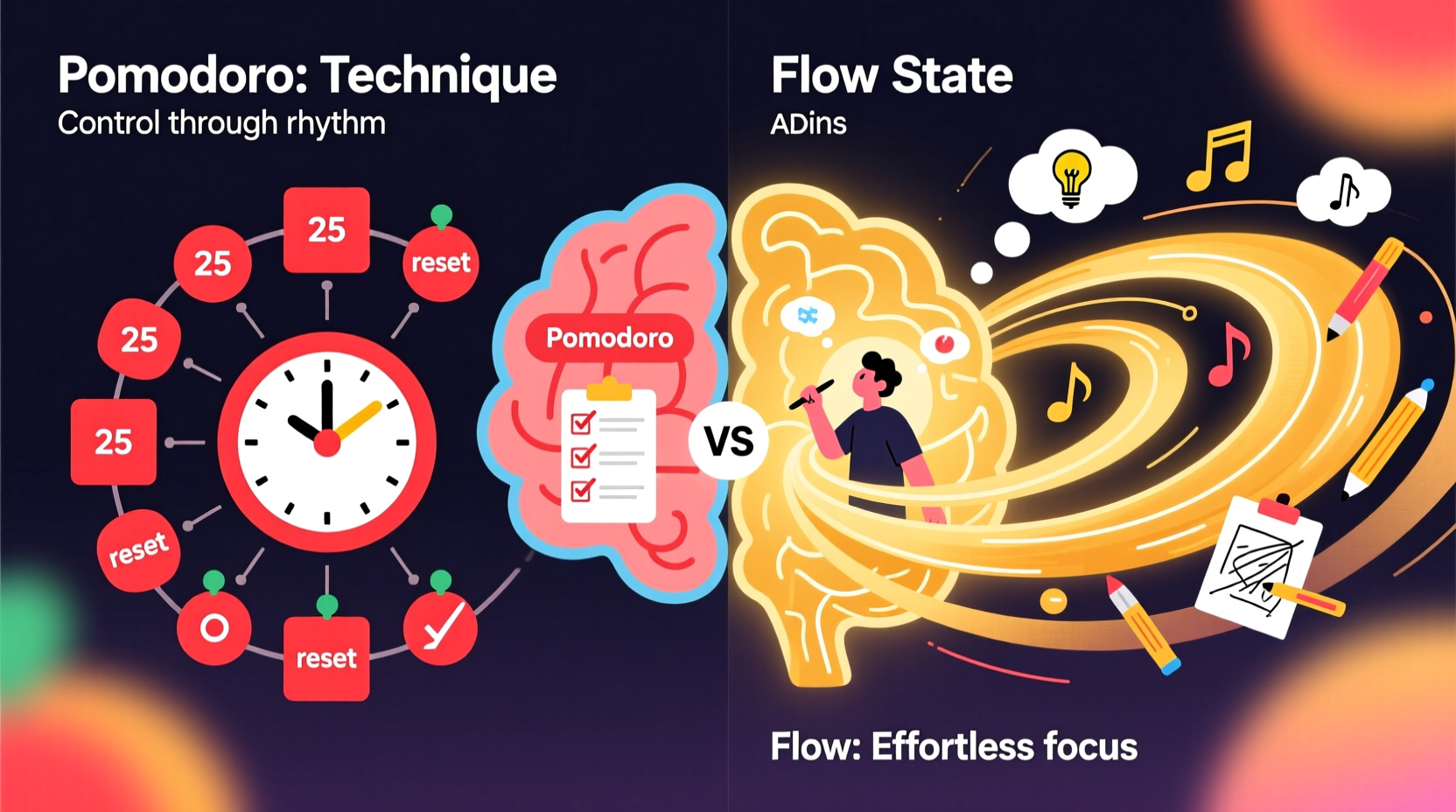
Two popular approaches have emerged: the Pomodoro Technique, a time-boxed method, and the pursuit of flow state, a condition of effortless immersion. While seemingly opposite—one imposes structure, the other celebrates spontaneity—both aim to enhance focus. For ADHD, the real question isn't which is better in theory, but which works more consistently in practice.
The Pomodoro Technique: Structure as a Support System
Developed by Francesco Cirillo in the late 1980s, the Pomodoro Technique breaks work into 25-minute intervals (called “Pomodoros”) separated by short 5-minute breaks. After four cycles, a longer 15–30 minute break follows. The goal is to reduce mental fatigue, increase accountability, and create rhythm.
For ADHD individuals, this structure offers several advantages:
- Predictable pacing: Knowing a break is coming reduces resistance to starting.
- External time cues: Timers override poor internal time estimation (a common ADHD trait).
- Momentum building: Completing one Pomodoro creates a small win, encouraging another.
- Reduced overwhelm: Breaking tasks into tiny chunks makes them feel manageable.
However, the technique has limitations. Rigid timing can backfire if interrupted mid-cycle, and forced breaks may disrupt rare moments of natural focus. Additionally, not all tasks fit neatly into 25-minute blocks—creative or complex work often requires longer warm-up periods.
Flow State: The Neurodivergent Superpower
Coined by psychologist Mihaly Csikszentmihalyi, flow state describes a mental zone where time seems to vanish, self-consciousness fades, and performance peaks. In flow, you’re fully immersed, challenged but capable, receiving immediate feedback.
Interestingly, people with ADHD often experience hyperfocus—a phenomenon closely related to flow. During hyperfocus, individuals with ADHD can work for hours on engaging tasks, oblivious to surroundings, hunger, or time. This isn’t a flaw; it’s a strength when channeled correctly.
“People with ADHD don’t have a focus deficit—they have a dysregulation of focus. They can focus too much, too intensely, on the wrong things at the wrong time.” — Dr. William Dodson, ADHD Specialist
The problem isn’t achieving flow; it’s controlling when and on what it happens. Hyperfocus often strikes during high-interest activities (video games, creative projects) while evading necessary but boring tasks (emails, paperwork). Unlike Pomodoro, flow cannot be scheduled—but it can be invited.
Conditions that foster flow include:
- Clear goals
- Immediate feedback
- A balance between challenge and skill
- Freedom from distractions
For ADHD brains, flow feels natural when interest aligns with task. But relying on it exclusively is risky. You can’t wait for inspiration to do your taxes.
Comparing Pomodoro and Flow: A Practical Breakdown
| Aspect | Pomodoro Technique | Flow State |
|---|---|---|
| Structure | Highly structured, time-based | Unstructured, emerges organically |
| Initiation | Low barrier to entry (just set a timer) | Hard to initiate on demand |
| Suitability for Boring Tasks | Effective (breaks reduce resistance) | Poor (lack of interest prevents entry) |
| Duration Control | Precise (25-min blocks) | Unpredictable (can last hours) |
| ADHD-Friendly? | Yes, provides external scaffolding | Yes, but inconsistent and hard to direct |
| Risk of Burnout | Low (built-in breaks) | High (loss of bodily awareness) |
The table reveals a key insight: Pomodoro excels at task initiation and consistency, while flow delivers peak performance but lacks reliability. For ADHD, consistency is often more valuable than intensity.
Hybrid Approach: Using Pomodoro to Invite Flow
Rather than choosing one over the other, many with ADHD find success blending both. The Pomodoro Technique can act as a gateway to flow by reducing the friction of starting. Once momentum builds, a Pomodoro session might naturally evolve into a state of deep focus.
Here’s how to use Pomodoro as a launchpad:
- Start small: Commit to just one 15–25 minute session.
- Choose the right task: Pick something with moderate interest or urgency.
- Eliminate distractions: Silence notifications, close tabs, use noise-canceling headphones.
- Use a physical timer: Visual cues help ground ADHD minds.
- Let go of the schedule if flow begins: If you're deeply engaged past the timer, consider continuing—just set a reminder to eat or stretch later.
This hybrid model respects both the need for structure and the potential for intense focus. It turns Pomodoro from a rigid rule into a flexible tool.
Real Example: How Sarah Manages Her Writing Workflow
Sarah, a freelance writer with ADHD, used to dread her morning writing blocks. Despite loving storytelling, she’d scroll endlessly before typing a sentence. She tried forcing flow—waiting until she “felt like it”—but deadlines suffered.
She adopted the Pomodoro Technique with modifications:
- First Pomodoro: 15 minutes, no pressure to produce quality.
- If she felt engaged after 15 minutes, she continued for a full 25.
- If ideas flowed past 25 minutes, she paused only for essentials (water, bathroom).
- She tracked which topics triggered flow and scheduled them during peak energy times.
Within weeks, her output doubled. More importantly, she stopped fearing the blank page. The timer wasn’t a prison—it was a bridge to focus.
“I don’t always reach flow,” she says, “but Pomodoro gets me close enough that sometimes, I slip right into it without noticing.”
Action Plan: Building an ADHD-Friendly Focus Strategy
Instead of adopting a one-size-fits-all method, build a personalized system. Use this checklist to get started:
- ✅ Audit your tasks: Identify which are boring vs. engaging.
- ✅ Apply Pomodoro to low-interest tasks (admin, emails, planning).
- ✅ Schedule high-interest tasks during peak energy windows.
- ✅ Use timers to start, but allow overflow if flow kicks in.
- ✅ Pair tasks with micro-rewards (e.g., “After two Pomodoros, I’ll watch one TikTok”).
- ✅ Track what works: Keep a simple log of focus duration and method used.
- ✅ Adjust intervals: Try 15, 25, or even 50-minute blocks based on task type.
“The best productivity system for ADHD isn’t the most popular one—it’s the one you can actually use consistently.” — Dr. Ari Tuckman, Psychologist and ADHD Expert
Frequently Asked Questions
Can people with ADHD achieve flow state?
Yes—and often more intensely than neurotypical individuals. This is commonly experienced as hyperfocus. The challenge isn’t achieving flow, but directing it toward necessary tasks rather than only enjoyable ones.
Is the Pomodoro Technique too rigid for ADHD?
It can be if applied inflexibly. The key is customization. Shorten intervals, skip breaks when in flow, or use Pomodoro only for specific task types. Think of it as a framework, not a rulebook.
Should I try to force flow state?
No. Flow can’t be forced, but it can be encouraged by creating optimal conditions: clear goals, minimal distractions, and tasks that match your skill level. Use structure to get close, then let go when engagement deepens.
Conclusion: Embrace Both, Master Neither
The debate between Pomodoro Technique and flow state misses the point for ADHD brains. It’s not about picking a winner—it’s about using each strategically. Pomodoro provides the scaffolding to begin, overcome inertia, and maintain consistency. Flow offers the reward of deep, satisfying work when conditions align.
The most effective approach is adaptive: structured enough to support weak executive function, flexible enough to honor moments of natural focus. By understanding your brain’s rhythms and leveraging tools without rigidity, you transform perceived weaknesses into strengths.




 浙公网安备
33010002000092号
浙公网安备
33010002000092号 浙B2-20120091-4
Comments
No comments yet. Why don't you start the discussion?