
For individuals with ADHD, maintaining consistent focus isn't just a productivity challenge—it's a neurological reality. Traditional time management methods often fail because they don’t account for attention variability, executive dysfunction, or the brain’s need for stimulation. Two approaches frequently discussed in neurodivergent circles are the Pomodoro Technique and cultivating Flow State. While both aim to improve concentration, they operate on fundamentally different principles. One is structured and external; the other is organic and internal. So which one actually works better for ADHD brains?
The answer isn’t straightforward. It depends on the individual, the task, and the phase of engagement. But understanding how each method aligns—or clashes—with ADHD neurology can help you choose the right strategy at the right time.
The Neurological Reality of ADHD and Focus
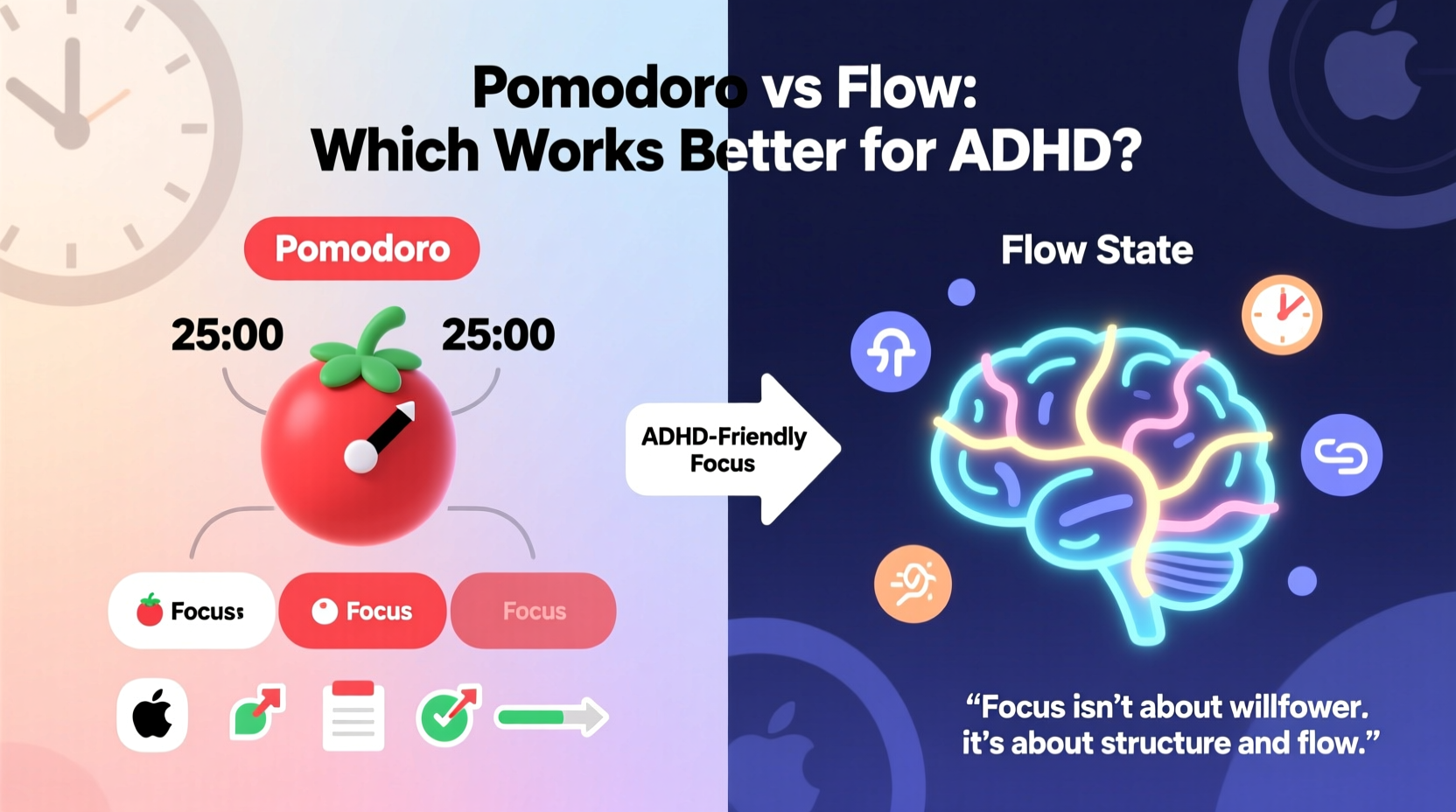
ADHD is not simply about distractibility. It involves dysregulation in dopamine pathways, impaired working memory, and inconsistent activation of the prefrontal cortex—the area responsible for planning, inhibition, and sustained attention. As a result, people with ADHD often struggle with tasks that lack immediate reward, novelty, or emotional significance.
However, paradoxically, many with ADHD experience hyperfocus—intense, prolonged concentration on activities that are stimulating or personally meaningful. This phenomenon mirrors what psychologists call “flow state.” Yet, initiating flow is unpredictable, and relying on it alone leads to inconsistency.
This tension sets the stage for evaluating structured systems like the Pomodoro Technique versus the elusive but powerful flow state.
Understanding the Pomodoro Technique: Structure as a Scaffold
Developed by Francesco Cirillo in the late 1980s, the Pomodoro Technique breaks work into 25-minute intervals (called “Pomodoros”) separated by short 5-minute breaks. After four cycles, a longer 15–30 minute break follows. The method relies on external pacing, routine, and timeboxing to reduce procrastination and mental fatigue.
For ADHD brains, this structure can serve as a cognitive scaffold:
- Externalizes time perception – Many with ADHD have poor time estimation (time blindness). A timer creates a concrete boundary.
- Reduces decision fatigue – You don’t decide when to start or stop; the system does.
- Builds momentum – Starting is often the hardest part. Committing to just 25 minutes lowers the psychological barrier.
- Incorporates forced recovery – Regular breaks prevent burnout and allow sensory reset.
When Pomodoro Works Best for ADHD
The technique shines during tasks that are:
- Routine or low-interest (e.g., email, admin, data entry)
- Prone to procrastination
- Requiring incremental progress over time
It’s less effective when inspiration strikes and deep immersion becomes possible—precisely when flow might take over.
Flow State: The ADHD Brain’s Hidden Superpower
Coined by psychologist Mihaly Csikszentmihalyi, flow is a mental state where a person is fully immersed in an activity, experiencing energized focus, enjoyment, and a loss of self-consciousness. Time seems to vanish, distractions fade, and performance peaks.
For many with ADHD, flow isn’t just productive—it feels euphoric. It provides the dopamine surge their brains crave. In fact, some researchers suggest that hyperfocus in ADHD may be a form of maladaptive or unregulated flow.
“Flow is autotelic—it’s rewarding in itself. For ADHD individuals, this intrinsic motivation can override the usual barriers to initiation.” — Dr. Thomas Brown, ADHD researcher and clinical psychologist
But here’s the catch: flow cannot be scheduled. It arises under specific conditions:
- Clear goals
- Immediate feedback
- Balanced challenge-skill ratio (not too easy, not too hard)
- Freedom from distraction
These conditions are fragile. Interruptions, anxiety, or mismatched task difficulty can collapse the state instantly.
The Double-Edged Sword of Flow for ADHD
While flow delivers exceptional output, it poses risks:
- Time blindness intensifies – You might look up three hours later, having skipped meals or missed appointments.
- Neglect of other responsibilities – Hyperfocus on one task can derail entire routines.
- Crash afterward – Mental exhaustion post-flow is common due to sustained neural activation.
- Unpredictability – You can’t rely on flow for deadlines or mundane tasks.
In essence, flow is powerful but unreliable as a primary productivity strategy.
Pomodoro vs Flow: A Comparative Breakdown
| Factor | Pomodoro Technique | Flow State |
|---|---|---|
| Structure | Highly structured, time-based | Organic, emergent |
| Initiation | Easy—just start the timer | Unpredictable, often requires priming |
| Sustainability | Consistent across days | Spontaneous, not guaranteed |
| Dopamine Response | Moderate, tied to completion of intervals | High, intrinsic reward during immersion |
| Best For | Low-interest, essential tasks | Creative, engaging, complex work |
| Risks for ADHD | May feel rigid or artificial | Can lead to neglect, burnout, time distortion |
| Control | Externally regulated | Internally driven, hard to control |
Neither method dominates across all scenarios. Instead, they complement each other when used intentionally.
Integrating Both: A Hybrid Strategy for ADHD Brains
The most effective approach isn’t choosing one over the other—it’s learning to toggle between them based on context.
Step-by-Step: Building a Flexible Focus System
- Start with Pomodoro for initiation
Use a 25-minute session to begin a task, even if you don’t feel like it. Often, starting triggers interest and can evolve into flow. - Recognize early signs of flow
If you notice time slipping, ideas flowing, and distractions fading, consider pausing the timer. Let yourself go deeper—if your schedule allows. - Set soft boundaries
Even in flow, use a gentle alarm (e.g., vibrating watch) after 90–120 minutes to check in: Have you eaten? Hydrated? Missed anything urgent? - Return to Pomodoro for maintenance tasks
After a flow session, switch back to timed intervals for lower-energy follow-up work like editing, organizing, or replying to messages. - Track patterns
Keep a simple log: When did flow occur? What triggered it? What time of day? Use this data to design your ideal work environment.
Real Example: Maya’s Writing Workflow
Maya, a freelance writer with ADHD, struggled with inconsistent output. Deadlines loomed, but she’d either freeze or disappear into writing marathons, missing client calls.
She redesigned her process:
- Mornings: Two Pomodoro sessions (25 min work / 5 min break) to respond to emails and outline articles.
- Afternoons: Open window for creative writing. If she felt engaged after the first 20 minutes, she’d disable notifications and let herself write uninterrupted.
- She set a silent alarm for 2 hours into any deep work session to stand up, stretch, and assess whether to continue.
Result? She met deadlines 95% of the time and produced higher-quality drafts. More importantly, she reduced guilt and mental fatigue.
Her insight: “Pomodoro gets me in the door. Flow lets me stay. But I need both to stay balanced.”
Expert Insight: What Neuroscience Says
Dr. Ari Tuckman, a clinical psychologist specializing in ADHD, emphasizes flexibility:
“The best systems for ADHD aren’t rigid. They provide enough structure to compensate for executive function challenges but leave room for the brain’s natural rhythms. Trying to force constant flow is unrealistic. Dismissing structure entirely leads to chaos. The sweet spot is structure with escape hatches.” — Dr. Ari Tuckman, author of *More Attention, Less Deficit*
Neuroimaging studies show that during flow, the default mode network (associated with mind-wandering) quiets down, while task-positive networks activate cohesively. In contrast, Pomodoro leverages external cues to activate top-down control—compensating for weaker endogenous regulation in ADHD.
Together, they engage both compensatory and natural pathways for attention.
Checklist: Optimizing Focus for ADHD Brains
- ✅ Use Pomodoro to start tasks you’re avoiding
- ✅ Adjust interval lengths to match your energy (try 15, 25, or 50 minutes)
- ✅ Identify your flow triggers (music, environment, time of day)
- ✅ Set passive reminders during deep work (e.g., smartwatch vibration)
- ✅ Schedule recovery time after intense focus sessions
- ✅ Avoid multitasking—even in flow, keep one primary task active
- ✅ Reflect weekly: What helped you focus? What derailed you?
Frequently Asked Questions
Can people with ADHD achieve flow more easily than neurotypical individuals?
Not necessarily more easily, but differently. ADHD brains may enter flow more readily in high-stimulation or personally meaningful tasks, but struggle to access it in low-dopamine environments. The threshold is uneven, not absent.
Is the Pomodoro Technique too rigid for ADHD?
It can be if applied inflexibly. The key is customization. Shorter intervals, movement breaks, visual timers, and pairing with accountability partners make it adaptable. Think of it as a framework, not a rulebook.
What should I do when I’m in flow but need to stop?
Create a “flow exit ritual”: jot down the next sentence or idea, save a placeholder, or record a quick voice memo. This reduces resistance to returning later and honors the momentum without sacrificing balance.
Conclusion: Work With Your Brain, Not Against It
The debate between Pomodoro and flow isn’t about superiority—it’s about suitability. For ADHD brains, productivity isn’t about mimicking neurotypical focus. It’s about designing systems that honor neurodivergence while supporting consistency.
The Pomodoro Technique offers scaffolding for when motivation wanes. Flow state delivers peak performance when conditions align. The most empowered approach combines both: using structure to build momentum, then allowing space for immersion when it arises.
Stop trying to force yourself into a mold that doesn’t fit. Start experimenting with rhythm, not rigidity. Track what works, refine your tools, and remember: your brain isn’t broken. It’s different—and with the right strategies, it can thrive.




 浙公网安备
33010002000092号
浙公网安备
33010002000092号 浙B2-20120091-4
Comments
No comments yet. Why don't you start the discussion?