
For individuals with ADHD, managing time and maintaining focus can feel like an uphill battle. Traditional productivity systems often fail because they don’t account for neurodivergent challenges such as distractibility, impulsivity, and difficulty sustaining attention. Two popular time management methods—Pomodoro and Flowtime—offer alternative approaches to structuring work. While both aim to improve concentration and reduce burnout, their suitability for ADHD brains varies significantly. Understanding the differences, strengths, and limitations of each can help you choose a system that aligns with your cognitive rhythm rather than fights against it.
Understanding the Pomodoro Technique
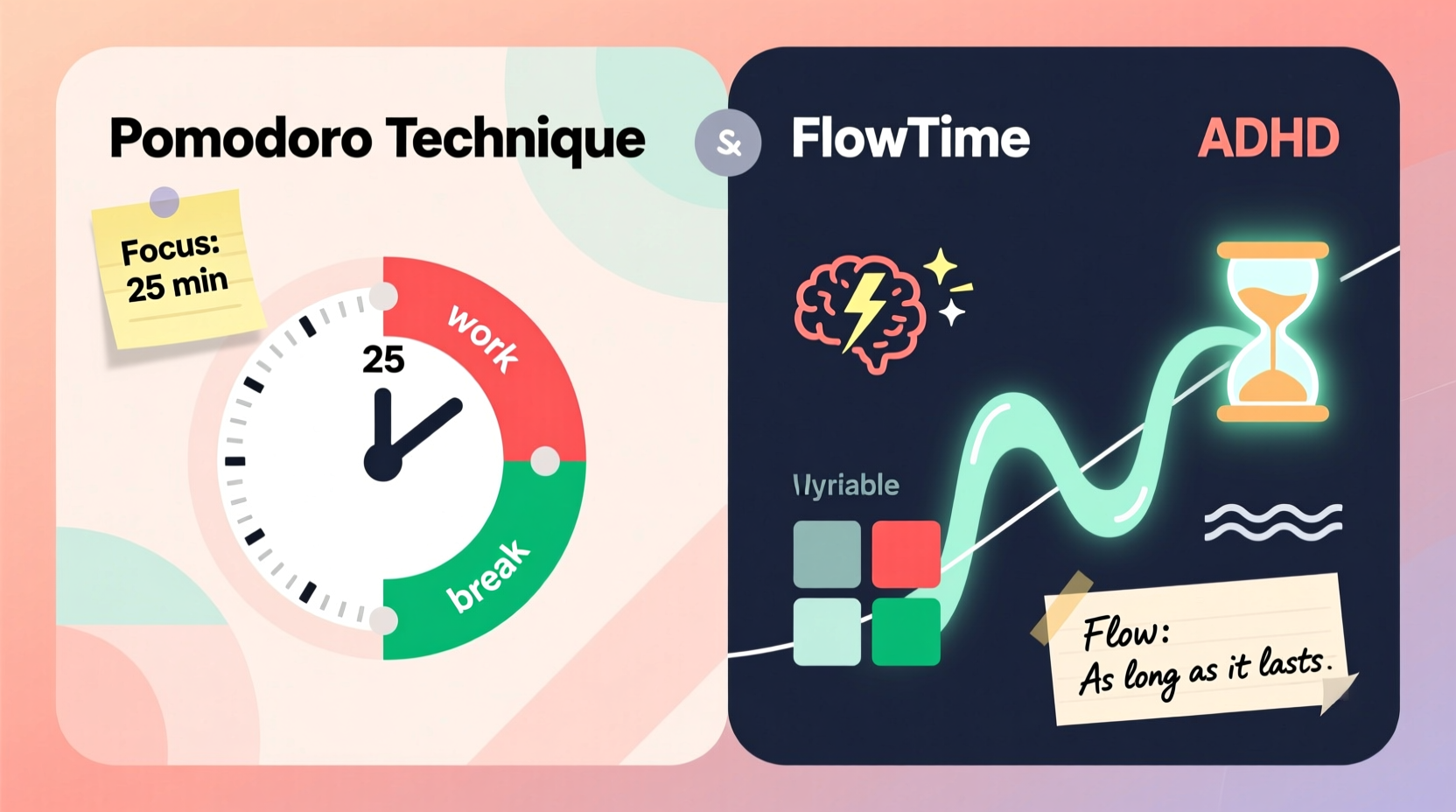
Developed by Francesco Cirillo in the late 1980s, the Pomodoro Technique is a structured time management method based on fixed intervals. The core structure involves:
- Working for 25 minutes (one \"Pomodoro\")
- Taking a 5-minute break
- After four Pomodoros, taking a longer 15–30 minute break
The method relies on external timers and strict adherence to intervals. Its strength lies in breaking overwhelming tasks into manageable chunks and building in regular rest periods to prevent mental fatigue.
For many people, this structure provides clarity and reduces decision fatigue. However, for those with ADHD, the rigidity can become counterproductive. A sudden burst of inspiration might be interrupted by a timer, or the pressure to perform within a fixed window may trigger anxiety. Additionally, transitioning from one task to another every 25 minutes can exacerbate attention switching difficulties common in ADHD.
Introducing the Flowtime Method
Flowtime is a flexible, intuition-based alternative to rigid time blocks. Instead of preset intervals, Flowtime encourages working in natural focus cycles. You begin a task and continue until you notice your attention waning or feel the need for a break. Once you pause, you record the duration of your focused session and take a break of your choosing.
This method prioritizes self-awareness over schedules. It doesn't force breaks at arbitrary times but respects the user’s internal cues. For someone with ADHD, this adaptability can be liberating. When hyperfocus strikes, you’re free to ride the wave without interruption. When distraction creeps in, you acknowledge it non-judgmentally and reset.
Flowtime isn’t about maximizing output per minute; it’s about cultivating a sustainable rhythm between effort and rest. This mindfulness-based approach aligns well with ADHD experiences, where energy and focus fluctuate unpredictably throughout the day.
“People with ADHD don’t lack attention—they have abundant attention, just not always where we need it. Systems that honor natural attention rhythms are far more effective than those trying to impose artificial discipline.” — Dr. William Dodson, ADHD Specialist
Comparing Pomodoro and Flowtime for ADHD
Choosing between Pomodoro and Flowtime isn’t just about preference—it’s about compatibility with how your brain functions. Below is a detailed comparison highlighting key factors relevant to ADHD management.
| Feature | Pomodoro Technique | Flowtime Method |
|---|---|---|
| Structure | Highly structured, fixed intervals | Flexible, self-directed timing |
| Attention Flexibility | Rigid—interruptions occur regardless of focus level | Adaptive—allows deep focus to continue uninterrupted |
| Decision Fatigue | Low—clear rules reduce choices | Moderate—requires self-assessment to determine breaks |
| Hyperfocus Utilization | Poor—forces breaks even during peak productivity | Excellent—encourages riding productive waves |
| Suitability for ADHD | Mixed—helpful for initiation, disruptive during focus | Generally high—respects neurodivergent rhythms |
| Tracking & Accountability | Strong—easy to count completed sessions | Requires journaling or logging for consistency |
The table reveals a critical insight: while Pomodoro excels in creating routine and reducing procrastination through micro-commitments, its inflexibility can clash with the dynamic attention patterns of ADHD. Flowtime, though less prescriptive, offers greater alignment with how many neurodivergent minds naturally engage with tasks.
When Pomodoro Works for ADHD (and When It Doesn’t)
Pomodoro isn’t inherently unsuitable for ADHD—it depends on context and customization. It tends to be most effective in scenarios involving:
- Task initiation struggles: The “just one Pomodoro” mindset lowers the barrier to starting.
- Monotonous or unengaging work: Timers create urgency and prevent drift.
- Overwhelm from large projects: Breaking work into 25-minute units makes goals feel achievable.
However, Pomodoro becomes problematic when:
- You’re in a state of hyperfocus and the timer pulls you out prematurely.
- The pressure of the ticking clock increases anxiety or performance stress.
- You’re unable to switch tasks smoothly after each interval due to transition lag.
In these cases, the method disrupts flow rather than supporting it. Some users report feeling frustrated or demoralized when they “fail” to complete a full Pomodoro, reinforcing negative self-perceptions common in ADHD.
A Real-World Example: Sarah’s Shift from Pomodoro to Flowtime
Sarah, a freelance graphic designer diagnosed with ADHD in her late twenties, spent years struggling with productivity systems. She initially adopted the Pomodoro Technique after reading about its popularity among creatives. At first, it helped her start projects she’d been avoiding. But soon, frustration set in.
“I’d finally get into a groove designing a logo,” she explained, “and right when I was figuring out the perfect font pairing, the timer would go off. I felt like I was being punished for focusing too well. I’d either ignore the alarm and feel guilty, or stop and lose the idea completely.”
After months of inconsistency, Sarah discovered Flowtime. She began tracking her work sessions without setting timers. Instead, she noted when she started working and paused only when she felt mentally drained or distracted. To her surprise, she found that some sessions lasted 40 minutes, others stretched to 90. Her best design breakthroughs happened during these long, uninterrupted stretches.
By trusting her natural rhythm, Sarah reduced resistance to work and increased both output and satisfaction. She still uses short timers occasionally for mundane tasks, but Flowtime became her primary framework for meaningful work.
How to Implement Flowtime Effectively with ADHD
While Flowtime sounds simple—work until you need a break—executing it consistently requires intentionality, especially for those prone to losing track of time or underestimating effort. Follow this step-by-step guide to make Flowtime work for you:
- Choose one task: Clearly define what you’re working on before starting.
- Begin working: Start your timer or simply note the time mentally or in a notebook.
- Work until you notice a shift: This could be restlessness, distraction, hunger, or mental fatigue.
- Pause and log the session: Record how long you worked and what you accomplished.
- Take a break of your choice: Move, hydrate, stretch—do something restorative.
- Repeat: Resume when ready, starting a new session.
To enhance accountability, maintain a daily log. Over time, patterns will emerge—such as your average focus span or most productive hours—which can inform future planning.
“Productivity for ADHD isn’t about doing more in less time. It’s about creating conditions where your brain feels safe, engaged, and motivated to participate.” — Dr. Ari Tuckman, Psychologist and ADHD Author
Practical Checklist: Choosing Your ADHD-Friendly Time Method
Use this checklist to evaluate which method—or combination—best suits your needs:
- ☐ Do I struggle to start tasks? → Try Pomodoro for initiation support.
- ☐ Do I frequently enter hyperfocus states? → Flowtime preserves these moments.
- ☐ Am I easily overwhelmed by open-ended structures? → Modified Pomodoro may offer needed scaffolding.
- ☐ Do I hate being interrupted mid-thought? → Flowtime avoids forced breaks.
- ☐ Do I need visible progress tracking? → Combine either method with a journal or app.
- ☐ Am I able to recognize my mental fatigue cues? → Flowtime depends on self-awareness.
- ☐ Can I customize intervals? → Adjust Pomodoro to 50/10 or 90/20 if standard timing doesn’t fit.
Frequently Asked Questions
Can I combine Pomodoro and Flowtime?
Yes, many people use a blended approach. For example, apply Pomodoro to routine tasks like emails or data entry, and use Flowtime for creative or cognitively demanding work. The key is matching the method to the task type and your current energy level.
Does Flowtime work if I have poor time perception?
It can, but it may require additional tools. Use a simple timer app that runs in the background so you can check elapsed time without pressure. Alternatively, pair Flowtime with body doubling or accountability partners who help you stay grounded in time.
Is there research supporting either method for ADHD?
While no large-scale studies directly compare Pomodoro and Flowtime for ADHD, clinical experience and behavioral principles suggest that flexible, low-pressure systems tend to yield better adherence. Executive function deficits in ADHD respond better to external supports that reduce cognitive load without imposing excessive rigidity.
Final Thoughts: Match the System to Your Brain, Not the Other Way Around
Time management isn’t one-size-fits-all—especially for ADHD. The goal isn’t to force yourself into a mold designed for neurotypical brains, but to find a rhythm that honors your unique cognitive style. Pomodoro can be a useful tool for overcoming inertia, but its rigid structure often clashes with the fluid attention patterns of ADHD. Flowtime, with its emphasis on self-awareness and flexibility, offers a more compassionate and sustainable alternative.
The most effective system is the one you can stick with—not because it’s trendy or widely recommended, but because it feels doable, respectful of your energy, and aligned with how you actually work. Experiment without judgment. Track what helps you move forward with less friction. And remember: progress isn’t measured in minutes logged, but in momentum gained and stress reduced.




 浙公网安备
33010002000092号
浙公网安备
33010002000092号 浙B2-20120091-4
Comments
No comments yet. Why don't you start the discussion?