
In an era where smartphones are nearly extensions of our hands, maintaining a secure grip is more important than ever. Whether you're scrolling on the subway, taking photos at a concert, or navigating a video call while multitasking, a slipping phone can mean dropped devices, cracked screens, or missed moments. Two of the most popular solutions—Pop Sockets and ring holders—have become staples in phone accessories. But which one truly offers better grip and convenience? The answer isn’t universal; it depends on how you use your phone, your lifestyle, and what kind of support you need.
This comparison dives deep into functionality, ergonomics, portability, and real-world performance to help you make an informed decision between Pop Sockets and ring holders.
Grip Performance: How Secure Are They?
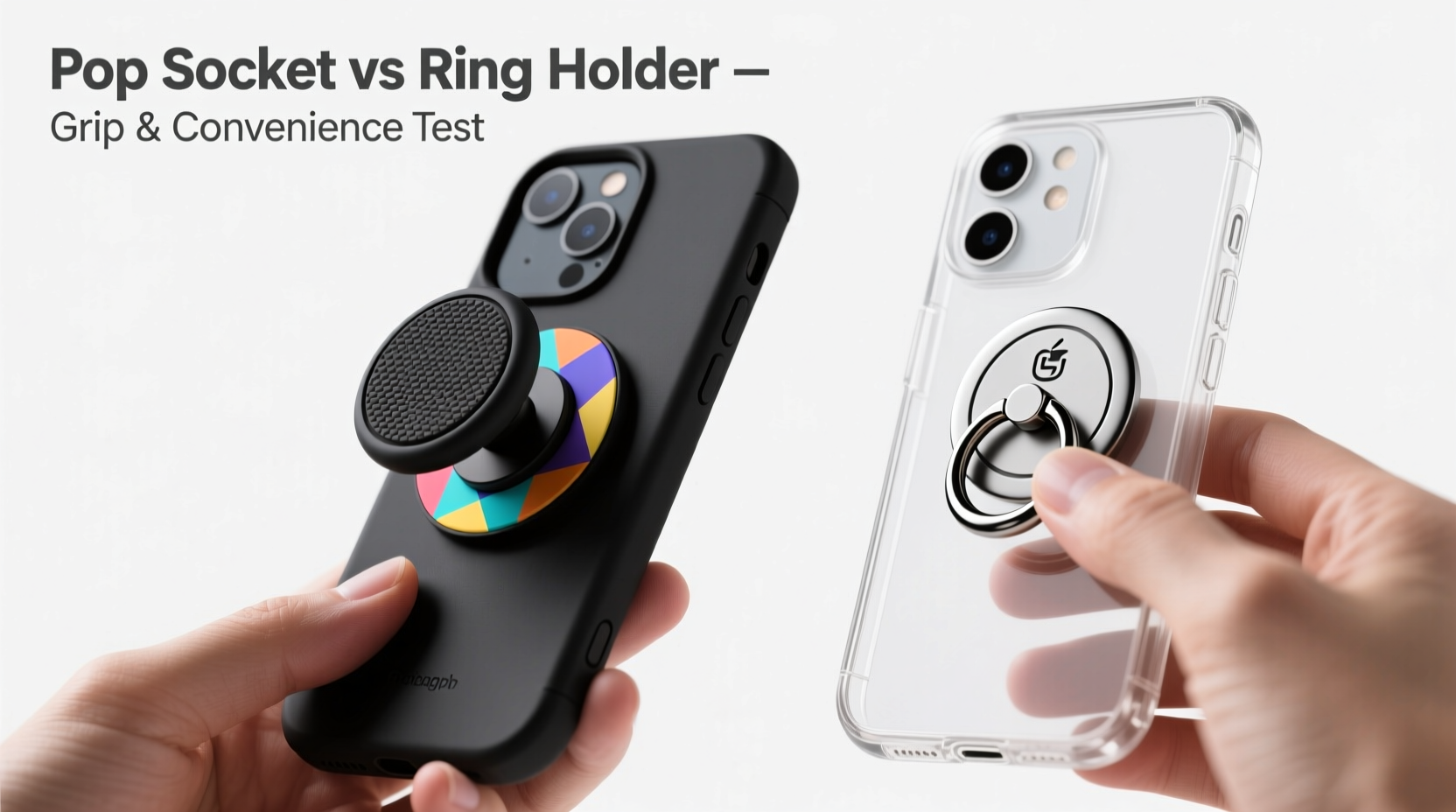
The primary reason people use phone grips is to avoid dropping their devices. Both Pop Sockets and ring holders aim to improve grip, but they do so in fundamentally different ways.
Pop Sockets feature a collapsible disc that expands outward from the back of your phone. When extended, your fingers slide into the gap between the disc and the phone, creating a semi-circular handle. This design allows for a firm, multi-finger hold—ideal when using your phone with one hand for extended periods. The soft-touch surface provides slight cushioning and resists slippage even when hands are slightly damp.
Ring holders, on the other hand, consist of a small metal or plastic loop mounted on a sticky base. You insert one or two fingers through the ring, which acts as an anchor. While effective for preventing drops, the grip is generally limited to a single finger, offering less overall stability. However, because the ring lies flat against the phone when not in use, it doesn't interfere with handling in the same way a protruding Pop Socket might.
Convenience and Portability Compared
Convenience isn’t just about holding your phone—it’s also about how the accessory affects everyday usability.
One major advantage of ring holders is their low profile. When folded down, they add minimal thickness and rarely interfere with sliding your phone into a pocket or bag. Their compact design makes them ideal for users who prioritize sleekness and portability. Some models even double as kickstands, allowing you to prop up your phone for hands-free viewing—a useful feature for watching videos or video calls.
Pop Sockets, while functional, are bulkier. Even when collapsed, they protrude slightly from the back of the phone, which can make pocket storage awkward, especially in tight jeans or slim jackets. Some users report that the raised center can catch on fabric or feel uncomfortable during prolonged handheld use. However, newer magnetic versions offer detachable designs, improving portability by allowing removal when not needed.
On the flip side, Pop Sockets offer expandable utility. Many models include wireless charging compatibility and can be swapped out for different colors or styles. Some even integrate cardholders—turning your phone into a makeshift wallet.
Real-World Example: Commuting with a Phone Grip
Sarah, a graphic designer in Chicago, uses her phone daily on public transit. She initially chose a ring holder for its slim fit in her coat pocket. However, after dropping her phone twice while standing on a crowded train, she switched to a Pop Socket. “The ring felt flimsy,” she said. “I could only hook one finger, and if I bumped someone, my phone would swing dangerously. With the Pop Socket, I can wrap three fingers around it. It feels like I’m actually holding the phone, not just tethering it.”
Still, Sarah noted a trade-off: “It sticks out too much for my back pocket. Now I keep it in my tote instead.” Her experience reflects a common compromise—better grip often comes at the cost of reduced pocketability.
Durability and Long-Term Use
No matter how well-designed a grip is, it must withstand daily wear. Both Pop Sockets and ring holders rely on adhesive backing to attach to your phone or case, and over time, this bond can weaken.
Pop Sockets use a gel-based adhesive that’s repositionable and reusable. The company claims it maintains stickiness for months and can be cleaned with water to restore adhesion. In practice, many users report that the grip holds strong for 6–12 months under normal conditions. However, exposure to heat (like leaving your phone on a car dashboard) can degrade the adhesive faster.
Ring holders typically use 3M industrial-strength adhesive, known for its durability. Once properly applied, these mounts rarely come loose unless physically pried off. However, unlike Pop Sockets, most ring holders aren’t designed to be repositioned. Attempting to remove them often leaves residue or damages the case.
“Adhesive longevity depends more on application technique than brand. Clean the surface thoroughly with alcohol, press firmly for 30 seconds, and wait 24 hours before use—this doubles the lifespan.” — David Lin, Mobile Accessory Engineer
Do’s and Don’ts of Adhesive Care
| Action | Pop Socket | Ring Holder |
|---|---|---|
| Clean with water to restore stickiness | ✅ Yes | ❌ No – damages adhesive |
| Reposition after initial attachment | ✅ Yes, multiple times | ❌ No – permanent bond |
| Use with wireless charging | ✅ Most newer models support it | ✅ Usually compatible |
| Remove without residue | ✅ Easy, low-residue | ⚠️ May leave sticky residue |
Usability Across Devices and Cases
Not all phones and cases are created equal, and compatibility matters.
Pop Sockets work best on flat surfaces. They struggle to adhere securely to curved backs (like some Samsung Galaxy models) or textured cases (such as rubberized or silicone skins). However, their modular design allows swapping between devices. If you change phones frequently, you can transfer your Pop Socket to a new case—provided the surface is smooth and clean.
Ring holders are more versatile in terms of placement. They can be mounted vertically near the edge for easier reach or centered for balance. Their rigid structure handles uneven surfaces better than Pop Sockets, though extreme curves still pose a challenge. One limitation: once placed, the position is fixed. If you mount it too high or too far to one side, there’s no easy fix.
For users with large-screen phones (6.5 inches and above), both accessories significantly improve one-handed reach. A ring holder placed on the lower half of the phone allows you to shift the device downward temporarily to tap the top corners. A Pop Socket, when used with the index and middle fingers, stabilizes the entire phone, reducing strain on the thumb.
Step-by-Step: Installing a Phone Grip for Maximum Hold
- Choose a clean, dry spot on the back of your phone or case—avoid seams, buttons, or curves.
- Wipe the area with an alcohol wipe and let it air dry completely.
- Peel the adhesive backing slowly and align the grip carefully—double-check positioning.
- Press down firmly with even pressure for at least 30 seconds.
- Avoid using the grip for at least 24 hours to allow full adhesion.
- Test gently by holding the phone upright before relying on it fully.
Which Is Better for Specific Lifestyles?
The best choice depends on your daily habits.
- Active users and travelers: Pop Sockets provide superior grip during movement. Hikers, runners, or urban commuters benefit from the multi-finger hold, especially when wearing gloves or sweating.
- Office professionals: Ring holders are sleeker and less obtrusive on desks. The kickstand feature is useful during video meetings, and the low profile doesn’t interfere with docking stations.
- Content creators: Pop Sockets offer better stability for filming handheld videos. The expanded base reduces micro-shakes, leading to smoother footage.
- Minimalists: Ring holders win for discretion. They don’t alter the phone’s silhouette dramatically and disappear visually when not in use.
Checklist: Choosing the Right Phone Grip
- ✅ Assess your phone size—larger screens benefit more from added grip.
- ✅ Consider your carrying method—back pockets favor ring holders; bags allow for Pop Sockets.
- ✅ Think about secondary features—do you want a kickstand or card storage?
- ✅ Evaluate your grip strength—those with weaker hands may prefer the ergonomic support of a Pop Socket.
- ✅ Check compatibility with wireless charging—some thick or metallic grips interfere with charging pads.
Frequently Asked Questions
Can I use a Pop Socket and a ring holder together?
Technically, yes—but not practically. Mounting both creates imbalance, adds unnecessary bulk, and increases the risk of catching on fabrics. Choose one based on your primary need: security (Pop Socket) or convenience (ring holder).
Do ring holders damage phone cases when removed?
They can. High-adhesion rings often leave behind sticky residue or pull off paint from soft cases. To minimize damage, warm the area with a hairdryer and peel slowly. Use rubbing alcohol to clean leftover adhesive.
Are Pop Sockets compatible with all phone cases?
No. They work best on hard, flat cases made of plastic, glass, or metal. Avoid using them on silicone, leather, or heavily textured cases, as the gel adhesive won’t bond effectively.
Final Verdict: Grip vs. Convenience
If grip security is your top priority, Pop Sockets are the clear winner. Their ergonomic design, multi-finger support, and shock-absorbing properties make them ideal for active users, those with larger phones, or anyone prone to accidental drops. The ability to reuse, reposition, and customize them adds long-term value.
However, if convenience, minimalism, and pocket-friendly design matter most, ring holders take the lead. Their slim profile, built-in kickstand function, and seamless integration with daily carry make them perfect for professionals, travelers who value discretion, and users who want subtle support without visual clutter.
Ultimately, the “better” option depends on your priorities. For maximum versatility, consider a magnetic Pop Socket that can be attached and removed as needed—giving you the best of both worlds.




 浙公网安备
33010002000092号
浙公网安备
33010002000092号 浙B2-20120091-4
Comments
No comments yet. Why don't you start the discussion?