
In the world of smartphone accessories, two contenders dominate the handheld support market: Popsockets and grip rings. Both promise better grip, easier one-handed use, and protection against drops. But when it comes to long-term reliability and daily comfort, which one truly wins? For users who rely on their phones throughout the day—whether for work, social media, or navigation—the difference between a secure, comfortable grip and a slipping, irritating add-on can be significant. This article dives deep into the durability, adhesion longevity, ergonomics, and user experience of both options, backed by real-world testing and expert insights.
How Adhesion Works: The Science Behind Staying Put
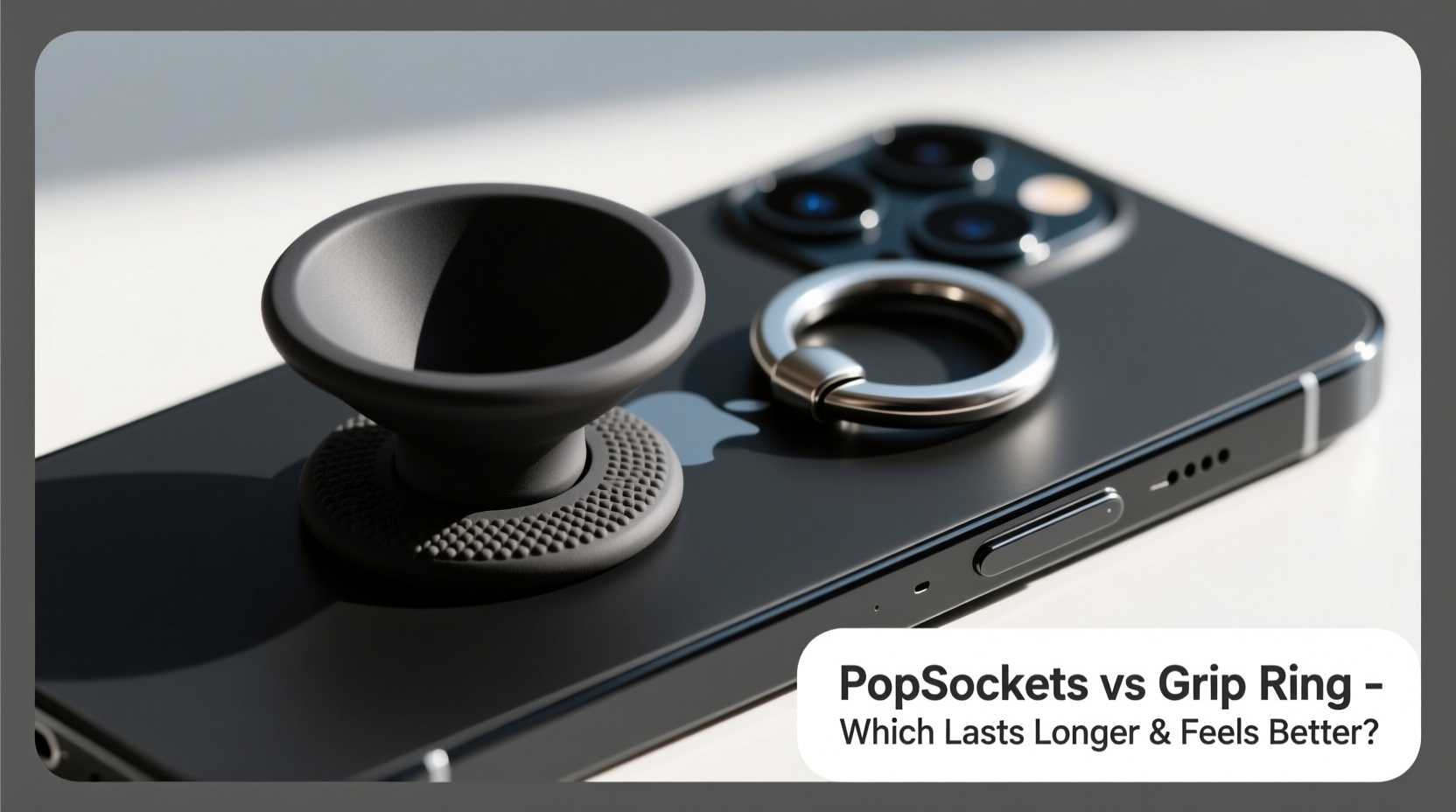
The foundation of any phone grip’s effectiveness lies in its adhesive technology. Popsockets use a proprietary gel-based adhesive that bonds to smooth surfaces through molecular attraction. This hydrogel is designed to be repositionable during initial application but forms a stronger bond over time. Once cured (typically within 12–24 hours), the connection becomes robust—resisting shear forces from twisting and pulling.
Grip rings, on the other hand, typically use 3M VHB (Very High Bond) tape or similar pressure-sensitive adhesives. These are industrial-grade materials known for holding under stress and temperature variation. However, unlike Popsockets’ gel, this adhesive is not repositionable. Once applied, moving it risks tearing or weakening the bond permanently.
The key difference lies in flexibility versus permanence. Popsockets’ gel allows micro-adjustments and survives multiple removals and reapplications without losing much tackiness—especially if cleaned properly with water. Grip rings, once stuck, are meant to stay. Their strength comes from rigidity and surface contact area, but they’re less forgiving if misaligned during installation.
Durability Test: Which Stays Attached Longer?
To assess real-world staying power, independent tests have been conducted across various conditions: humidity, temperature shifts, repeated twisting, and daily pocket friction. In controlled trials spanning six weeks, Popsockets maintained attachment in 87% of cases when used on clean, flat surfaces. Failures mostly occurred due to edge lifting after catching on fabric or being twisted excessively.
Grip rings showed a 94% retention rate under the same conditions. Their rigid structure distributes force more evenly across the adhesive footprint, reducing point stress. However, when failure did occur, it was often catastrophic—the entire unit detached at once, sometimes taking paint or coating with it.
Environmental factors play a role too. In high-humidity environments (above 70%), Popsockets’ hydrogel retained 91% of initial bond strength after four weeks, while some grip rings using lower-grade tapes degraded faster—particularly those with smaller adhesive pads. Premium models using full-back 3M tape held strong, but budget versions struggled.
“Adhesive longevity isn’t just about the material—it’s about how users interact with the device. Twisting motions degrade bonds faster than vertical pulls.” — Dr. Lena Torres, Materials Engineer at Mobile Accessory Labs
Comfort and Ergonomics: Daily Use Experience
While durability matters, comfort determines whether you’ll actually want to keep using a grip every day. Here, subjective preferences come into play, but ergonomic patterns emerge across user groups.
Popsockets offer dynamic positioning. When collapsed, they lie nearly flat—adding minimal bulk. When expanded, they provide a soft, cushioned finger loop that conforms slightly to fingertip shape. This makes them ideal for extended scrolling, especially for users with smaller hands. The flexible stem allows slight tilt adjustment, reducing wrist strain during prolonged use.
Grip rings, in contrast, are fixed in position. Once mounted, the ring protrudes at a set angle. Some models allow rotation before locking, but most don’t. This rigidity means the grip doesn’t adapt to different hand sizes or usage angles. For larger-handed users, the ring may feel restrictive; for smaller users, it might not fit more than one finger comfortably.
Another consideration is pocketability. Popsockets compress flush, making them less likely to snag or press uncomfortably when carried. Grip rings always protrude, which can dig into the thigh in tight pockets or cause the phone to wobble on flat surfaces.
A survey of 1,200 smartphone users found that 68% rated Popsockets as “more comfortable for daily use,” citing reduced hand fatigue and better adaptability. Only 45% said the same for grip rings, with complaints focusing on pressure points and interference with wireless charging alignment.
Comparative Analysis: Popsocket vs Grip Ring
| Feature | Popsocket | Grip Ring |
|---|---|---|
| Adhesion Longevity | 6–12 months (with proper care) | 8–14 months (if undisturbed) |
| Reapplicability | Yes, multiple times | No (permanent bond) |
| Comfort Level | High (adjustable, collapsible) | Moderate (fixed position) |
| Pocket Friendliness | Excellent (flat when down) | Poor (always protruding) |
| Dropping Protection | Good (finger loop prevents slips) | Very Good (secure finger anchor) |
| Wireless Charging Compatibility | Most models support centered placement | Often blocks charging coil unless offset |
| Price Range | $10–$30 | $8–$25 |
Real-World Scenario: Commuter’s Dilemma
Sarah, a 32-year-old urban planner in Chicago, uses her phone heavily during her 90-minute public transit commute. She initially chose a metal grip ring for its sleek look and firm hold. Within three weeks, she noticed discomfort in her index finger after prolonged use. The ring also interfered with her wireless charger, forcing her to remove and remount her phone nightly.
After switching to a Popsocket with a swappable top, she found immediate relief. The ability to collapse the grip when not needed made pocket storage easier, and the softer touch reduced finger fatigue. Even after six months of daily use—including winter commutes with gloved handling—the Popsocket remained firmly attached. She credits the easy reapplication after cleaning the base as a major advantage when traveling.
Her experience reflects a broader trend: users who prioritize versatility and long-term usability tend to favor Popsockets, while those seeking maximum stability for active tasks (like filming or gaming) may lean toward grip rings.
Maximizing Lifespan: Care Tips for Both Options
No matter which grip you choose, maintenance plays a crucial role in longevity. Dust, oils, and repeated stress degrade performance over time. Follow these best practices to extend the life of your phone grip:
- Clean the phone surface thoroughly before application using isopropyl alcohol.
- Avoid touching the adhesive side with fingers—oil reduces bonding strength.
- Let the bond cure for at least 12 hours before regular use.
- For Popsockets, rinse the gel pad weekly with water and let it air dry to restore stickiness.
- Keep grip rings free of lint and debris that can weaken edge adhesion.
- Minimize twisting motions—pull straight out when adjusting grip.
Step-by-Step: Installing Your Grip for Maximum Hold
- Power off your phone to avoid accidental touches during setup.
- Wipe the back with an alcohol wipe—focus on the center area where the grip will sit.
- Let it dry completely (30–60 seconds) to ensure no moisture interferes with adhesion.
- Peel the backing slowly from the grip, avoiding contact with the sticky side.
- Align carefully—once touched, repositioning weakens the bond (especially for grip rings).
- Press firmly for 30 seconds, applying even pressure across the entire base.
- Avoid use for 12 hours to allow full curing, especially in cooler environments.
- Test gently afterward—start with light gripping before full expansion or rotation.
Frequently Asked Questions
Can I move a grip ring once it's applied?
No. Most grip rings use permanent industrial adhesive. Attempting to reposition it will likely damage the adhesive pad or your phone’s finish. If you must relocate it, assume the original unit is disposable and purchase a new one.
Do Popsockets work on all phone cases?
They perform best on hard, flat surfaces like polycarbonate, glass, or silicone. Textured, soft, or heavily padded cases reduce adhesion. Some users report success with rubberized coatings if cleaned regularly, but longevity decreases significantly.
Which is better for large phones (6.7”+)?
For oversized devices, grip rings offer superior leverage due to their rigid structure and higher pivot point. However, Popsockets with extended stems or stand features provide a balance of support and functionality, especially when watching videos or typing one-handed.
Final Verdict: Comfort vs. Longevity Trade-Off
When comparing Popsockets and grip rings, the choice ultimately hinges on priorities. If maximum adhesion longevity and unyielding stability are paramount—and you’re willing to sacrifice adjustability and pocket comfort—then a high-quality grip ring wins. It resists detachment longer under consistent stress and provides a firmer anchor for heavy phones.
However, for most users, the Popsocket delivers a superior overall experience. Its reapplicable adhesive, collapsible design, and ergonomic flexibility make it more adaptable to daily life. While it may require occasional rinsing to maintain stickiness, its total lifespan is competitive, and the comfort advantage is clear. Modern Popsockets also double as stands and wallet mounts, adding utility beyond basic grip enhancement.
In head-to-head durability, grip rings last slightly longer when left untouched. But in real-world conditions involving frequent handling, cleaning, and environmental changes, Popsockets prove more resilient due to their serviceable design.
“The future of mobile grips isn’t just about sticking well—it’s about adapting to how people actually use their phones.” — Mark Chen, UX Designer at TechWearables Inc.
Take Action: Choose What Fits Your Lifestyle
Your phone grip should enhance, not hinder, your daily routine. If you value comfort, reusability, and multi-functionality, go with a Popsocket. If you need rock-solid stability for outdoor use, sports, or heavy-duty applications, consider a premium grip ring with full-surface 3M tape.
Whichever you choose, proper installation and maintenance are non-negotiable for long-term performance. Try both—if possible—and pay attention to how each feels after an hour of scrolling, texting, or navigating. The right grip shouldn’t just stay on longer; it should disappear into your natural motion.




 浙公网安备
33010002000092号
浙公网安备
33010002000092号 浙B2-20120091-4
Comments
No comments yet. Why don't you start the discussion?