
When summer heat rolls in and your home lacks central air conditioning, two popular options emerge: portable air conditioners and window units. Both promise relief from rising temperatures, but they differ significantly in design, installation, efficiency, and long-term value. While portable ACs are marketed as convenient, flexible solutions—especially for renters or those without suitable windows—many users question whether that convenience comes at the cost of actual cooling performance. So, is a portable AC truly efficient compared to a traditional window unit? The answer depends on how you define \"efficient\" and what your cooling priorities really are.
How Cooling Efficiency Is Measured
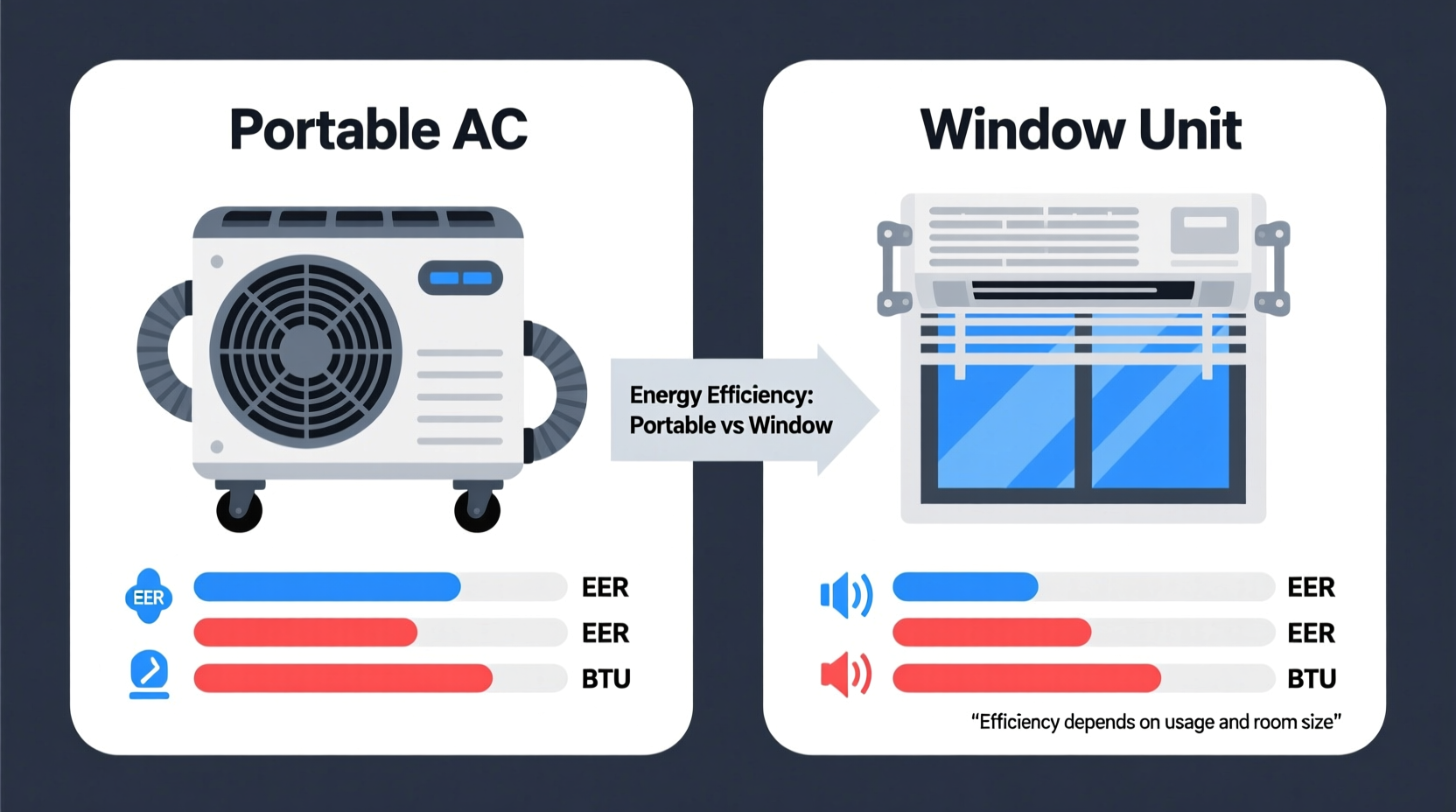
Cooling efficiency isn’t just about how cold a room gets—it’s about how much cooling you get per unit of electricity consumed. The standard metric used in the U.S. is the **EER (Energy Efficiency Ratio)**, calculated by dividing the cooling output (in BTUs) by the power input (in watts). A higher EER means better efficiency.
For example, an air conditioner with 10,000 BTUs and consuming 1,200 watts has an EER of 8.3. Window units typically range from 9 to 12 EER, while most portable models fall between 6 and 9.5. This gap reveals a fundamental disadvantage: portable ACs generally use more energy to deliver the same level of cooling.
“Window units have had decades of refinement. Portable ACs, while improving, still struggle with inherent inefficiencies due to their dual-hose or single-hose airflow design.” — Dr. Alan Reyes, HVAC Systems Analyst at Northeast Climate Labs
The reason lies in physics. Portable units must expel hot air through a hose vented out a window or wall. In doing so, they create negative pressure indoors, pulling in warm outside air through gaps in doors and walls. This undermines cooling consistency and forces the unit to work harder.
Design and Operation: Key Differences
To understand why efficiency varies, it helps to compare how each system operates.
- Window Units: Installed directly into a window frame, these split the cooling process: the condenser (hot side) sits outside, while the evaporator (cool side) stays inside. This separation allows effective heat rejection without affecting indoor air balance.
- Portable ACs: All components are housed in a single box. They require a vent hose to channel exhaust heat outside. Most use either one or two hoses. Single-hose models draw indoor air for cooling, then expel it—creating a vacuum that pulls in unconditioned outdoor air. Dual-hose models improve this by using one hose for intake and another for exhaust, but even these lag behind window units in overall efficiency.
Performance Comparison: Real-World Cooling Results
Efficiency claims on product labels often don’t reflect real-world conditions. Independent testing shows consistent patterns:
| Feature | Window Unit (10,000 BTU) | Portable AC (10,000 BTU, Dual-Hose) | Portable AC (10,000 BTU, Single-Hose) |
|---|---|---|---|
| Average EER | 10.5 | 8.7 | 6.9 |
| Cooling Speed (to drop 10°F in 200 sq ft) | 18 minutes | 28 minutes | 35+ minutes |
| Noise Level (dB) | 52 dB | 56 dB | 58 dB |
| Energy Use (kWh/month, 8 hrs/day) | 78 kWh | 95 kWh | 112 kWh |
| Estimated Annual Cost (at $0.15/kWh) | $140 | $171 | $201 |
The data shows that even high-end dual-hose portable models can't match the energy economy of a mid-tier window unit. Single-hose versions perform noticeably worse, especially in humid climates where dehumidification demands increase workload.
Mini Case Study: Sarah’s Studio Apartment
Sarah rents a 350-square-foot studio in downtown Austin. Last summer, she opted for a popular 10,000-BTU single-hose portable AC because her landlord prohibited window units. Despite following setup instructions, she noticed the room only cooled to 78°F during peak afternoons when it was 98°F outside. Her electric bill rose by $47 that month.
In contrast, her neighbor Mark installed a 10,000-BTU window unit in his identical apartment. He reported dropping the temperature to 72°F within 20 minutes and saw only a $28 increase in his monthly bill. Both units ran roughly 8 hours daily.
Sarah switched to a window model this year (with landlord approval) and now maintains 71°F comfortably. “I thought portability was worth the trade-off,” she said. “But I didn’t realize how much more it would cost me in both comfort and money.”
When a Portable AC Makes Sense
Despite lower efficiency, portable air conditioners aren’t obsolete. They serve specific needs where window units aren’t viable:
- Renters who can’t modify windows
- Rooms without operable windows (e.g., basement offices)
- Temporary or supplemental cooling (e.g., server rooms, garages)
- Mobility across multiple rooms
If you choose a portable model, maximize its effectiveness with these strategies:
Checklist: Optimizing Your Portable AC Setup
- Choose a dual-hose model if available—avoid single-hose units unless absolutely necessary.
- Use the shortest, straightest exhaust hose possible; avoid coiling or extending it unnecessarily.
- Seal the window vent kit tightly to prevent hot air leakage.
- Place the unit away from walls and furniture to allow proper airflow.
- Clean or replace filters every 2–4 weeks during heavy use.
- Drain internal condensate regularly or connect a continuous drain hose if supported.
- Supplement with ceiling or fan circulation to distribute cool air evenly.
Installation and Practical Considerations
One of the biggest selling points of portable ACs is ease of setup. Most come with a window bracket that installs in minutes and requires no permanent modifications. Window units, meanwhile, demand secure mounting, proper support brackets, and sometimes assistance lifting heavier models (some exceed 70 lbs).
However, ease doesn’t equal safety or durability. Portable units generate significant moisture, which must be managed. Many self-evaporative models claim “no draining,” but in high-humidity environments, internal reservoirs still fill up. Neglecting to empty them triggers automatic shutoffs, interrupting cooling.
Window units, though bulkier, handle condensation more effectively by channeling water outside via the external condenser pan. They also tend to have longer lifespans—often 8–10 years versus 5–7 for portables—due to sturdier construction and less strain from compromised airflow.
Step-by-Step Guide: Installing a Portable AC Correctly
- Choose the right room size: Match BTUs to square footage. For moderate climates, use 20 BTUs per sq ft. In hot, sunny areas, aim for 25–30 BTUs per sq ft.
- Select the vent location: Use a sliding or double-hung window near an outlet. Avoid casement or awning-style windows that don’t accommodate kits well.
- Assemble the exhaust hose and window kit: Attach the hose securely to the back of the unit and insert the panel into the window track.
- Seal all gaps: Use included foam or weatherstripping to close spaces around the panel. Even small leaks reduce efficiency.
- Position the unit centrally: Keep it upright and away from curtains or furniture blocking intake vents.
- Plug into a dedicated outlet: Avoid extension cords. High startup wattage can trip breakers or damage electronics.
- Run and monitor: Set to lowest temperature for first hour, then adjust. Check hose temperature—hot exhaust indicates proper function.
Environmental and Long-Term Impact
Efficiency isn’t just about your wallet—it affects environmental footprint too. A portable AC consuming 112 kWh/month emits approximately 80 pounds of CO₂ over a three-month summer (assuming average U.S. grid mix). A comparable window unit emits closer to 56 pounds. Over five years, that’s nearly 120 extra pounds of carbon from the portable model.
Additionally, portable units often end up discarded earlier due to mechanical failures or dissatisfaction with performance. Their compact compressors and constrained airflow lead to faster wear. When replaced prematurely, this contributes to e-waste and repeated manufacturing impact.
“The most sustainable appliance is the one you keep working efficiently for years. Window units consistently outperform portables in longevity and repairability.” — Lisa Tran, Senior Researcher at Sustainable Appliance Institute
FAQ: Common Questions About Portable vs Window ACs
Can a portable AC cool a large room as well as a window unit?
Generally, no. Even with the same BTU rating, portable units struggle to maintain low temperatures in larger spaces due to heat re-entry from negative pressure and less effective heat dissipation. For rooms over 400 sq ft, a window unit is almost always more effective.
Are dual-hose portable ACs worth the extra cost?
Sometimes. Dual-hose models eliminate the negative pressure issue by drawing outdoor air for condenser cooling, improving efficiency by 15–20% over single-hose versions. However, they still trail behind comparably sized window units in EER and noise. If you must go portable, choose dual-hose—but expect higher operating costs.
Do portable ACs really save space?
They save window space, yes—but they take up floor area, often blocking pathways or limiting furniture layout. Most weigh 60–80 lbs and require proximity to a vented window. In small apartments, this can be a bigger inconvenience than anticipated.
Final Verdict: Efficiency vs. Convenience
So, is the portable AC actually efficient? Objectively, no—not when measured by energy use, cooling speed, or long-term value. Window units remain superior in nearly every technical category. They cool faster, use less electricity, last longer, and provide quieter operation.
That said, a portable AC can be the right choice if your situation limits alternatives. Renters, temporary occupants, or those with non-standard windows may find the flexibility outweighs the efficiency penalty. But if you own your home, rent with permission, or have a suitable window, a window unit will deliver better comfort, lower bills, and greater reliability.
Ultimately, efficiency should be weighed against practicality. But never assume convenience comes free. In the case of portable air conditioners, you’re often paying more over time—both financially and environmentally—for the privilege of mobility.




 浙公网安备
33010002000092号
浙公网安备
33010002000092号 浙B2-20120091-4
Comments
No comments yet. Why don't you start the discussion?