
When it comes to cooling a room without central air conditioning, many homeowners turn to either portable air conditioners or window units. While both serve the same basic purpose—lowering indoor temperatures—their efficiency, installation requirements, and long-term performance vary significantly. Despite their convenience and mobility, portable ACs consistently underperform compared to their window-mounted counterparts. The reason? It all comes down to thermodynamics, airflow design, and how each system handles waste heat.
This article breaks down the core engineering and operational differences between portable and window air conditioners, explains why portable models are inherently less efficient, and offers practical guidance for consumers deciding which option best suits their needs.
How Air Conditioners Work: A Quick Primer
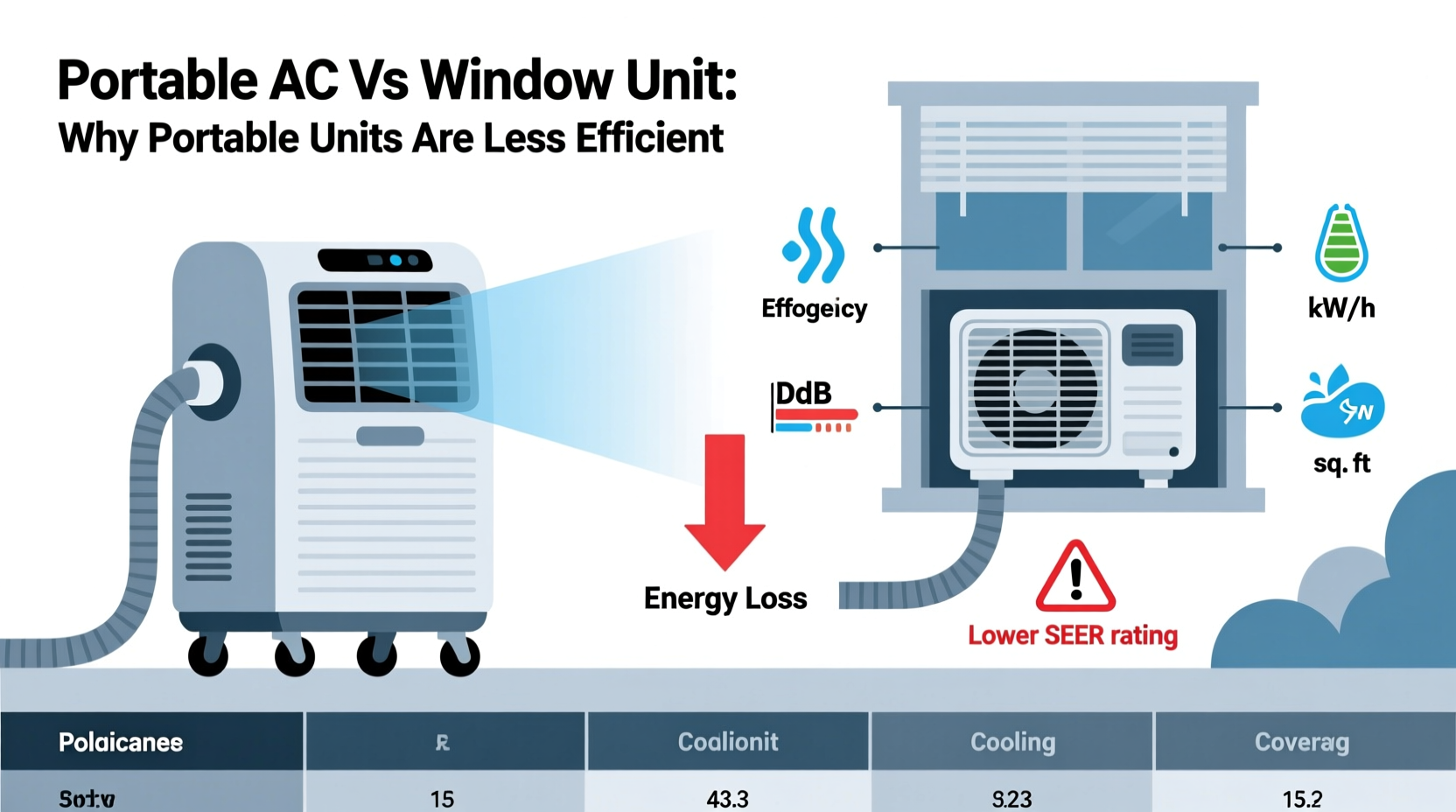
All air conditioners operate on the same fundamental principle: they move heat from inside a space to the outside using a refrigerant cycle. This process involves four key components—compressor, condenser, expansion valve, and evaporator coil. Warm indoor air passes over the cold evaporator coil, cooling the air while transferring heat to the refrigerant. That heated refrigerant is then compressed and sent to the condenser, where it releases heat outdoors.
The critical factor in efficiency is how effectively an AC can reject heat outside. Any system that fails to expel heat efficiently will struggle to cool the room—and may even contribute to net warming over time.
Design Differences: Portable vs Window Units
The primary distinction between portable and window air conditioners lies in their physical configuration and integration with the building envelope.
- Window units are installed directly into a window frame or wall sleeve, creating a sealed barrier between indoor and outdoor environments. The hot side (condenser) faces outward, while the cold side (evaporator) blows cooled air indoors.
- Portable ACs are freestanding boxes placed inside the room. They draw in warm air, cool it, and expel hot exhaust through a single hose (or sometimes two) routed out a window via a kit.
While portability seems like a clear advantage—no permanent installation, easy relocation—the trade-off is significant in terms of thermal efficiency and energy consumption.
The Single-Hose Problem
Most portable air conditioners use a single duct to exhaust hot air. Here’s where physics becomes a problem: as the unit pulls indoor air across the evaporator to cool it, the warmed refrigerant travels to the condenser, which uses the same indoor air supply to dissipate heat—then pushes that superheated air outside through the hose.
But removing air from the room creates negative pressure. To balance this, outside air gets pulled in through cracks, doors, windows, and other openings. Since this replacement air is typically hotter and more humid than the indoor environment, the AC must now work harder to cool incoming warm air—essentially fighting against itself.
“Single-hose portable ACs don’t just fail to cool efficiently—they often increase the overall heat load in adjacent spaces.” — Dr. Alan Pierce, HVAC Systems Engineer, ASHRAE Fellow
Efficiency Metrics: BTUs, EER, and Real-World Performance
Air conditioner performance is measured using several metrics, but two are most relevant: British Thermal Units (BTUs) and Energy Efficiency Ratio (EER).
- BTU indicates cooling capacity—the higher the number, the more heat the unit can remove per hour.
- EER = BTUs ÷ watts consumed. Higher EER means better efficiency.
On paper, many portable ACs advertise high BTU ratings (e.g., 14,000 BTU), suggesting strong cooling power. However, real-world testing shows these numbers are misleading due to poor heat rejection and parasitic air infiltration.
Comparative Efficiency Table
| Model Type | Avg. BTU Rating | Avg. EER | Ventilation Method | Effective Cooling Output* |
|---|---|---|---|---|
| Window Unit (8,000 BTU) | 8,000 | 10.5–12.0 | Dual-side separation (indoor/outdoor) | ~8,000 BTU |
| Single-Hose Portable (14,000 BTU) | 14,000 | 2.8–4.5 | Single exhaust hose | ~5,000–6,000 BTU (net) |
| Dual-Hose Portable (12,000 BTU) | 12,000 | 3.8–5.2 | Separate intake/exhaust hoses | ~8,000–9,000 BTU (net) |
*Effective cooling output accounts for heat infiltration and pressure imbalance effects.
As shown, even a lower-BTU window unit outperforms a higher-rated portable model because it maintains proper thermal separation and doesn’t disrupt indoor air balance.
Why Dual-Hose Portables Are Better—but Still Fall Short
Dual-hose portable ACs attempt to solve the negative pressure issue by using one hose to exhaust hot air and another to draw in outdoor air specifically for condenser cooling. This prevents the room from becoming negatively pressurized.
However, problems remain:
- The condenser still uses unconditioned outdoor air, which is hotter than indoor air—reducing heat transfer efficiency.
- Both hoses occupy part of a window, limiting ventilation and natural light.
- Installation kits are often poorly sealed, allowing hot air leakage.
- Units remain bulkier and noisier than comparable window models.
Even dual-hose systems rarely achieve EER values above 5.2, whereas modern ENERGY STAR-certified window units regularly exceed 11.0.
Real-World Example: Office Overheating Dilemma
Consider a small home office in Phoenix, Arizona—approximately 150 sq ft with standard insulation and west-facing windows. During summer afternoons, internal temperatures regularly reach 88°F despite blinds being drawn.
The occupant purchases a popular 12,000 BTU single-hose portable AC, expecting relief. After setup, the unit runs continuously. The thermostat reads 77°F near the machine, but the far corner remains at 83°F. Humidity feels higher than before. Electric bills spike by $45/month.
An HVAC technician evaluates the situation and finds:
- Negative pressure pulling in 95°F desert air through door gaps.
- Exhaust hose kinked behind furniture, restricting airflow.
- Unit cycling inefficiently due to overheating condenser.
The technician replaces the portable with an 8,000 BTU ENERGY STAR window unit. Within 20 minutes, the entire room stabilizes at 74°F. Noise drops significantly. Monthly energy usage decreases by 30% compared to the portable model.
This scenario illustrates that raw BTU claims mean little when real-world conditions degrade actual performance.
Energy Costs and Long-Term Impact
Inefficiency isn't just about comfort—it's about cost. Let’s compare annual operating expenses based on average U.S. electricity rates ($0.15/kWh) and 500 hours of seasonal use.
Estimated Annual Operating Cost Comparison
| Unit Type | BTU | Power Draw (Watts) | EER | Annual Cost |
|---|---|---|---|---|
| Window AC (ENERGY STAR) | 8,000 | 700 | 11.4 | $52.50 |
| Single-Hose Portable | 14,000 | 1,400 | 3.5 | $105.00 |
| Dual-Hose Portable | 12,000 | 1,100 | 4.8 | $82.50 |
Over five years, the single-hose portable costs nearly $260 more to operate than the window unit—more than the price of some entry-level models. Add in potential damage from excess humidity or inadequate cooling, and the total cost of ownership rises further.
Practical Considerations Beyond Efficiency
Despite their drawbacks, portable ACs remain popular. Why? Because certain situations make window units impractical.
- Rented apartments prohibiting window modifications.
- Historic buildings with non-standard or restricted windows.
- Multi-room cooling needs with frequent repositioning.
- Temporary setups (event spaces, garages, workshops).
In these cases, portability outweighs efficiency concerns. But users should understand the limitations and adjust expectations accordingly.
Checklist: Choosing the Right Option for Your Space
- ✅ Determine if window installation is allowed or feasible.
- ✅ Measure room size and calculate required BTUs (20 BTU/sq ft is a baseline).
- ✅ Check electrical circuit capacity—portables often require dedicated outlets.
- ✅ Assess noise tolerance—portables tend to be louder (50–60 dB).
- ✅ Prioritize EER over BTU when comparing models.
- ✅ For portables, verify inclusion of a dual-hose system and quality window seal kit.
- ✅ Consider supplemental dehumidification if living in a humid climate.
Frequently Asked Questions
Can I improve the efficiency of my portable AC?
Yes, though limits exist. Use a dual-hose model, ensure the exhaust hose is straight and short, seal the window adapter completely, keep filters clean, and close off unused rooms. Avoid placing the unit in direct sunlight or near heat sources.
Are there any truly efficient portable air conditioners?
Not in the traditional sense. Even the best dual-hose models cannot match the thermodynamic efficiency of a properly installed window unit. Some newer “evaporative-cooled” or hybrid designs show promise in dry climates but are ineffective in humidity.
Why do manufacturers advertise high BTUs if they’re misleading?
Manufacturers test BTUs under ideal lab conditions (ASHRAE standards), not real-world settings. While technically accurate, these figures don’t reflect net cooling output when negative pressure and heat infiltration occur. Regulatory bodies have debated revising labeling practices, but no changes have been implemented yet.
Final Recommendations and Alternatives
If your goal is effective, energy-efficient cooling, a window air conditioner remains the superior choice for most residential applications. Modern models are quieter, smarter (with Wi-Fi controls), and significantly more efficient than even a decade ago.
For those unable to install a window unit, alternatives include:
- Ductless mini-splits: High-efficiency, permanent solution with indoor heads and outdoor compressors.
- Evaporative coolers: Effective only in dry climates; consume less energy but add moisture.
- Cooling fans with misting systems: Provide perceived cooling through evaporation.
- Passive cooling strategies: Improved insulation, blackout curtains, ceiling fans, and strategic ventilation.
Portable ACs should be viewed as a last-resort solution—acceptable for temporary use, supplemental cooling, or when structural constraints prevent better options.
“The convenience of a portable AC is undeniable, but consumers need to recognize it comes at a steep efficiency penalty. In most cases, investing in a window unit—or exploring alternative cooling methods—delivers better comfort and lower long-term costs.” — Sarah Lin, Senior Analyst, Appliance Efficiency Institute
Conclusion: Make an Informed Decision
Understanding the science behind cooling efficiency empowers you to make smarter choices. Portable air conditioners offer mobility and ease of setup, but their single-hose design, poor EER ratings, and tendency to introduce warm air undermine their effectiveness. Window units, by maintaining strict separation between indoor and outdoor airflows, deliver consistent, reliable, and far more efficient cooling.
Before purchasing any cooling appliance, evaluate your space, usage patterns, and long-term goals. Don’t be swayed by inflated BTU numbers or marketing claims. Look at EER ratings, read independent reviews, and prioritize thermal performance over convenience—unless true portability is essential.




 浙公网安备
33010002000092号
浙公网安备
33010002000092号 浙B2-20120091-4
Comments
No comments yet. Why don't you start the discussion?