
Smoothies have become a staple in modern diets—packed with nutrients, quick to prepare, and endlessly customizable. But as lifestyles grow more mobile, the question arises: do you need a bulky countertop blender, or can a compact portable model truly deliver the same experience on the go? The answer isn’t straightforward. While both types serve the purpose of blending ingredients into a drinkable form, their capabilities, limitations, and ideal use cases differ significantly.
For fitness enthusiasts, busy professionals, travelers, or parents on the move, portability is a major selling point. Yet many hesitate, wondering if sacrificing size means sacrificing performance. This article dives deep into the practical realities of portable versus full-size blenders, examining power, texture, ease of cleaning, battery life, and real-world usability. By the end, you’ll know exactly which model aligns with your lifestyle—and whether “making smoothies anywhere” is truly feasible.
Power and Performance: What Blending Really Requires
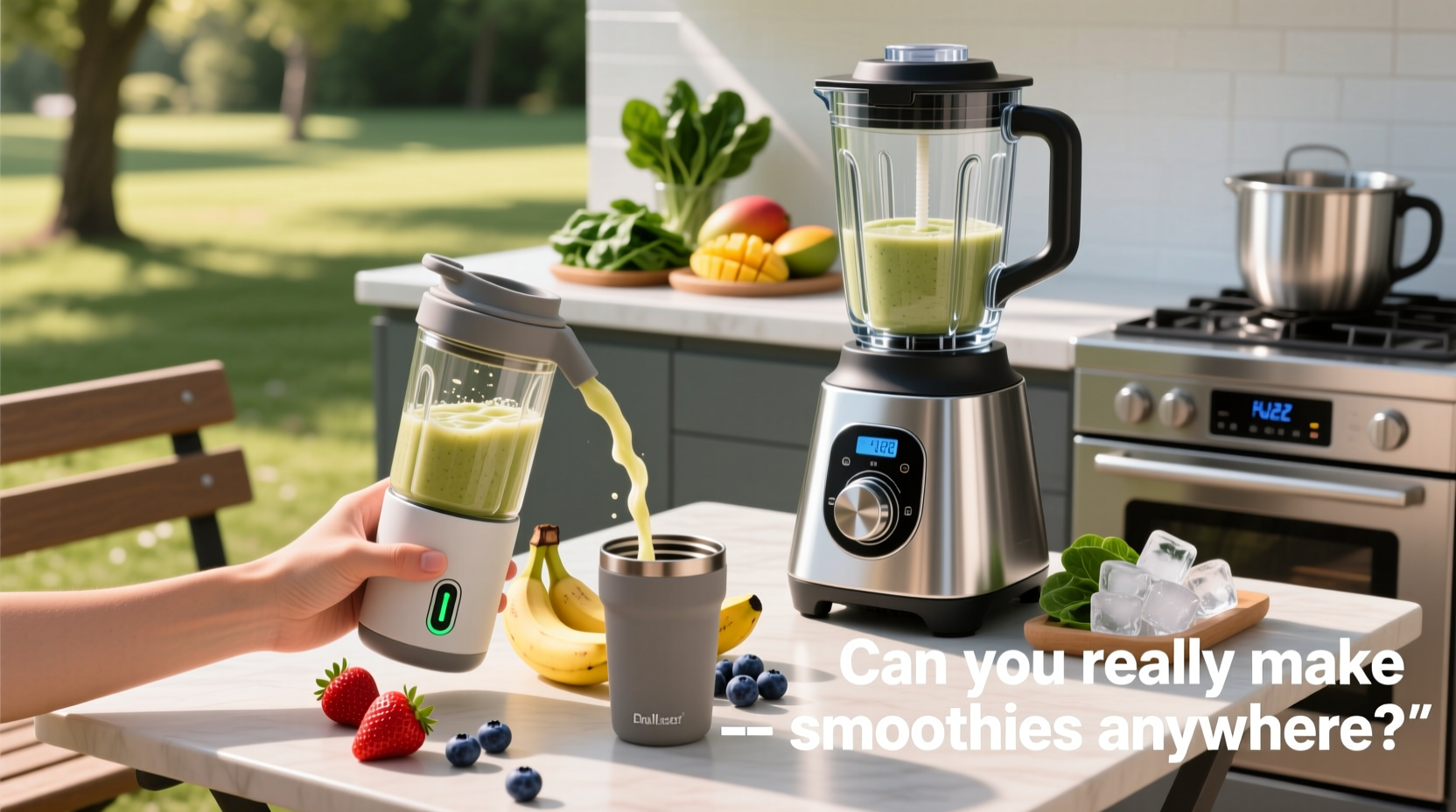
The core difference between portable and full-size blenders lies in motor strength. Full-size kitchen blenders typically range from 500 to 1500 watts, allowing them to crush ice, pulverize frozen fruit, and blend fibrous greens like kale or spinach into silky-smooth textures. High-powered models such as the Vitamix or Blendtec are engineered for consistency and durability, capable of handling large batches and tough ingredients with minimal effort.
In contrast, most portable blenders operate between 100 and 300 watts. They rely on rechargeable lithium-ion batteries, which inherently limit sustained power output. While they can handle soft fruits, yogurt, protein powder, and leafy greens in small quantities, they often struggle with frozen ingredients or dense fibers. Users report needing to thaw frozen berries beforehand or risk incomplete blending and motor strain.
“Blending efficiency isn’t just about speed—it’s about torque and blade design. Portable units lack the mechanical advantage of high-torque motors, so they compensate with pre-soaking or shorter blending cycles.” — Dr. Alan Reeves, Appliance Engineer and Food Processing Specialist
This doesn’t mean portable blenders are ineffective. For light-duty tasks—like mixing a post-workout shake with banana and protein powder—they perform admirably. But if your smoothie routine includes raw vegetables, nuts, seeds, or ice, a full-size model remains the superior choice for texture and reliability.
Portability vs Practicality: Real-World Use Cases
The appeal of a portable blender is undeniable: no cords, no counter space, and the freedom to blend at the gym, office, park, or during a road trip. Most models are designed as single-serve bottles with blending blades attached directly to the base. After blending, you simply remove the blade unit, attach a drinking cap, and go.
However, true portability comes with trade-offs:
- Battery Life: A typical charge lasts 10–20 blends, depending on usage. Heavy users may need to recharge daily.
- Capacity: Most portable blenders hold 12–20 oz, suitable for one person but impractical for families.
- Noise Level: While quieter than full-size models, they’re not silent—blending in quiet offices or libraries can be awkward.
- Charging Access: Without a nearby outlet or power bank, recharging becomes a logistical hurdle.
Full-size blenders, while stationary, offer unmatched versatility. You can make multiple servings at once, create soups, nut butters, or even grind coffee beans. Their larger pitchers allow layering ingredients strategically (liquids at the bottom, heavier items on top), reducing air pockets and improving blend quality.
Comparative Overview: Key Features Side-by-Side
| Feature | Portable Blender | Full-Size Kitchen Blender |
|---|---|---|
| Motor Power | 100–300 watts | 500–1500 watts |
| Capacity | 12–20 oz (single serve) | 48–72 oz (multiple servings) |
| Power Source | Rechargeable battery (USB-C or wall charger) | AC plug-in |
| Blending Time | 30–60 seconds per blend | 10–30 seconds |
| Cleaning | Rinse immediately; some parts dishwasher-safe | Dishwasher-safe pitcher; self-cleaning cycles available |
| Ideal For | On-the-go shakes, travel, small kitchens | Families, meal prep, heavy-duty blending |
| Price Range | $30–$80 | $100–$600+ |
A Day in the Life: Real Example of Portable Blender Use
Consider Maya, a freelance graphic designer who works remotely from co-working spaces and cafes. Her morning routine includes a green smoothie made with spinach, frozen mango, chia seeds, almond milk, and protein powder. At home, she uses a high-end full-size blender effortlessly. But when working offsite, she relies on her portable blender.
She prepares her ingredients the night before, thawing the mango slightly and pre-measuring chia seeds into a small container. In the morning, she pours almond milk into the blender bottle, adds spinach and mango, then blends for 45 seconds. The result is drinkable but slightly chunky—she notices undissolved chia seeds and fibrous bits of spinach. She carries a small brush to clean the blade unit in the restroom sink, which takes two minutes.
While convenient, the process requires planning and compromise on texture. At home, her full-size blender delivers a consistently smooth result in half the time, with minimal cleanup thanks to its self-cleaning function. For Maya, the portable blender fills a niche—it enables smoothie consumption away from home—but doesn’t fully replace her kitchen model.
Cleaning and Maintenance: The Hidden Factor
Cleanliness directly impacts longevity and hygiene. Full-size blenders usually have wide-mouth pitchers that are easy to scrub by hand or place in the dishwasher. Many premium models offer a “clean cycle”: add soap and water, run for 30 seconds, and rinse. This makes maintenance nearly effortless.
Portable blenders present more challenges. The blade assembly is small and intricate, often trapping food particles. If not rinsed immediately after use, residue dries and becomes difficult to remove. Some users report mold growth in the gasket around the blade if left unattended overnight. While many components are labeled dishwasher-safe, repeated washing can degrade seals over time.
Step-by-Step Guide: Choosing the Right Blender for Your Needs
Follow this decision-making process to determine which blender suits your lifestyle:
- Assess Your Smoothie Habits: Do you make smoothies daily? For one person or multiple people? If you're feeding a family or batch-prepping, a full-size model is more efficient.
- Evaluate Your Environment: Do you have reliable access to an outlet? Are you frequently traveling, camping, or working outside the home? Portability matters more in dynamic settings.
- Test Ingredient Complexity: List your common ingredients. If you regularly use ice, frozen fruit, nuts, or fibrous greens, prioritize power and capacity.
- Consider Storage Space: In small apartments or dorm rooms, a portable blender saves valuable counter and cabinet space.
- Set a Budget: Portable blenders are affordable entry points. Full-size models are an investment but offer long-term value through durability and versatility.
- Determine Cleanup Tolerance: If you dislike washing small parts or don’t have immediate sink access, a full-size blender with self-cleaning features may be worth the trade-off in mobility.
Can You Really Make Smoothies Anywhere?
The short answer: yes—but with caveats. Portable blenders enable smoothie creation in places where traditional appliances can’t go. You can blend at the gym, on a hiking trail (with power), in a hotel room, or during a commute. However, “anywhere” assumes you have ingredients, liquid, and a way to clean the device afterward.
True freedom requires preparation. You must carry your blender, ingredients, charging cable, and cleaning supplies. Outdoor environments may lack running water, making post-blend hygiene difficult. Extreme temperatures affect battery performance—cold weather reduces charge efficiency, while heat can trigger overheating shutdowns.
Moreover, blending noise may draw attention in quiet or public spaces. Some gyms and workplaces have policies against using personal electrical devices. So while the technology exists to blend on the move, social and logistical factors still limit spontaneity.
FAQ: Common Questions About Portable and Full-Size Blenders
Can a portable blender crush ice?
Most cannot reliably crush ice. A few high-end portable models claim limited ice-crushing ability, but they require small cubes and short blending bursts to avoid damaging the motor. For regular ice use, a full-size blender with a dedicated ice-crushing setting is strongly recommended.
Are portable blenders safe to carry in bags?
Yes, if properly sealed. Always ensure the drinking lid is tightly secured over the blade unit before placing it in a bag. Leaks are the biggest risk—using leak-proof silicone gaskets and checking seals regularly minimizes spills.
Do full-size blenders use a lot of electricity?
They consume more power per use, but only for short durations. A 1000-watt blender used for one minute consumes roughly 0.017 kWh—less than running a microwave for five minutes. Given their efficiency and multi-use functionality, energy cost is negligible over time.
Expert Insight: Balancing Innovation and Functionality
“The portable blender market has grown rapidly, but innovation has focused more on convenience than performance. We’re seeing better battery life and improved blade designs, but physics limits how much power you can pack into a 1-pound device. For now, they complement rather than replace full-size models.” — Lena Torres, Consumer Appliance Analyst at HomeTech Review
Final Checklist: Before You Buy
- ✅ Decide whether you prioritize portability or performance
- ✅ Check battery life and charging method (USB-C preferred)
- ✅ Confirm dishwasher-safe components for easier cleaning
- ✅ Read reviews focusing on durability and motor longevity
- ✅ Test the seal quality—look for double gaskets to prevent leaks
- ✅ Consider buying a spare blade unit or replacement cups for convenience
Conclusion: Making the Right Blend Work for You
The choice between a portable blender and a full-size kitchen model isn’t about which is objectively better—it’s about alignment with your lifestyle. If you value convenience, mobility, and simplicity, a portable blender empowers you to enjoy smoothies beyond the kitchen. It’s a practical tool for solo users, travelers, and those with minimal space.
But if you demand consistent texture, handle complex recipes, or feed multiple people, a full-size blender remains unmatched in power and versatility. The good news? You don’t have to choose one or the other. Many households benefit from owning both—a high-performance kitchen workhorse and a compact companion for on-the-go days.
Ultimately, “making smoothies anywhere” is possible—but it requires realistic expectations and smart planning. With the right tools and habits, you can maintain your healthy routine no matter where life takes you.




 浙公网安备
33010002000092号
浙公网安备
33010002000092号 浙B2-20120091-4
Comments
No comments yet. Why don't you start the discussion?