
Smoothies have become a staple in modern diets—not just for fitness enthusiasts but for anyone seeking a quick, nutrient-dense meal replacement or snack. As demand grows, so does the variety of blenders designed to meet it. The debate between portable blenders and full-size countertop models often centers on convenience versus performance. But when it comes down to one critical factor—how smooth your smoothie actually turns out—the answer isn’t always obvious.
While full-size blenders dominate kitchen counters with their power and capacity, portable blenders promise freedom from cords, countertops, and cleanup routines. Yet, blending effectiveness hinges on more than just motor strength. Blade design, jar shape, ingredient prep, and even user technique play vital roles in achieving that silky, lump-free consistency we all crave.
This article dives deep into the mechanics, real-world results, and trade-offs between portable and full-size blenders, focusing squarely on texture quality. Whether you're sipping at the gym, office, or home, understanding what truly affects smoothness will help you make an informed decision.
Power and Motor Performance: The Core of Smooth Blending
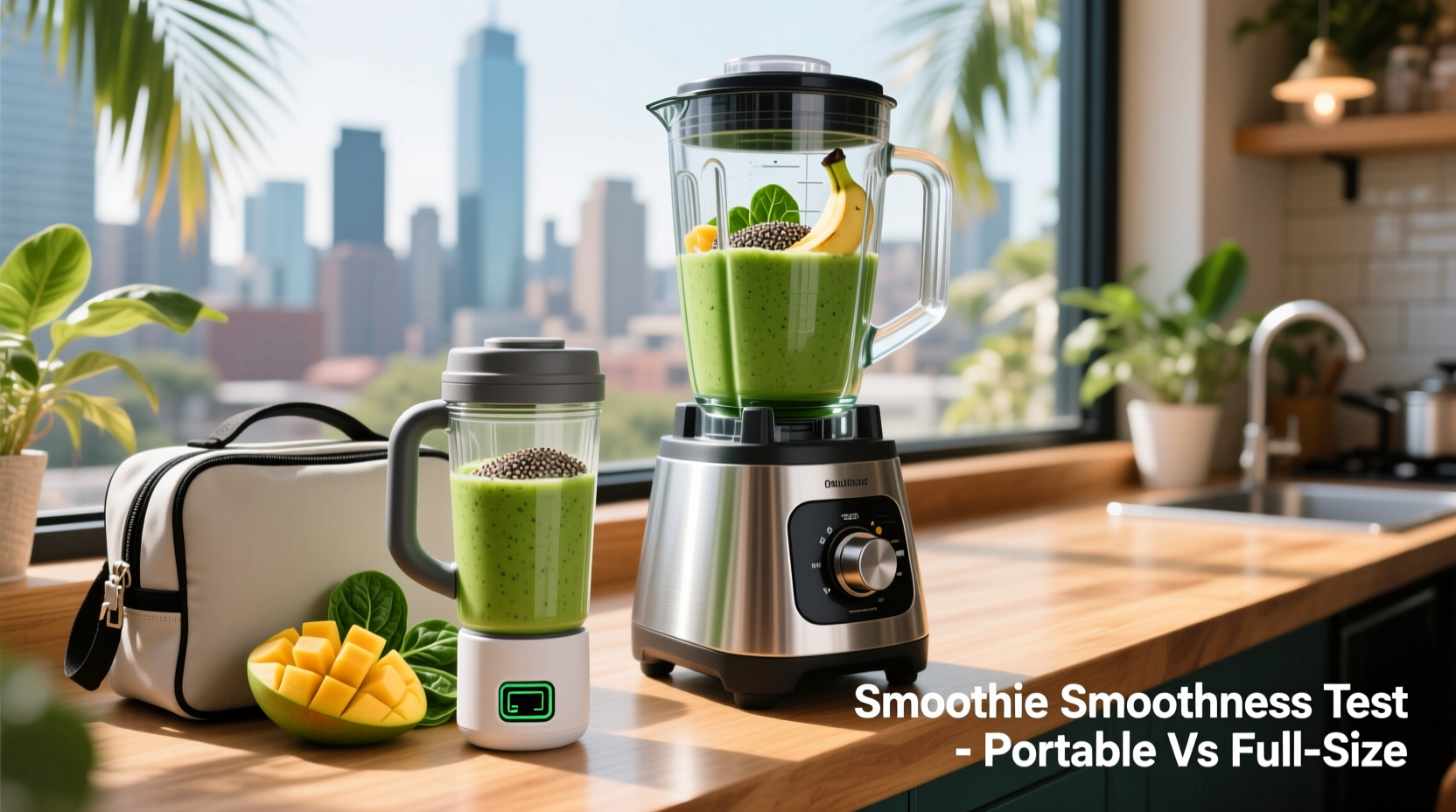
The most apparent difference between portable and full-size blenders lies in motor power. Full-size models typically range from 800 to 1500 watts, with high-end brands like Vitamix and Blendtec delivering enough torque to pulverize ice, frozen fruit, and fibrous greens in seconds. This raw power enables consistent vortex formation—where ingredients are pulled down into the blades repeatedly—resulting in uniform particle breakdown.
In contrast, portable blenders operate on battery-powered motors averaging 200 to 400 watts. While sufficient for soft fruits and liquids, they struggle with denser components. Lower RPM (revolutions per minute) means less shear force, leading to incomplete emulsification. Ingredients like chia seeds, kale stems, or frozen mango chunks may remain partially intact unless pre-soaked or pre-chopped.
“High wattage doesn’t guarantee smoothness alone, but it significantly increases the probability of achieving it—especially with minimal prep.” — Dr. Alan Reeves, Food Texture Scientist
However, some advanced portable units now feature smart pulsing technology and optimized blade geometry to compensate for lower power. Still, physics remains a limiting factor: smaller motors generate less centrifugal force, reducing blending efficiency over time.
Blade Design and Jar Geometry: Engineering Matters
Even with equal power, two blenders can yield different textures due to differences in blade configuration and container shape. Full-size blenders benefit from decades of engineering refinement. Their wide, tapered pitchers create natural turbulence, guiding ingredients back toward the center where blades are most effective. Stainless steel blades are often multi-tiered—angled to cut vertically and horizontally—ensuring thorough processing.
Portable blenders, constrained by size, usually employ shorter, fixed blades attached directly to the base. The narrow, cylindrical jars limit fluid dynamics, making it harder to maintain a consistent vortex. Ingredients often settle above the blades, requiring frequent shaking or stirring mid-blend. Some models include ridged interiors or spiral grooves to enhance flow, but these are secondary fixes rather than fundamental solutions.
Texture degradation also occurs near the top third of portable blends. Without sufficient downward pull, foam accumulates, leaving thicker sediment at the bottom. Users frequently report having to stop blending, swirl the mixture manually, and restart—a process that defeats the purpose of speed and convenience.
| Feature | Full-Size Blender | Portable Blender |
|---|---|---|
| Motor Power | 800–1500W | 200–400W |
| Blade Material | Stainless steel, multi-level | Stainless steel, single-tier |
| Jar Shape | Tapered, wide base | Cylindrical, narrow |
| Vortex Efficiency | High (self-circulating) | Low (requires manual agitation) |
| Blend Time for Smooth Texture | 30–60 seconds | 60–90+ seconds (with interruptions) |
Real-World Testing: Texture Comparison Across Scenarios
To evaluate actual performance, several common smoothie recipes were tested using both types of blenders under identical conditions: same ingredients, temperatures, quantities, and preparation methods.
Test 1: Basic Green Smoothie
- Ingredients: 1 banana, 1 cup spinach, ½ cup frozen pineapple, 1 tbsp almond butter, 1 cup almond milk
- Result (Full-Size): Completely smooth after 45 seconds. No detectable fiber strands or graininess.
- Result (Portable): Acceptable after 75 seconds but required three pauses to shake. Slight grittiness noted near the finish; visible flecks of spinach remained.
Test 2: Thick Protein Shake
- Ingredients: 1 scoop whey protein, ½ cup oats, 1 tbsp flaxseed, 1 cup whole milk, ½ cup frozen berries
- Result (Full-Size): Uniformly creamy. Oats fully broken down, no clumping.
- Result (Portable): Clumps of unblended oats and flaxseed present. Required extended blending (2 minutes) and still left residue at the bottom.
Test 3: Ice-Heavy Detox Drink
- Ingredients: 1 cup crushed ice, cucumber slices, lemon juice, mint, water
- Result (Full-Size): Fine, slush-like consistency achieved in 30 seconds.
- Result (Portable): Inconsistent texture. Ice shards remained even after 90 seconds. Motor overheated and paused automatically.
These tests confirm that while portable blenders can handle simple combinations, they fall short when texture complexity increases. Full-size units consistently deliver superior homogenization across all categories.
When Portability Wins: Practical Use Cases
Despite their limitations in texture refinement, portable blenders excel in specific contexts. For users who prioritize mobility over perfection—such as travelers, students, or office workers—they offer undeniable advantages.
Imagine a nurse working a 12-hour shift who wants a quick banana-yogurt blend during a five-minute break. A portable blender allows her to mix directly in the cup, drink without transferring, and rinse quickly at the sink. Even if the texture is slightly coarse, the trade-off in time and access is worthwhile.
“I used to skip breakfast because I didn’t have time to clean a big blender. Now I toss my ingredients in the night before, blend at work, and throw the cup in my bag. It’s not perfect, but it keeps me eating well.” — Sarah Lin, Registered Nurse
This scenario illustrates a key insight: smoothness expectations vary by context. At home, with time and resources, consumers expect barista-level results. On the go, functionality often outweighs finesse. Portable blenders fill this niche effectively—not by matching full-size performance, but by enabling behavior change through accessibility.
Optimizing Results: How to Get Smoother Blends from Any Blender
You don’t need a $500 machine to achieve great texture—but you do need strategy. Regardless of device type, certain techniques dramatically improve outcomes.
Step-by-Step Guide to Smoother Blends
- Layer Liquids First: Always add liquid to the bottom. This lubricates the blades and initiates rotation immediately upon starting.
- Add Soft Ingredients Next: Follow with yogurt, nut butter, or ripe fruit to create a base slurry.
- Top with Solids Last: Place frozen items, ice, or fibrous greens on top so they’re pulled down gradually.
- Start Slow, Then Ramp Up: Begin at low speed for 10 seconds to prevent air pockets, then increase to maximum.
- Pause and Swirl (Especially for Portables): Stop every 20–30 seconds to shake or stir, ensuring even exposure to blades.
- Use Warm Liquids When Possible: Cold thickens viscosity. Room-temperature liquids blend more easily, especially in low-power devices.
- Pre-Chop Dense Ingredients: Cut bananas into coins, dice apples, crush ice slightly—anything to reduce workload.
Expert Tips for Choosing Based on Your Needs
Selecting the right blender depends less on blanket superiority and more on alignment with lifestyle patterns. Consider the following checklist before purchasing:
✅ Checklist: Which Blender Is Right for You?
- Do you primarily make smoothies at home with complex ingredients? → Choose full-size
- Are you blending ice, nuts, or frozen produce regularly? → Choose full-size
- Do you travel frequently or lack kitchen access? → Consider portable
- Is counter space limited? → Portable saves space
- Do you value easy cleanup over ultimate texture? → Portable wins
- Are you willing to pre-cut or pre-soak ingredients for better results? → Portable becomes viable
No single blender fits all needs. Many health-conscious users now own both: a powerful countertop model for home use and a compact unit for travel or workdays. This dual approach maximizes flexibility without sacrificing quality.
Frequently Asked Questions
Can a portable blender crush ice effectively?
Most portable blenders can handle small amounts of soft ice or crushed cubes, but struggle with large, dense pieces. Repeated use with hard ice risks damaging blades or draining batteries prematurely. For regular ice blending, a full-size blender with higher torque is strongly recommended.
Why does my portable blender leave chunks at the bottom?
This is typically due to poor vortex formation. Narrow jars and weaker motors fail to circulate ingredients fully. To minimize this, blend in shorter bursts, shake the bottle between cycles, and ensure adequate liquid volume to facilitate movement.
Are expensive portable blenders as good as cheap full-size ones?
Not quite. High-end portables like Ninja Fit or NutriBullet GO perform better than budget models, but still can't match entry-level full-size blenders like Oster or Hamilton Beach in texture refinement. If smoothness is your priority, even a $70 countertop blender will outperform a $100 portable.
Final Verdict: Smoothness Favors Full Size, But Context Decides
When measured strictly by output quality, full-size blenders produce smoother, more consistent smoothies. Their superior motor power, blade design, and container engineering allow them to handle diverse ingredients with minimal user intervention. If your goal is café-quality texture at home, nothing beats a dedicated countertop model.
However, “better” only matters if it aligns with how you live. A blender that sits unused because it's too bulky or complicated offers no benefit. Portable blenders remove friction from healthy habits. They may deliver slightly coarser results, but they enable consistency—often the most important factor in long-term wellness.
The choice ultimately comes down to priorities. Want flawless texture and don’t mind cleaning a larger appliance? Go full-size. Need something that fits in your backpack and gets used daily? A portable might be the smarter investment—even if it’s not technically “better.”




 浙公网安备
33010002000092号
浙公网安备
33010002000092号 浙B2-20120091-4
Comments
No comments yet. Why don't you start the discussion?