
In an age where smartphones, tablets, and wearables are essential to daily life, staying powered on the go is no longer optional—it’s a necessity. Enter the world of external battery solutions: terms like “portable charger” and “power bank” are used almost interchangeably in marketing materials, product descriptions, and everyday conversation. But are they truly the same thing? Or is there a meaningful distinction in function, design, or performance? The answer isn’t as straightforward as it seems, and understanding the nuances can help you make smarter purchasing decisions.
The confusion stems from overlapping terminology and inconsistent labeling across brands and regions. While most consumers treat “portable charger” and “power bank” as synonyms, subtle technical and contextual differences do exist—especially when examining features like output capacity, charging speed, portability, and internal technology. This article breaks down the naming confusion, compares actual performance metrics, and equips you with the knowledge to select the best device for your lifestyle.
Origins of the Naming Confusion
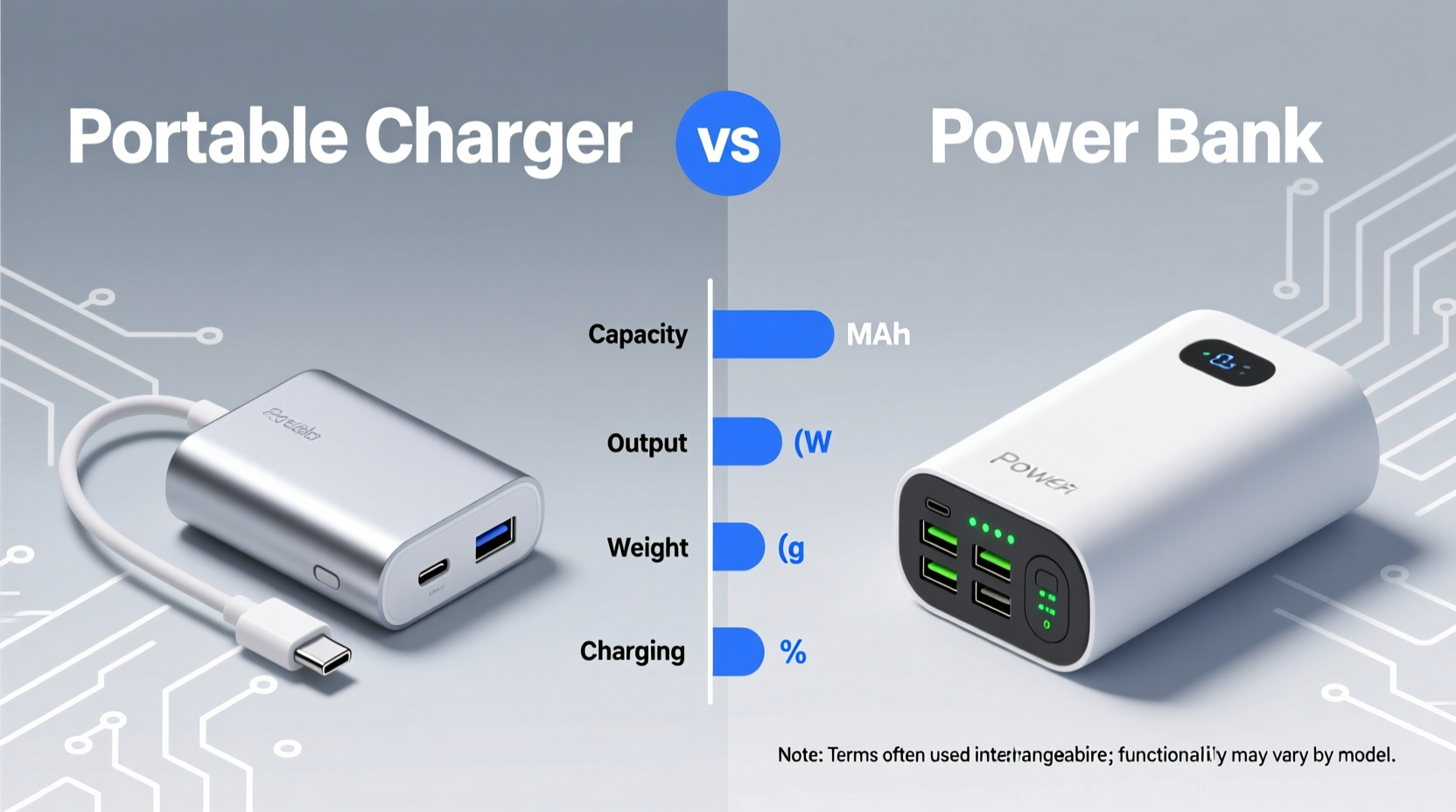
The terms “portable charger” and “power bank” emerged around the same time in the early 2010s, as smartphone usage surged and built-in batteries struggled to keep up. Initially, “power bank” gained traction in tech communities and retail markets as a descriptor for a standalone battery pack that stores electrical energy for later use. It functions like a bank: you “deposit” charge by plugging it into a wall outlet and “withdraw” it to power your devices.
“Portable charger,” on the other hand, sounds more functional—emphasizing the act of charging rather than storage. Some manufacturers adopted this term to appeal to casual users who might not understand what a “bank” refers to in this context. Over time, both terms have been used synonymously, leading to widespread ambiguity.
“Language evolves with consumer behavior. When 'power bank' sounded too technical, brands pivoted to 'portable charger' for broader appeal.” — Dr. Lena Patel, Consumer Technology Linguist at MIT Media Lab
Today, there’s no official standard differentiating the two. Regulatory bodies like the FCC or IEC don’t classify these devices based on name alone. Instead, classification depends on technical specifications such as battery capacity (measured in milliampere-hours, mAh), output voltage, number of ports, and safety certifications.
Technical Differences That Matter
While branding may blur the lines, real performance differences emerge when comparing models marketed under either label. These differences aren’t tied to the name but rather to engineering choices made during design. Below are key technical aspects that affect usability and efficiency:
- Battery Capacity: Ranges from 2,000 mAh (minimal phone boost) to over 20,000 mAh (multiple full charges). Higher capacity usually means heavier weight.
- Output Ports: USB-A, USB-C, or both. Modern power banks increasingly support USB-C Power Delivery (PD), enabling faster charging for compatible devices.
- Input Charging Speed: How quickly the power bank itself recharges. Slower input means longer downtime between uses.
- Efficiency Rate: Not all stored energy reaches your device due to conversion losses. High-quality units maintain 85–90% efficiency.
- Safety Features: Overcharge protection, short-circuit prevention, and temperature control vary significantly between budget and premium models.
Performance Comparison: What Real Users Experience
A 10,000 mAh power bank labeled as a “compact portable charger” may claim to fully charge an iPhone 14 twice. In practice, due to energy loss during transfer, real-world results often deliver only 1.5 full charges. Similarly, a so-called “high-speed portable charger” without USB-PD will not fast-charge a modern iPad Pro, regardless of marketing claims.
The brand’s reputation plays a bigger role than the name on the box. For example, Anker and Belkin tend to use “power bank” consistently across their product lines, emphasizing technical specs. Meanwhile, generic Amazon sellers often use “portable charger” to highlight convenience, sometimes at the expense of durability or consistent output.
Differences in Design and Use Cases
Design intent often reflects the intended user base—and subtly influences which term is used. Consider the following scenarios:
| Use Case | Common Term Used | Typical Features | Target User |
|---|---|---|---|
| Travel & outdoor adventures | Power bank | High capacity (20,000+ mAh), rugged casing, multiple ports | Hikers, digital nomads |
| Daily urban commuting | Portable charger | Compact size, slim profile, single USB-C port | Office workers, students |
| Emergency backup | Either term | Low capacity (3,000–5,000 mAh), keychain-style | General consumers |
| Professional fieldwork | Power bank | Pass-through charging, LED indicators, solar compatibility | Photographers, surveyors |
This pattern suggests that “power bank” is more commonly associated with robust, high-performance gear, while “portable charger” leans toward lightweight, lifestyle-oriented products. However, exceptions abound. A sleek MagSafe-compatible accessory from Apple is officially called a “battery pack,” yet retailers often list it as a “portable charger.”
Mini Case Study: Sarah’s Weekend Trip Gone Wrong
Sarah, a freelance photographer, packed a small “ultra-portable charger” for a weekend shoot in the mountains. Advertised as 8,000 mAh with “fast charging,” she assumed it would keep her mirrorless camera battery and phone powered throughout the trip. By Saturday afternoon, the device had failed to recharge her phone even once. Upon inspection, she realized the unit only supported 5W output—barely enough for trickle charging—and lacked pass-through capability. She returned home frustrated, having missed critical shots.
Had she researched the specs instead of relying on the appealing name, she might have chosen a true power bank with 18W PD output and a lithium-polymer cell designed for reliability in variable temperatures. Her experience highlights how marketing language can mislead even informed buyers.
How to Choose the Right Device: A Step-by-Step Guide
Selecting the ideal external battery doesn’t require technical expertise—just a clear understanding of your needs. Follow this practical timeline to make a confident decision:
- Assess Your Devices: List the gadgets you need to charge. Note their battery capacities and preferred charging methods (e.g., USB-C PD, Qi wireless).
- Determine Required Capacity: Multiply your phone’s battery size (e.g., 3,200 mAh) by the number of full charges desired. Add 20% buffer for inefficiency.
- Evaluate Portability Needs: Will you carry it daily? Opt for under 300g and pocket-friendly dimensions. For occasional use, higher capacity is acceptable.
- Check Output Specifications: Look for at least 12W per port; 18W or higher if you own modern smartphones or tablets.
- Verify Safety Certifications: Ensure the product has UL, CE, or FCC certification. Avoid unbranded units with inflated capacity claims.
- Test Charging Speed: After purchase, time how long it takes to charge your phone from 20% to 80%. Compare against manufacturer claims.
Checklist: Before You Buy Any Portable Charger or Power Bank
- ✅ Battery capacity matches my charging needs
- ✅ Supports fast charging (USB-PD or Qualcomm Quick Charge)
- ✅ Includes necessary cables or has built-in connectors
- ✅ Weighs less than 400g if carried daily
- ✅ Has at least one USB-C output port
- ✅ Certified by recognized safety standards (FCC, CE, RoHS)
- ✅ Offers customer reviews with verified performance feedback
- ✅ Includes a warranty of at least 12 months
Frequently Asked Questions
Is a portable charger safer than a power bank?
No. Safety depends on build quality, circuitry, and certifications—not the name. Both types use lithium-ion or lithium-polymer batteries, which are safe when properly engineered. Poorly made units of either kind pose fire or overheating risks.
Can I bring a power bank on a plane?
Yes, but with restrictions. Most airlines allow power banks under 100Wh (about 27,000 mAh) in carry-on luggage only. Devices over this limit require airline approval. Never pack them in checked baggage due to fire risk.
Why does my portable charger lose effectiveness after six months?
All lithium-based batteries degrade over time. After 300–500 charge cycles, capacity typically drops to 80% of original. Frequent full discharges, exposure to heat, and using incompatible chargers accelerate this decline.
Expert Insight: What Engineers Look For
When designing next-generation mobile power solutions, engineers prioritize energy density, thermal management, and charge/discharge efficiency over branding semantics.
“We don’t call them ‘chargers’ or ‘banks’ internally—we call them ‘external energy reservoirs.’ The focus is on minimizing voltage drop and maximizing cycle life.” — Rajiv Mehta, Senior Hardware Engineer at EcoVolt Labs
This mindset shift underscores a crucial point: the functionality matters far more than the label. A well-built 15,000 mAh power bank with GaN (gallium nitride) circuitry will outperform a poorly made “premium portable charger” every time.
Conclusion: Focus on Function, Not Labels
The debate between “portable charger” and “power bank” is ultimately semantic. What truly impacts your experience is the device’s technical performance, build quality, and suitability for your routine. Whether you’re powering a phone during a cross-country flight or keeping a tablet alive during a long workday, prioritize measurable features over marketing language.
Next time you shop, skip the buzzwords. Read the spec sheet. Test real-world reviews. Choose based on output speed, capacity accuracy, and safety—not whether the box says “charger” or “bank.” Your devices—and your peace of mind—will thank you.




 浙公网安备
33010002000092号
浙公网安备
33010002000092号 浙B2-20120091-4
Comments
No comments yet. Why don't you start the discussion?