
When you're on the move and your phone battery is dwindling, two common solutions come to mind: a portable power bank or a car charger. Both promise to keep your device powered, but which one actually delivers a faster charge? The answer isn't always straightforward—it depends on technical specifications, usage context, and even your vehicle's electrical system. Understanding the nuances between these two charging methods can help you make smarter decisions about how and when to refuel your smartphone.
With modern phones supporting fast charging technologies like USB Power Delivery (PD) and Qualcomm Quick Charge, not all chargers are created equal. A high-end power bank might outperform a basic car charger, while a premium car adapter could surpass a low-capacity power bank. This article breaks down the key factors that determine charging speed, compares real-world performance, and helps you choose the right tool for the job.
How Charging Speed Actually Works
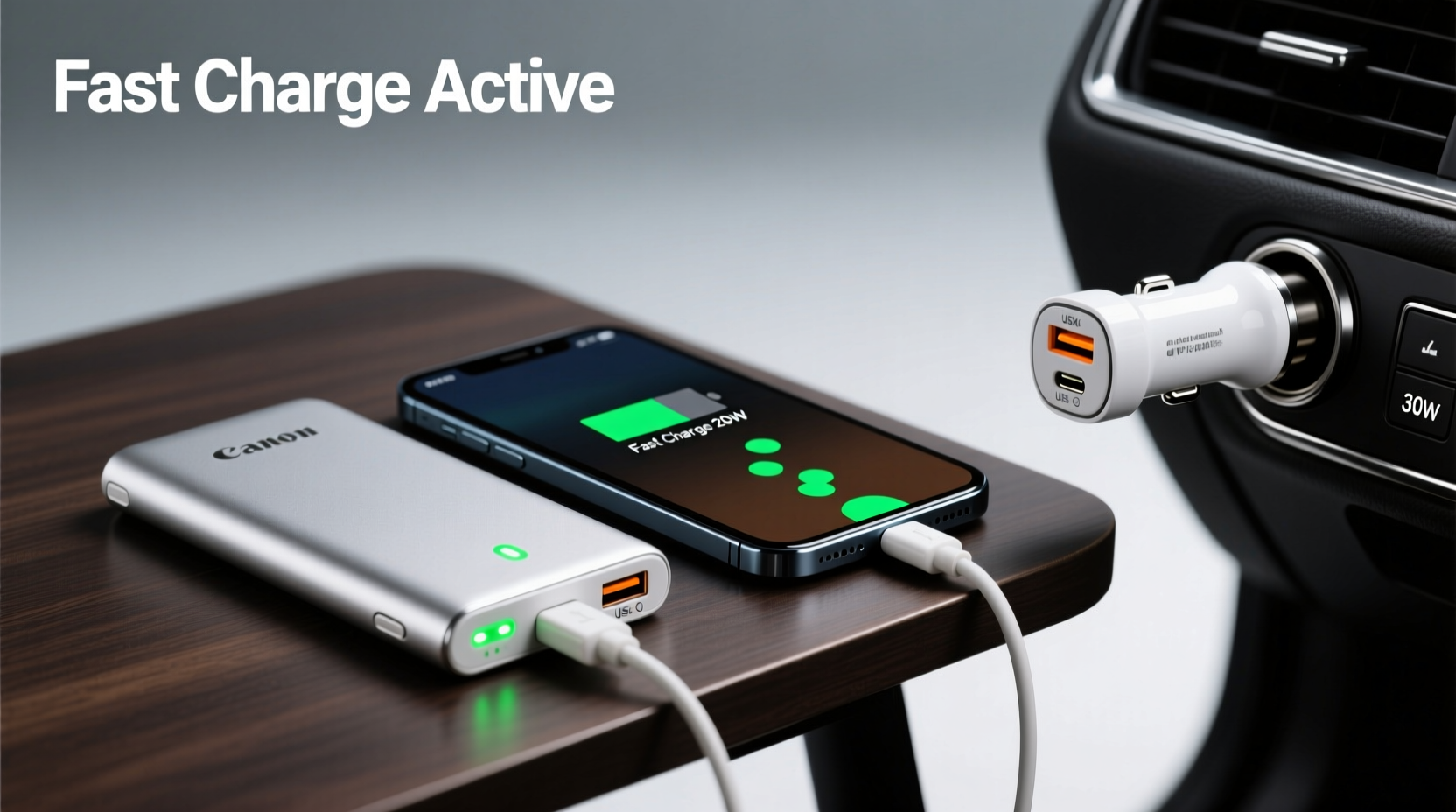
Before comparing power banks and car chargers, it’s essential to understand what determines how fast a device charges. Charging speed isn’t just about plugging in—it’s governed by voltage, amperage, wattage, and communication protocols between the charger and your phone.
The formula for calculating power is simple: Watts = Volts × Amps. A higher wattage generally means faster charging, assuming your phone supports it. For example:
- A 5V/1A charger delivers 5 watts—standard for older devices.
- A 5V/3A charger outputs 15 watts, suitable for many modern smartphones.
- A 9V/2A charger using Quick Charge 3.0 provides 18 watts, significantly reducing charge time.
- USB-C PD chargers can go up to 30W or more, enabling ultra-fast charging on compatible devices.
Beyond raw numbers, smart negotiation happens between your phone and the charger via protocols like USB Power Delivery (PD), Qualcomm Quick Charge, or Apple Fast Charging. If either the charger or cable doesn’t support the required protocol, your phone defaults to slower standard charging—even if connected to a high-wattage source.
“Charging speed depends on compatibility as much as power output. A mismatched charger can bottleneck even the fastest phone.” — Dr. Lena Torres, Electrical Engineer & Mobile Power Specialist
Power Bank Performance: Capacity vs Output
Portable power banks offer convenience and independence from outlets. However, their ability to charge quickly hinges on two main factors: output capability and internal circuitry.
Many users assume that a higher mAh rating automatically means faster charging. That’s a misconception. While capacity (measured in milliamp-hours) indicates how much total energy a power bank stores, it doesn’t reflect how fast it can deliver that energy. A 20,000mAh power bank with only a 5V/1A output will charge your phone slowly, despite its large size.
Modern fast-charging power banks now feature dual USB ports, including USB-C input/output with PD support. High-performance models like Anker’s PowerCore series or Xiaomi’s Mi Power Banks can deliver up to 30W via USB-C, allowing them to charge compatible phones at near-original wall-charger speeds.
Another consideration is efficiency loss. Power banks convert stored DC power to output current, and this process generates heat and wastes energy. Typically, only about 60–70% of the rated capacity reaches your phone due to conversion losses, cable resistance, and battery chemistry.
Car Charger Capabilities: From Basic to Turbo
Car chargers plug into your vehicle’s 12V cigarette lighter socket and convert automotive voltage into usable 5V (or higher) USB power. Their performance varies widely based on design and technology.
Basic car chargers often max out at 5V/1A (5W), barely enough to maintain charge during GPS navigation. These are outdated and should be avoided if fast charging is a priority. In contrast, modern dual-port car adapters from brands like Aukey, Belkin, or Samsung support up to 30W combined output, with intelligent distribution across ports.
Higher-end models use dynamic voltage regulation to stabilize output even when engine RPM fluctuates. This ensures consistent delivery of fast-charging profiles like QC 4+ or USB-PD. Some luxury vehicles even include built-in USB-C ports with native 18W+ output, eliminating the need for third-party adapters.
However, car electrical systems aren’t perfectly stable. Voltage drops during engine startup or surges from alternator fluctuations can interrupt charging or damage poorly designed chargers. Quality matters—cheap car chargers may fail under stress or lack proper circuit protection.
Direct Comparison: Power Bank vs Car Charger
To determine which option charges faster, we must compare real-world specs, not just theoretical potential. Below is a side-by-side comparison of typical devices in each category:
| Feature | High-End Power Bank | Premium Car Charger |
|---|---|---|
| Max Output | 30W (USB-C PD) | 30W (Dual Port, PD + QC) |
| Input Type | USB-C (supports 18W+ recharge) | N/A (powered by car battery) |
| Mobility | Fully portable, works anywhere | Tied to vehicle use |
| Charge Stability | Consistent, regulated output | May fluctuate with engine conditions |
| Recharge Time (for power bank) | 4–6 hours (to full) | N/A |
| Best Use Case | Travel, emergencies, outdoor use | Daily commute, road trips |
In terms of peak charging speed, top-tier power banks and car chargers are nearly identical—both capable of delivering 18–30W fast charging. However, consistency favors power banks, which operate on stable internal circuits. Car chargers depend on your vehicle’s electrical health and alternator performance, introducing variability.
Real-World Example: Charging an iPhone 15 During a Road Trip
Consider a scenario where a user drives two hours daily and needs to charge an iPhone 15, which supports 20W USB-PD fast charging.
Using a $12 no-name car charger labeled “2.4A,” the phone receives only 5V/1.5A (~7.5W). After two hours of driving, the phone gains about 45% charge—slower than expected. Switching to a certified 20W USB-C PD car charger from Anker, the same drive results in a 0–80% charge in 45 minutes, with full charge reached within 90 minutes.
On the other hand, a 10,000mAh power bank with 20W PD output fully recharges the iPhone 15 once and still has reserve capacity. No driving required. It charges just as fast as the premium car charger but offers flexibility during flights, hikes, or subway rides.
This illustrates that while car chargers can be fast, they require investment in quality hardware. Meanwhile, a good power bank provides consistent speed regardless of environment.
Which One Charges Faster? The Verdict
If both devices are high-quality and support modern fast-charging standards, there is **no significant difference in maximum charging speed** between a top-tier power bank and a premium car charger. Both can deliver 18–30W, enabling 0–50% charges in 20–30 minutes on compatible phones.
However, several practical factors tip the balance depending on context:
- For consistent speed anywhere: Choose a high-output power bank (20W+ USB-C PD).
- For daily commutes: A reliable car charger with dual ports and surge protection makes sense.
- For long trips: Combine both—a car charger keeps your phone topped off while simultaneously recharging the power bank.
The limiting factor is rarely the charger itself but rather compatibility. Using a non-PD cable with a PD power bank, or a frayed USB-A cord with a QC car charger, can cut charging speed by half. Always pair your charger with a high-quality cable rated for fast data and power transfer (e.g., USB-IF certified).
Step-by-Step Guide: Maximizing Phone Charging Speed
- Identify your phone’s fast-charging capability. Check manufacturer specs (e.g., “Supports USB-PD 3.0” or “QC 4+”).
- Select a charger matching that standard. For iPhones, choose USB-C PD; for Samsung Galaxy phones, prioritize Adaptive Fast Charging or PD.
- Use a certified cable. Avoid generic cables—they often limit current flow and lack proper shielding.
- Check the charger’s actual output rating. Don’t rely on marketing claims; verify watts (e.g., 18W, 20W, 30W).
- Minimize background activity. Close apps, disable Bluetooth, and enable Airplane Mode for fastest charging.
- Keep devices cool. Heat slows charging; avoid direct sunlight or thick cases during charging.
- Test performance. Use apps like AccuBattery (Android) to monitor real-time charging speed.
Frequently Asked Questions
Can a power bank charge my phone faster than my original wall charger?
Yes—if the power bank has equal or higher wattage output and supports the same fast-charging protocol (e.g., USB-PD). Many modern power banks match or exceed OEM wall adapter performance.
Why does my car charger work slowly even though it says “fast charge”?
Likely causes include poor build quality, incompatible charging protocol, damaged USB port, or insufficient power draw from the car’s socket. Try a different charger or test voltage output with a multimeter.
Is it safe to leave a power bank charging overnight?
Most reputable brands have overcharge protection and auto-shutoff. Still, it’s best practice to unplug once fully charged to prolong battery lifespan. Avoid leaving low-cost, uncertified units plugged in unattended.
Checklist: Choosing the Right Charging Solution
- ✅ Confirm your phone supports fast charging (PD, QC, etc.)
- ✅ Match the charger’s output (watts) to your phone’s max input
- ✅ Prefer USB-C PD for future-proofing and cross-device compatibility
- ✅ Buy from reputable brands (Anker, Belkin, UGREEN, Samsung)
- ✅ Use certified cables with E-Marker chips for high-power transfer
- ✅ Test actual charging speed after purchase
- ✅ Carry both a power bank and car charger for full coverage
Final Thoughts: Speed Isn’t Everything—Context Is King
While both portable power banks and car chargers can deliver fast charging, the best choice depends on your lifestyle. If you spend hours driving, a robust car charger integrated into your routine makes perfect sense. But if you value freedom from cords and vehicles, a high-output power bank gives unmatched versatility.
Ultimately, neither wins outright in speed. What matters most is selecting a device that matches your phone’s capabilities, uses quality components, and fits seamlessly into your day. Investing in one strong power bank and one dependable car charger creates a resilient charging ecosystem—ensuring your phone never dies when you need it most.




 浙公网安备
33010002000092号
浙公网安备
33010002000092号 浙B2-20120091-4
Comments
No comments yet. Why don't you start the discussion?