
The way we consume movies at home has evolved dramatically. Once limited to small CRT televisions, today’s viewers can choose between cinematic-sized TVs or portable projectors that turn any wall into a theater screen. Both promise immersive entertainment, but they deliver vastly different experiences depending on your lifestyle, space, and priorities. Whether you're setting up a dedicated media room or craving outdoor movie nights under the stars, understanding the strengths and trade-offs of portable projectors versus big screen TVs is essential.
This comparison dives deep into image quality, installation flexibility, ambient lighting sensitivity, sound performance, portability, cost, and long-term usability—giving you a clear roadmap to decide which technology aligns with your ideal viewing experience.
Image Quality and Screen Size: The Core Viewing Experience
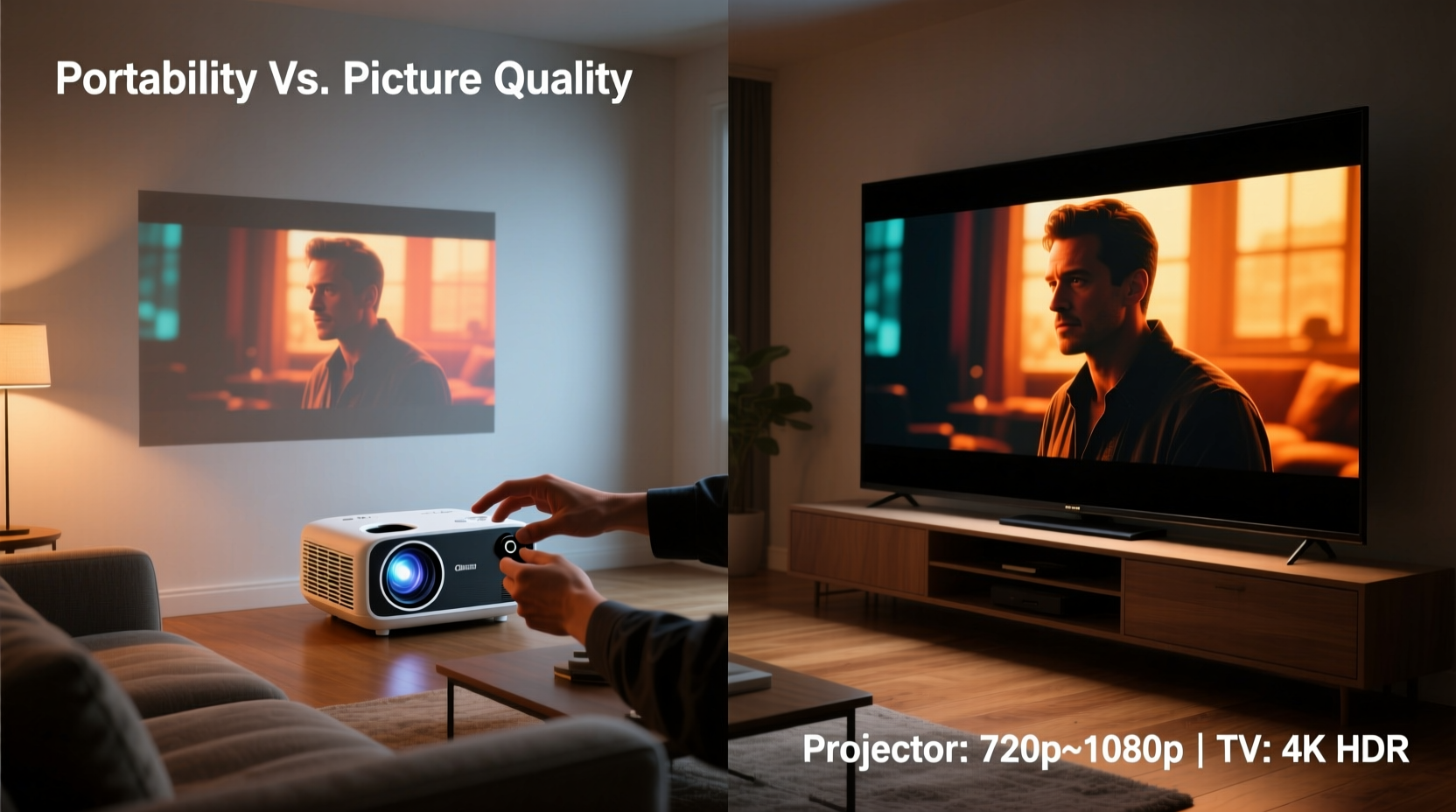
At the heart of any home cinema decision lies image quality. Resolution, contrast, brightness, color accuracy, and screen size all contribute to how lifelike and engaging a movie feels.
Big screen TVs, particularly modern OLED and QLED models ranging from 65 to 100 inches, offer exceptional clarity. Most come standard with 4K resolution (3840 x 2160 pixels), HDR support (Dolby Vision, HDR10+), and pixel-level contrast control. OLED panels, in particular, deliver perfect blacks because each pixel emits its own light and can be turned off completely. This results in stunning depth and realism, especially in dark scenes.
In contrast, portable projectors typically max out at 1080p resolution, though some premium models now offer native 4K. However, even when marketed as \"4K,\" many use pixel-shifting technology rather than true 4K panels. Brightness is another key limitation: most portable units range from 500 to 2,000 ANSI lumens. For reference, high-end TVs can achieve peak brightness levels exceeding 2,000 nits—far surpassing typical projector output.
Where projectors shine is in screen size. While a 100-inch TV is massive and expensive, a portable projector can easily project a 120-inch or even 200-inch image. This creates a more enveloping, theatrical feel—ideal for action films or epic sci-fi sagas. However, larger images require darker environments to maintain contrast and prevent washout.
“Screen size impacts emotional engagement. A 150-inch image fills more of your peripheral vision, triggering a stronger sense of immersion than even the best 75-inch TV.” — David Lin, Home Theater Designer at Cinematic Living
Installation and Flexibility: Where and How You Watch
One of the biggest advantages of portable projectors is their versatility. Lightweight and compact—some smaller than a hardcover book—they can be set up almost anywhere. Place one on a coffee table, balcony railing, or camping trailer shelf, and within minutes, you have a temporary theater. Many models include built-in batteries, enabling cord-free operation for two to four hours.
Big screen TVs, by comparison, are permanent fixtures. Installation involves mounting on a wall or placing on a stand, running power and HDMI cables, and often hiring professionals for clean setups. They’re not designed to move frequently, and relocating a 75-inch or larger display requires careful handling and recalibration.
Projectors win for users who value mobility: travelers, renters, students, or families who want to switch between indoor living rooms and backyard movie nights. But this flexibility comes with setup compromises. Projectors require precise alignment (keystone correction helps, but degrades image quality), proper throw distance, and a flat surface. Ambient light must be minimized unless using an ultra-short-throw model with an ALR (ambient light rejecting) screen.
TVs, meanwhile, offer plug-and-play simplicity. Turn them on, and the picture is ready—no focusing, no darkening the room, no screen adjustments. Their consistent positioning also makes them ideal for mixed-use spaces like living rooms where people watch news, sports, or play video games throughout the day.
Setup Comparison Table
| Feature | Portable Projector | Big Screen TV |
|---|---|---|
| Installation Time | 5–15 minutes (per session) | 1–2 hours (initial setup) |
| Mobility | High – can be moved daily | Low – fixed location |
| Power Needs | Battery or outlet | Outlet required |
| Optimal Environment | Dark or dimly lit rooms | All lighting conditions |
| Screen Requirement | Wall or portable screen | None (self-emissive) |
Real-World Use Case: The Urban Apartment Dweller
Sophia lives in a 600-square-foot downtown apartment. She loves hosting weekend movie nights but doesn’t have space for a large TV or a permanent projector setup. Her coffee table doubles as a projector base, and she uses a retractable 100-inch screen mounted near the ceiling. On sunny afternoons, she watches YouTube videos on her tablet. But when friends come over, she dims the lights, sets up the portable projector, and streams the latest Marvel film.
She chose a $700 LED-based 1080p projector with 1,200 lumens and built-in Android TV. It fits in a tote bag and charges via USB-C. While the colors aren’t as vibrant as her neighbor’s $3,000 OLED TV, the sheer size of the image makes her feel like she’s inside the movie. “It’s not perfect,” she admits, “but for the price and space savings, it’s magical.”
Sophia’s story reflects a growing trend: consumers prioritizing experiential value over technical perfection. For those with spatial constraints or dynamic lifestyles, portability and scalability often outweigh raw image specs.
Sound, Connectivity, and Smart Features
Audio performance is another critical factor. Most big screen TVs come with integrated speakers—often stereo or virtual surround systems. While convenient, these rarely deliver rich bass or room-filling sound. Serious viewers usually pair TVs with soundbars or full surround systems.
Similarly, portable projectors include small onboard speakers. These are adequate for dialogue but lack depth and volume. High-end models may feature dual speakers with Dolby Audio, but external Bluetooth speakers or soundbars are strongly recommended for cinematic impact.
Connectivity options are robust on both sides. Modern TVs offer multiple HDMI 2.1 ports, Wi-Fi 6, Bluetooth, Apple AirPlay, and Chromecast. Portable projectors increasingly include smart platforms (Android TV, Roku TV), HDMI inputs, USB playback, and wireless casting. Some even support Bluetooth headphones for silent viewing.
Latency matters for gamers. TVs generally have lower input lag (under 15ms in game mode), making them better suited for fast-paced console gaming. Projectors, especially budget models, may introduce 40–100ms of delay, which can disrupt responsiveness.
Total Cost of Ownership and Longevity
Initial purchase price is just one part of the equation. Consider ongoing costs and lifespan.
A high-quality 75-inch 4K OLED TV starts around $2,000 and can exceed $5,000 for top-tier models. They typically last 7–10 years with minimal degradation, especially if burn-in is avoided through varied content and screen savers.
Portable projectors range from $300 for basic 720p models to $1,500+ for 4K laser units. However, lamp-based models require bulb replacements every 2,000–5,000 hours (costing $100–$200), while LED and laser light sources last 20,000 to 30,000 hours—effectively the life of the device. Battery degradation over time may reduce cord-free usage.
If you watch two movies per week, a projector used for five years accumulates about 500 hours of runtime—well within LED lifespan limits. But frequent daily use could wear out components faster than a TV.
Cost Comparison Over Five Years
- Big Screen TV (75\" OLED): $2,500 (purchase) + $0 maintenance = $2,500
- Portable Projector (LED 1080p): $700 (purchase) + $0 bulb = $700
- Projector (Lamp-Based): $500 (purchase) + $150 bulb replacement = $650
While projectors appear cheaper upfront, pairing them with a quality screen ($100–$300) and audio system narrows the gap. Still, for multi-environment use, the projector offers far greater utility per dollar.
Step-by-Step Guide: Choosing the Right Option for You
Follow this decision-making process to identify the best fit for your needs:
- Assess Your Primary Viewing Environment: Do you have a dedicated media room with controlled lighting? → TV. Do you want flexibility across rooms or outdoors? → Projector.
- Determine Screen Size Goals: Want 100+ inches? → Projector. Satisfied with up to 85 inches? → TV.
- Evaluate Lighting Conditions: Can you darken the room? → Projector viable. Lots of ambient light? → TV preferred.
- Consider Mobility Needs: Will you travel with it or change locations weekly? → Projector. Permanent setup? → TV.
- Set a Realistic Budget: Include accessories. If total spend must stay under $1,000, a projector + screen + speaker combo may offer more value than a mid-range TV.
- Test Before Committing: Rent or demo both options if possible. See how each feels in your actual space.
Frequently Asked Questions
Can a portable projector replace my TV completely?
Possibly, but with caveats. If you watch content mostly at night, don’t mind setup time, and prioritize screen size over convenience, yes. However, daytime viewing, sports, and live TV are less practical due to light sensitivity and startup delays.
Do projectors work well in daylight?
Standard portable projectors struggle in bright rooms. Only high-lumen (3,000+) models with ALR screens perform moderately well in ambient light. For all-day use, a big screen TV remains superior.
Are projector images worse than TV images?
In absolute terms—yes, when comparing like-for-like conditions. TVs offer higher brightness, better contrast, and sharper detail. But perceived quality depends on context. A 150-inch 1080p image in a dark room can feel more impactful than a 75-inch 4K TV, even if technically inferior.
Final Recommendation: Match Technology to Lifestyle
The choice between a portable projector and a big screen TV isn’t about which is objectively better—it’s about which aligns with how you live and watch.
Choose a **big screen TV** if you want reliability, vivid daytime performance, low maintenance, and seamless integration into daily life. It’s ideal for families, sports fans, and anyone who values hassle-free operation.
Choose a **portable projector** if you crave cinematic scale, enjoy outdoor screenings, move frequently, or live in a compact space. It’s perfect for movie enthusiasts, travelers, and those seeking a flexible, experience-driven setup.
Some users opt for both—a TV for everyday viewing and a projector for special movie nights. As hybrid solutions improve, blending portability with image quality, the line between these technologies continues to blur.
“The future of home entertainment isn’t one-size-fits-all. It’s about having the right tool for the moment—whether that’s a razor-sharp TV for the morning news or a starlit backyard projection of your favorite classic.” — Raj Patel, Senior Editor at Home Tech Review




 浙公网安备
33010002000092号
浙公网安备
33010002000092号 浙B2-20120091-4
Comments
No comments yet. Why don't you start the discussion?